Category Archives: Obama

GM Brags: Since bailout 70% of our manufacturing outside of US. Announced GM R&D moving to China (video)

This will make your stomach turn. Your bailout money goes to sponsor Chinese propaganda films sponsored by GM. You can watch a GM CEO Dan Ackerson brag that since the bailout 70% of GM’s manufacturing is outside of the USA. They also announced that much of GM’s R&D will move to China in part so as to give advanced technology to the Chinese Government.

Remember that according to far left university academic theory U.S. wealth is essentially “capitalist ill-gotten gains” and that our wealth needs to be transferred to the rest of the world.

Romney vs. Obama First Debate Editor’s Live Blog

Editor’s Live Blog:

Wow, so much BS in this debate there is not enough time to hope to respond to it all in a timely manner.

Obama’s tax cuts for small businesses aren’t tax cuts at all, they are tax credits meaning that if you jump through government hoop A & B – and then meet stipulation circumstance A, B, C and D – you get a tax credit. Well that doesn’t work because people aren’t doing when is best for their business or the economy, they are doing what government wants. These “tax cuts” are so targeted only a few get them. This is no different from government picking winners and losers. Economic growth happens when people have money AND freedom.

Actually Mitt lowering the rates and cleaning up the deductions has been done before, Reagan did it and it worked. Remember Kemp/Roth in 1981 followed up with TEFRA in 1986? Romney needed to hit the mortgage collapse out of the park and he just didn’t. He needs me on his communications team to show him how. This is not difficult.

Romney – I will eliminate any program I have to borrow money from China to keep going that are not working and important. I hope and wish.

Obama talked about going after some wasteful over duplicated education programs – he went after education programs alright, like the working and very successful DC voucher program…. all to make the teachers union happy (and screwed the kids).

I liked Romney’s “I have five boys” comment – nicest way to call out a lie I have ever heard 😉

Well the stock in those who make small planes will now drop due to that comment Obama. That will cost jobs just in the coming weeks. Mark me.

Obama says Social Security is structurally sound. Like heck it is. Social Security does not even try to grow a pot of money to prefund people’s retirement.

Romney’s point on Medicare is right on. OK Romney now boot that voucher talking point out of the park – you had better….and he didn’t. It is Medicare part D expanded because Part D came in 40% under budget, gives more choice and works. It is not just a voucher system.

Obama talks about being at the mercy of insurance companies – What you DONT want to be is at the mercy of ObamaCares IPAB – Case in point –https://politicalarena.org/2012/10/03/obamacare-panel-targeting-womens-health-screenings-again/

Romney hits Obama on his unelected board making decisions about your care in Obamacare – FINALLY! Survey’s of Small Businesses show that ObamaCare is scrapping hiring plans – WHAM – Go MITT!

Romney – government as well as private studies show that millions of people will lose their employer based insurance as a result of ObamaCare – that is true. Obama is pretending like that problem doesn’t exist.

Obama is a broken record “Romney just wants to help the rich”…

Veteran Communications Strategist Lisa Marie Cashman – They are both trying to be too civil.

ME – They are both trying to remember their talking points and get them out, it is better to use such minutia for rebuttals and comebacks. Dear Mitt, please go watch Reagan’s debate with Carter. Thanks.

Cashman –  They are both reaching to meet the middle. The independent and enrolled votes are equally important; however Obamacare restricts growth. I wish Romney would hit the tack on the medical devices tax and the real estate tax.

Obama – The IPAB (ObamaCare panel) by law cannot tell doctors what to do – But the ObamaCare board can do is say what they will pay for. And they can say that doctors have to jump through every hoop they wish or they will not get paid on any of their patients…and if they are not paid for the care will not be given. Nice try Barack.

‎Romney – $90 billion for failed green jobs programs would have hired 2 million teachers – ZAP!!

Mitt – Education funds should follow the child. (Obama – they should follow the teachers’s UNIONS).

The problems with “federal support” in education Obama is that such support comes with thousands of strings attached that pick winners and losers and that make for political agendas and make everything more expensive overall. Race to the Top has been a bureaucratic nightmare.

Mitt, meeting with Democrat leaders in Congress will not be like meeting legislators in your state. The likes of Pelosi and Reid are far more partisan and radical than anyone you face in state government. So either the current Dem Leadership will have to be swept away or you will have to defeat them.

Our friend CSteven Tucker of the Insurance Tips & Advice Blog says – NOT ONE REPUBLICAN VOTED FOR OBAMACARE & The Senate has BLOCKED more than 30 GOP proposals. He wouldn’t know working together if it slapped him…

So true Steven. The Republicans were locked out of the room and we didn’t get many of the details of what was in ObamaCare until after it was passed.

Final thoughts – Well “hope and change” vs Romney won’t work. It sold when he faced a non existent Bush domestic policy in his second term vs McCain. But now Obama has a record to defend. Obama has used one office to run for the next and/or used tricks to get his serious opponents tossed off the ballot in Illinois. So he is not used to having to have a record to defend and tonight it showed.

Both sides had a lot of emotional investment in this debate and now that investment is being vented. All in all this debate was not a game changer. Both sides got facts wrong, but Obama was in the larger truth deficit. In the area of “non-verbals” Romney was the clear winner. He was more energized and assertive and as a result he looked more presidential because he came into the debate with a better posture.

Pretty much sums it up for me – LINK

ObamaCare Panel Targeting Women’s Health Screenings…Again


When a Department of Health and Human Services (HHS) panel associated with the ObamaCare Independent Payment Advisory Board (IPAB) [ Also at times referred to as the death panel  – Editor] targeted breast cancer screenings for women over age 40 talk radio and the alternative media was able to make such a stink that even some of the Obama favoring elite media couldn’t help but report on it. As a result it was reversed.

Why is it that women’s and minority health are the first to be targeted for cuts as ObamaCare takes over? It is because those groups vote Democrat in such large numbers, that the Democrat leadership can do whatever it wants and likely keep that group secured as a voting block. With the elite media covering for them most of the time they can get away with it. Do you ever wonder why inner city minorities get the worst teachers, worst schools, worst city services and worst police protection in cities and areas ran by Democrats? It is for the same reason. No matter what the Democrats do they believe they will always get 85% or better of the black vote, so they put resources in swing districts to win swing voters.

If you doubt it just keep reading…..

Remember this from 2009?

Breast Exam Guidelines Test Obama Cost-Cutting

Nov. 20, 2009 (Bloomberg) — A medical debate over breast-cancer screening that has turned political may set the tone for a battle over President Barack Obama’s health-care overhaul that will resonate for years.

The furor over a federal panel’s recommendation against mammograms for most women in their 40’s shows the obstacles the U.S. may face trimming costs in a $2.5 trillion health system, even when research suggests the cuts may be appropriate, said Uwe Reinhardt, a Princeton University economist.

With a health-care overhaul nearing a Senate vote, Republicans said the recommendations by the panel, the U.S. Preventive Services Task Force, for fewer mammograms proved Obama’s agenda will lead to rationed care. Democrats, fearful of antagonizing a key voting group in women, said the U.S. won’t change federal reimbursements to support guidelines that most women shouldn’t get regular mammograms until age 50.

The panel’s suggestions provided “the perfect place to throw a bomb into the health-care debate,” said Representative Lynn Woolsey, a Democrat of California and co-leader of the 82- member Congressional Progressive Caucus, in an interview. “We’re not going to ration anything. We’re going to give people choices based on science.”

‘Worst-Case Scenario’

The new guidelines would reduce annual mammograms by more than half under a “worst-case scenario,” said Junaid Husain, a Boston-based analyst at Soleil Securities, in a note to investors Nov. 17. Senator Sam Brownback, a Republican of Kansas, said the task force’s recommendations represent the start of an Obama administration plan to ration health care to pay for its overhaul.

“There are other ways to reduce costs,” Brownback said in an interview. Data show that 17 percent of breast-cancer deaths occur in women from ages 40 to 50, he said. Those statistics mean the panel “is effectively saying 17 percent wasn’t high enough to warrant spending the money to save lives.”

Democrats active in supporting the health-care overhaul legislation sought to distance themselves from the panel’s advice. Woolsey said resources will have to be used more efficiently, “but we’re not going to start with women.”

Medical economists said the U.S. will have to prepare itself for these kinds of decisions if it wants to cut health- care costs. Health-care legislation calls for comparative effectiveness research, as a way to determine whether treatments and procedures aren’t being overused.

Oh they are basing those decisions on science alright – political science; and politics is exactly why they reversed it. After all if it was based on “real science” and decisions are based on that basis only then why reverse it? Almost one if five breast cancer deaths are women aged 40-50. So to Obama’s appointees one in five breast cancer deaths is a safe gamble to ensure that services aren’t overused. They are not going to start with women? Oh really?

And so here we go again…

Our friend Steven Tucker who runs the Health Insurance Tips and Advice Blog put up on his Facebook page:

My wife had her routine physical today and she was asked to sign the new “voluntary” HHS data mining form for the BarryCare IPAB rationing panel. She said I’m not comfortable signing this. And, they told her, well we can’t bill Blue Cross if you don’t sign it. Oh, so it’s not really voluntary then? THEN her doctor informed her of the new “guidelines” on pap smears. Kathleen Supercillious has decided that pap smears are only needed every 5 years now. Folks, Ameritopia is already upon us. ” Forward” …. to Cervical cancer.

So I started doing some digging and look at this, not only are these “voluntary” ObamaCare becoming mandated over time, but the IPAB is targeting women’s pap tests for cuts [the U.S. Preventive Services Task Force is a part of HHS/IPAB]. What happened to not letting the government get between you and your doctor? Here is the positive spin from NBC News:

Pap smear every five years? Panel says it’s safe.

Most women can go as long as five years between cervical cancer screenings as long as they make sure to get both a Pap smear and an HPV test when they do get examined, a government panel said Wednesday.

The interval between cervical cancer screenings can safely be extended for women between the ages of 30 and 65, according to the new recommendations from the U.S. Preventive Services Task Force.

Women ages 21 to 30 should still get a Pap smear every three years, the interval currently recommended. But those younger than 21 and older than 65 can skip the screen altogether, the experts concluded.

The panel is urging a extended intervals in screenings in an attempt to cut back on the number of women who end up being treated for lesions that might resolve on their own.

The downside could be a very small potential increase in the number of women who might die of cervical cancer, experts said.

“It’s a trade-off,” said Dr. Michael LeFevre, co-vice chair of the task force and a professor of family and community medicine at the University of Missouri at Columbia.

Some expert who is also a far left professor that helped come up with this guideline says it’s safe so it must be so right NBC? Let is by clear, like the 17% of breast cancer deaths above, this isn’t science, it is gambling. It is gambling with women’s lives and if they get away with this minorities will be next. These recommendations will be phased into being mandatory over time.

There is a reason why insurance companies have set their guidelines for pap screenings to every three years, they did it because it was better for customers, saved lives, and it increased profits as fighting cancer is the early stages is much cheaper than fighting it at a late stage…BUT that is not the case when you factor in these same patients when they retire and go on Medicare. Fending off and fighting cancer in those over 65 with a history of it is very expensive, so the IPAB is content with letting such citizens die off, but all that death panel talk was just fear mongering…

Related:

Obama’s Own Cousin Dr. Milton Wolf – ObamaCare does harm, rations care – LINK

British National Health Service: late cancer diagnosis kills 10,000 a year – LINK

Advice to Mitt Romney Before Tonight’s Presidential Debate

[Editor’s Note – Bila is one of the best in the business, so naturally her advice is about as solid as any can be, but even so we would like to add a little to it:

The press likes to steer the debate format to 30 or 60 second answers. This favors Democrats because one can spew several lies in such a time, and one cannot respond to such lies with specifics in the same time frame, and since almost every major progressive thinker has written that deception is a valid political tactic it is a problem. Republicans should resist or insist on rules that do not have time limits that are too short. The elite media also likes such short times because it helps create sound bites, gaffes and promotes emotionally charged drama that helps media ratings but is bad for the country. 

Debate moderators, such as Gwen Ifel and George Stephanopoulos are entrenched Democratic Party hired guns, who get hired by networks because, well because of just that reason; they will ask questions that will steer the debate about non-issues (like birth control), and will steer the debate away from Obama’s record, don’t let them get away with it. It is appropriate and necessary to take a reporter to task  for not doing an ethical job so if that means calling them out and humiliating then Newt style, than by all means do so.] 

Our pal Jedediah Bila:

Tonight, voters across the country will tune in to the first 2012 presidential debate. President Obama and Governor Romney will take the stage at the University of Denver to debate domestic policy from 9:00-10:30 p.m. ET. This is an incredibly important night for Romney, a chance for him to define himself to voters still on the fence and an opportunity to draw a clear, bold contrast between his vision and that of our President.

To be blunt, Romney must have a successful night. In order to make that happen, there are a few things I think he needs to do.

Jedediah Bila
Communications Strategist Jedediah Bila

Governor Romney, here’s my advice:

1) Clearly articulate the discrepancy between Obama’s 2008 campaign promises and what he delivered as President. What did Obama say the unemployment rate would be if his stimulus was passed? Remember when Obama said that adding $4 trillion in debt was unpatriotic? Where was his leadership on tax reform and responsible budgeting? Was entertaining lobbyists part of his plan to change business as usual in Washington? The list goes on and on. People need to be reminded that what they voted for in 2008 is not what they received.

2) Dismantle Obama’s supposed allegiance to the middle class. What about Obamacare’s tax hikes on the middle class? Heritage reminds us: “Obamacare imposes a penalty—or tax increase—on Americans who do not purchase health insurance. The Congressional Budget Office estimates that most of those paying these taxes are middle-class individuals and families making less than 500 percent of the federal poverty level: $59,000 for an individual and $120,000 for a family of four. Three million lower-income and middle-class Americans will pay an estimated $2 billion in these ‘mandate taxes.’”

What about middle-class coal workers suffering at the hands of Obama’s overregulation? Perhaps some Americans weren’t paying attention when Senator Obama talked about bankrupting the coal industry in 2008. Remind them in light of coal plant closures in 2012.

Keep in mind that Obama will present his allegiance to the middle class within the larger context of his class-warfare strategy of imposing tax hikes on small business owners and other hard-working Americans he broadly labels “millionaires and billionaires.” Never–ever–be afraid to tackle class warfare. Let President Obama pit Americans against each other; be the leader who unites us under policies that benefit all.

3) Be bold in drawing a distinction between your vision and that of Obama (as reflected through his policies these last four years). If this is going to be a choice election, the choice needs to be abundantly clear. Part of outlining that distinction is a willingness to get specific. Voters have little patience for ambiguity at this point, particularly those disheartened Independents who fell for ‘hope’ and ‘change’ in 2008. When asked a specific question, give very specific answers–numbers, facts, figures, policy outlines, cost, and benefits. Details inspire voter confidence in you and your vision.

4) Delivery matters. Leave talking points, affected tones, rigidity, and timidity behind. Instead, bring to the stage realness, empathy for the plight of struggling Americans, fearlessness with respect to tackling Obama’s failed policies and this country’s challenges, and confidence about both your policy and your ability to execute it.

You have been painted by the opposition as out of touch, detached, and unable to connect with voters. The only person who can prove that caricature wrong is you. Remember that Ronald Reagan didn’t just get elected because people believed he was the guy who could fix things; he also got elected because underneath all of that political talk, voters saw a real person who connected with them. In the 2008 vice-presidential debate, Sarah Palin reminded voters of that element by focusing her attention not on Biden or the moderators, but right through the camera’s lens on the American people. Remember to talk directly to voters, and it will make all the difference.

Most importantly, recall that Obama has a tendency to get defensive and arrogant when challenged. Be his opposite. Welcome the challenges and refute the President’s claims with a down-to-earth, fact-filled rebuttal. Always remember that arrogance does not equal confidence. Confidence inspires voters; arrogance conveys that you think you’re smarter than the rest of us. Confidence is appealing; arrogance is not.

5) Finally, own the Bain Capital argument, the tax return argument, and any other petty distraction put forth by Obama to draw the curtain over the unemployment numbers, ballooning debt and deficit, overregulation, and the rest of his policy disasters.

Mitt, you have a choice: Either own the narrative or President Obama will. It’s up to you.

Romney Campaign Prepped to Deal With Elite Media Bias

It is good to see Republicans talking about elite media bias and actively taking strategy to counter it. It is important to make examples of elite media reporters by name when they decide to behave like state run media.

Emily Miller:

It’s hard to compete with someone who gets Nobel Prizes and Grammy Awards just for showing up at the office. In running against someone as highly praised as Barack ObamaMitt Romney has his work cut out for him. As his supporters point out, Wednesday night’s presidential debate offers the Republican candidate a chance to present his plan for prosperity directly to the country. He needs to take it.

On Sunday, New Jersey Gov. Chris Christie explained the importance of the debate to ABC’s George Stephanopoulos. “Let’s face it, George, there’s been a lot of filtering going on,” the Republican chief executive said to the former Democratic aide. “This is the first moment when the American people are going to be able to see these two guys side by side laying out their vision unfiltered. And I think that’s going to be a powerful moment for Mitt Romney.”

The Media Research Center (MRC) on Tuesday documented the purported impartiality of Mr. Stephanopoulos‘ debate analysis since he joined ABC in 1997. According to MRC, the anchor of “This Week” and “Good Morning America” declared the Democratic candidate the winner in eight of the nine general election presidential debates.

Over on “Fox News Sunday,” host Chris Wallace mentioned two stories this week that struck him about media bias. He held up the Washington Post from Wednesday and pointed to the lead story, “Ohio, Florida Give Obama an Edge,” and the sidebar, “For Obama, the Buckeye State May be a Bull’s-eye.” The Fox News anchor noted that his wife had said to him, “I guess the race is over according to The Washington Post.”

He then showed the cover of Time magazine this week, which has Mr. Romney in a church stained-glass window, and noted that with just five weeks before the election, the magazine was focused on the candidate’s religion instead of his economic or foreign policies.

Mr. Wallace also asked his guest, vice presidential candidate Paul Ryan, whether he thinks “the mainstream media is carrying water for Barack Obama.” The Wisconsin Republican replied, “I think it kind of goes without saying that there’s definitely a media bias. … I’m a conservative person, I’m used to media bias. We expected media bias going into this.”

Clinton’s and Carter’s Pollsters: The Elite Media is Lying to You to Help Obama (video)

Doug Schoen was Bill Clinton’s pollster in the White House and Pat Caddell had the same position for Jimmy Carter. These are not “right wing” bloggers and pundits. These two men have been as in the center of Democratic Party politics as it gets for the last 35 years.

We have written about the incredible amounts of media bias that has been at a whole new level since 2008, and while that bias has been there since the 1960’s, it has never been as outrageous as it is today.

Pat Caddell and Doug Schoen with Megyn Kelly:

To see the entire video where Pat Caddell makes his case go HERE.

Here is the Gallup Poll that is referred to in the conversation:

September 21, 2012

U.S. Distrust in Media Hits New High

Fewer Americans closely following political news now than in previous election years

by Lymari Morales

WASHINGTON, D.C. — Americans’ distrust in the media hit a new high this year, with 60% saying they have little or no trust in the mass media to report the news fully, accurately, and fairly. Distrust is up from the past few years, when Americans were already more negative about the media than they had been in years prior to 2004.

Trend since 1997: In general, how much trust and confidence do you have in the mass media -- such as newspapers, TV, and radio -- when it comes to reporting the news fully, accurately, and fairly -- a great deal, a fair amount, not very much, or none at all?

The record distrust in the media, based on a survey conducted Sept. 6-9, 2012, also means that negativity toward the media is at an all-time high for a presidential election year. This reflects the continuation of a pattern in which negativity increases every election year compared with the year prior. The current gap between negative and positive views — 20 percentage points — is by far the highest Gallup has recorded since it began regularly asking the question in the 1990s. Trust in the media was much higher, and more positive than negative, in the years prior to 2004 — as high as 72% when Gallup asked this question three times in the 1970s.

This year’s decline in media trust is driven by independents and Republicans. The 31% and 26%, respectively, who express a great deal or fair amount of trust are record lows and are down significantly from last year. Republicans’ level of trust this year is similar to what they expressed in the fall of 2008, implying that they are especially critical of election coverage.

Independents are sharply more negative compared with 2008, suggesting the group that is most closely divided between President Barack Obama and Republican Mitt Romney is quite dissatisfied with its ability to get fair and accurate news coverage of this election.

More broadly, Republicans continue to express the least trust in the media, while Democrats express the most. Independents’ trust fell below the majority level in 2004 and has continued to steadily decline.

Trend: Trust in Mass Media, by Party

70 Economic Facts Democrats Aren’t Fixing

Instead they are using these problems as “crisis opportunities” to increase government power and enrich their friends.

Economic Collapse Blog:

$3.59 – When Barack Obama entered the White House, the average price of a gallon of gasoline was $1.85.  Today, it is $3.59.

22 – It is hard to believe, but today the poverty rate for children living in the United States is a whopping 22 percent.

23 – According to U.S. Representative Betty Sutton, an average of 23 manufacturing facilities permanently shut down in the United States every single day during 2010.

30 – Back in 2007, about 10 percent of all unemployed Americans had been out of work for 52 weeks or longer.  Today, that number is above 30 percent.

32 – The amount of money that the federal government gives directly to Americans has increased by 32 percent since Barack Obama entered the White House.

35 – U.S. housing prices are now down a total of 35 percent from the peak of the housing bubble.

40 – The official U.S. unemployment rate has been above 8 percent for 40 months in a row.

42 – According to one survey, 42 percent of all American workers are currently living paycheck to paycheck.

48 – Shockingly, at this point 48 percent of all Americans are either considered to be “low income” or are living in poverty.

49 – Today, an astounding 49.1 percent of all Americans live in a home where at least one person receives benefits from the government.

53 – Last year, an astounding 53 percent of all U.S. college graduates under the age of 25 were either unemployed or underemployed.

60 – According to a recent Gallup poll, only 60 percent of all Americans say that they have enough money to live comfortably.

61 – At this point the Federal Reserve is essentially monetizing much of the U.S. national debt.  For example, the Federal Reserve bought up approximately 61 percent of all government debt issued by the U.S. Treasury Department during 2011.

63 – One recent survey found that 63 percent of all Americans believe that the U.S. economic model is broken.

71 – Today, 71 percent of all small business owners believe that the U.S. economy is still in a recession.

80 – Americans buy 80 percent of the pain pills sold on the entire globe each year.

81 – Credit card debt among Americans in the 25 to 34 year old age bracket has risen by 81 percent since 1989.

85 – 85 percent of all artificial Christmas trees are made in China.

86 – According to one survey, 86 percent of Americans workers in their sixties say that they will continue working past their 65th birthday.

90 – In the United States today, the wealthiest one percent of all Americans have a greater net worth than the bottom 90 percent combined.

93 – The United States now ranks 93rd in the world in income inequality.

95 – The middle class continues to shrink – 95 percent of the jobs lost during the last recession were middle class jobs.

107 – Each year, the average American must work 107 days just to make enough money to pay local, state and federal taxes.

350 – The average CEO now makes approximately 350 times as much as the average American worker makes.

400 – According to Forbes, the 400 wealthiest Americans have more wealth than the bottom 150 million Americans combined.

$500 – In some areas of Detroit, Michigan you can buy a three bedroom home for just $500.

627 – In 2010, China produced 627 million metric tons of steel.  The United States only produced 80 million metric tons of steel.

877 – 20,000 workers recently applied for just 877 jobs at a Hyundai plant in Montgomery, Alabama.

900 – Auto parts exports from China to the United States have increased by more than 900 percent since the year 2000.

$1580 – When Barack Obama first took office, an ounce of gold was going for about $850.  Today an ounce of gold costs more than $1580 an ounce.

1700 – Consumer debt in America has risen by a whopping 1700% since 1971.

2016 – It is being projected that the Chinese economy will be larger than the U.S. economy by the year 2016.

$4155 – The average American household spent a staggering $4,155 on gasoline during 2011.

$4300 – The amount by which real median household income has declined since Barack Obama entered the White House.

$6000 – If you can believe it, the median price of a home in Detroit is now just $6000.

$10,000 – According to the Employee Benefit Research Institute, 46 percent of all American workers have less than $10,000 saved for retirement, and 29 percent of all American workers have less than $1,000 saved for retirement.

49,000 – In 2011, our trade deficit with China was more than 49,000 times larger than it was back in 1985.

50,000 – The United States has lost an average of approximately 50,000 manufacturing jobs a month since China joined the World Trade Organization in 2001.

56,000 – The United States has lost more than 56,000 manufacturing facilities since 2001.

$85,000 – According to the New York Times, a Jeep Grand Cherokee that costs $27,490 in the United States costs about $85,000 in China thanks to all the tariffs.

$175,587 – The Obama administration spent $175,587 to find out if cocaine causes Japanese quail to engage in sexually risky behavior.

$328,404 – Over the next 75 years, Medicare is facing unfunded liabilities of more than 38 trillion dollars.  That comes to $328,404 for each and every household in the United States.

$361,330 – This is what the average banker in New York City made in 2010.

440,00 – If the federal government began right at this moment to repay the U.S. national debt at a rate of one dollar per second, it would take over 440,000 years to totally pay it off.

500,000 – According to the Economic Policy Institute, America is losing half a million jobs to China every single year.

2,000,000 – Family farms are being systematically wiped out of existence in the United States.  According to the U.S. Department of Agriculture, the number of farms in the United States has fallen from about 6.8 million in 1935 to only about 2 million today.

$2,000,000 – At this point, the U.S. national debt is rising by more than 2 million dollars every single minute.

2,600,000 – In 2010, 2.6 million more Americans fell into poverty.  That was the largest increase that we have seen since the U.S. government began keeping statistics on this back in 1959.

5,400,000 – When Barack Obama first took office there were 2.7 million long-term unemployed Americans.  Today there are twice as many.

16,000,000 – It is being projected that Obamacare will add 16 million more Americans to the Medicaid rolls.

$20,000,000 – The amount of money the U.S. government was spending to create a version of Sesame Street for children in Pakistan.

25,000,000 – Today, approximately 25 million American adults are living with their parents.

40,000,000 – According to Professor Alan Blinder of Princeton University, 40 million more U.S. jobs could be sent offshore over the next two decades if current trends continue.

46,405,204 – The number of Americans currently on food stamps.  When Barack Obama first entered the White House there were only 32 million Americans on food stamps.

88,000,000 – Today there are more than 88 million working age Americans that are not employed and that are not looking for employment.  That is an all-time record high.

100,000,000 – Overall, there are more than 100 million working age Americans that do not currently have jobs.

$150,000,000 – This is approximately the amount of money that the Obama administration and the U.S. Congress are stealing from future generations of Americans every single hour.

$2,000,000,000 – The amount of money that JP Morgan has admitted that it will lose from derivatives trades gone bad.  Many analysts are convinced that the real number will actually end up being much higher.

$147,000,000,000 – In the U.S., medical costs related to obesity are estimated to be approximately 147 billion dollars a year.

295,500,000,000 – Our trade deficit with China in 2011 was $295.5 billion.  That was the largest trade deficit that one country has had with another country in the history of the planet.

$359,100,000,000 – During the first quarter of 2012, U.S. public debt rose by 359.1 billion dollars.  U.S. GDP only rose by 142.4 billion dollars.

$454,000,000,000 – During fiscal 2011, the U.S. government spent over 454 billion dollars just on interest on the national debt.

$1,000,000,000,000 – The total amount of student loan debt in the United States recently surpassed the one trillion dollar mark.

$1,170,000,000,000 – China now holds approximately 1.17 trillion dollars of U.S. government debt.  Yet the U.S. government continues to send them millions of dollars in foreign aid every year.

$1,600,000,000,000 – The amount that has been added to the U.S. national debt since the Republicans took control of the U.S. House of Representatives.  This is more than the first 97 Congresses added to the national debt combined.

$5,000,000,000,000 – The U.S. national debt has risen by more than 5 trillion dollars since the day that Barack Obama first took office.  In a little more than 3 years Obama has added more to the national debt than the first 41 presidents combined.

$5,000,000,000,000 – What the real U.S. budget deficit in 2011 would have been if the federal government had used generally accepted accounting principles.

$11,440,000,000,000 – The total amount of consumer debt in the United States.

$15,734,596,578,458.59 – The U.S. national debt as of June 7, 2012.

$200,000,000,000,000 – Today, the 9 largest banks in the United States have a total of more than 200 trillion dollars of exposure to derivatives.  When the derivatives market completely collapses there won’t be enough money in the entire world to fix it.

Israeli Prime Minister Benjamin Netanyahu U.N. Speech Complete Video (9-23-12)

Israeli Prime Minister Natanyahu’s speech to the United Nations where he explains his nations struggle to survive against the tide of genocidal threats and acts of violence from jihadist states.

Netanyahu also makes the case that Iran should not be allowed to have a nuclear weapon. His speech was great politics, but strategically not so much. Due to reported pressure from the Obama Administration Netanyahu postponed his “red line” date to March. The truth is that no one really knows when Iran will have enough enriched uranium to make nuclear weapons, perhaps they do already and by drawing the red line in March Iran has already been given six more months to do what they have been doing. Some have been touting the economic sanctions that are in place against Iran, but this also benefits Iran. Why? Two reasons. Sanctions do not work well against oil producing states and that is just a fact of history and Iran is served by the idea of sanctions because it gives the illusion of “doing something” while giving Iran the time it needs to enrich uranium.

Indiana Senate Candidate Votes Against His Own State’s Major Employers

Joe Donnelly medical device manufacturers


Joe Donnelly is a member of the House of Representatives in Indiana’s 2nd Congressional District (South Bend) and is running for Senate in Indiana against Republican Dick Mourdock.

In the interests of full disclosure, Joe is my Congressman and I have talked with him a few times.

Joe Donnelly is one of “those” swing district politicians. What do I mean by that? Donnelly plays a very dishonest balancing act of keeping his right foot in Indiana and his far left foot in DC. Joe Donnelly is a reliable vote for the far left on any close vote, but on some big votes where the party leadership knows it has enough to pass what they like, Donnelly will vote ‘No’ so he can come home and tell the South Bend Tribune what an independent conservative Democrat he is; all while ensuring that Pelosi and the Democrat leadership get what they want.  The most famous player of this game in Indiana politics is former Congressman Tim Roemer, who of course is also from South Bend.

One of the most famous examples of Roemer’s play of this style of politics was on the 1993 Clinton tax increase and budget. Roemer voted to preserve Clinton’s new taxes and spending increases in the new budget 44 times in votes as the Bill was being amended and debated, but on the final vote, knowing it had enough voted to pass the House, he voted ‘No’ so he could come home and tell the people that the Clinton Budget spent and taxed too much.

MSNBC’s Lawrence O’Donnell once said that we need ‘Blue Dogs’ like Donnelly because they help cover what the real socialists are doing.

Indiana has a great deal of medical device manufacturing, Bayer, Miles Labs, and countless others have a long history here. While the 2.3% tax that Donnelly voted for on medical devices might not seem like a lot if you are talking about a device such as a personal blood sugar meter from Bayer, which is made in Donnelly’s home district, on a top of the line MRI Machine that tax translates into a $11,500 tax on every machine. In order to stay competitive with overseas competition cuts will have to be made and often that means outsourcing. While not every medical device costs as much as an MRI, X-Ray machines and defibrillator’s etc still cost tens of thousands of dollars so the 2.3% tax makes the difference between being competitive and non-competitive. While Democrats are still struggling to explain how ObamaCare will make health care cheaper by slapping over 20 new taxes on it, the medical device tax is already costing Indiana much needed jobs:

An Indiana company’s decision to scrap expansion plans due to a looming tax on medical devices has renewed pressure on the Senate to consider a House-passed bill repealing the tax.

House Speaker John Boehner, in a written statement, urged the Senate to take up the bill “as soon as possible.”

Companies in the medical device industry for months have been calling on Congress to strip the provision. Amid the complaints, though, several firms have already taken steps to cut back U.S. investment out of concern for the tax’s impact.

Cook Medical, an Indiana-based medical equipment manufacturer, last week said it’s nixing plans to open five new plants in the next five years — claiming the tax will cost between $15 million and $30 million a year, cutting into money that would otherwise go toward expanding into new facilities in the Midwest.

“Unfortunately, we have had to shelve these expansion plans and look overseas for that,” Allison Giles, vice president for federal affairs with the company, told FoxNews.com. “It’s a huge amount for us.”


Obama Advisor Valerie Jerrett’s Cook County Luxury Towers Assessed at 25% of Value

Valerir Jarrett is a Chicago Democrat Party power broker and President Obama’s most trusted advisor. The slum lord side of her business has been known to those active in politics for a long time, but outside of Chicago what is less known is that the Chicago Tax Board of Review, which is headed by Cook County Democrat Chairman Joe Berrios, is essentially ran as a RICO enterprise trading influence and donations for big breaks on property tax assessments. We wrote about this as a part of a larger story on Chicago corruption HERE.

[See the RICO filing against the Chicago BOR HERE. The RICO complaint charges the Commissioners on the Board of Tax Appeals and their staff with extortion and bribery. It states that the Commissioners, powerful members of the Cook County Democratic Party and the Machine, grant tax reductions based upon the campaign contributions made by property tax law firms and lawyers who practice before the Board of Review. Institutionalizing “bribery and quid pro quo as the mandatory means for the adjudication of tax appeals” in Chicago.] 

Washington Free Beacon:

Senior White House adviser and long-time Obama confidant Valerie Jarrett’s role in a number of controversial Chicago housing developments has garnered her investments worth millions of dollars while highlighting the administration’s extensive business ties to presidential donors.

Before joining the Obama administration in 2009, Jarrett was president and chief executive officer of the Habitat Company, a real estate development firm founded by major Democratic donor Daniel Levin. Before that, she served three years as commissioner of the Chicago Department of Planning and Development under Mayor Richard Daley.

Jarrett currently owns an 11-percent equity interest in Kingsbury Plaza, a 46-story luxury apartment complex developed by Habitat between 2005 and 2007 at a cost of more than $100 million.

She valued the investment at between $1 million and $5 million on her 2011 financial disclosure form, up from $250,001 in 2010. A Jarrett spokesman told the Washington Times that the investment was “a direct result of her 13 years working for Habitat.”

Cook County records show the Kingsbury property is worth around $27.2 million, but thanks to a series of legal appeals beginning in 2003, the land and building are assessed at a much lower value for tax purposes. Since 2008, the property has been designated a “special commercial structure” and is taxed at a value of just $6.8 million, or 25 percent of the actual value.

Asked how such a property could enjoy such a low taxable value, an official with the Cook County Assessor’s Office told the Free Beacon that the property’s owners “must have good attorneys.”

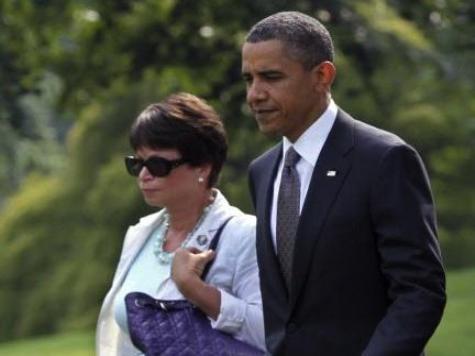
Jarrett and Obama
Valerie Jarrett and Barack Obama

In addition to Jarrett’s investment through her former employer, she received deferred compensation of more than $556,000 in January 2009, on top of her $302,000 salary the previous year.

Levin, the firm’s founder, has close ties to the Obama administration and the Democratic Party. Levin and his wife, Fay Hartog Levin, are long-time acquaintances of the president’s, and have personally donated nearly $1 million to Democratic candidates and committees since 1989, including about $25,000 each to Obama.

In 2009, President Obama appointed Hartog Levin ambassador to the Netherlands, a move that drew criticism from government accountability advocates. The president has a history of awarding top donors and fundraisers with ambassadorships and other administrations posts.

The Levins each hold personal stakes in the Kingsbury development worth at least $1 million as of 2011.

Jarrett’s involvement in Chicago real estate development between 1992 and 2009 was marred with controversy, much of which centered on Habitat’s role as the sole developer for “family public housing,” a status granted under a district court ruling in 1987.

Under Jarrett’s leadership, Habitat oversaw the development of a number of public housing projects, one of which, in the Cabrini Green neighborhood, was dubbed a “national symbol of urban despair.” Others became so run-down the city had to ask the federal government to intervene.

A 2003 Harvard Law Review article cited the decline of the Cabrini Green development as an embodiment of the negative consequence associated with the “privatization of public housing.”

“They are rapidly displacing poor people, and these companies are profiting from this displacement,” Matt Ginsberg-Jaeckle of Southside Together Organizing for Power, a Chicago community organization, told the Boston Globe in 2008.

ICE Agents Sue: Homeland Security Punished Us for Obeying Federal Law (video)

Stop enforcing the law or we will punish you for obeying federal statute. George Orwell call your office.

Of course this is not the first time federal agents have blown the whistle on the Obama administration. It was the ATF Agents on the ground that went public outing the Obama Administration program to send American guns to drug cartels in hopes that it would provide an excuse to pass new anti-gun laws.

This administration is lawless and keeps pushing the envelope because by and large the elite media will not cover news like this with much prominence.


Allen West on how the Democrat Leadership is “very extreme” (video)

I think it is very extreme to go from $10.6 to $16 Trillion in less than four years

I think it is very extreme when the highest annual deficit of 458 Billion (before they got elected) is shattered by four straight years of trillion dollar plus deficits

I think it is very extreme Keystone project that could have provided 23,000 direct jobs and over 100,000 indirect jobs because of the environmental lobby the President decided not to do it.

I think it is very extreme when you create 71,000 pages of new government regulations a year when you have a “Regulations Czar” who is saying they are scaling back on new regulations.

We can talk about being extreme because the facts are on our side…

Kirsten Powers on the Media Double Standard on VP Biden Gaffes (video) – UPDATED!

Biden makes more gaffes than all politicians combined, but since he is a Democrat it is OK. Democrat Strategist Kirsten Powers takes the honest road and tells about the glaring double standard the media has with Biden compared to any Republican politician.

Flashback: Liberal Media Attacks on Republican VP Nominees

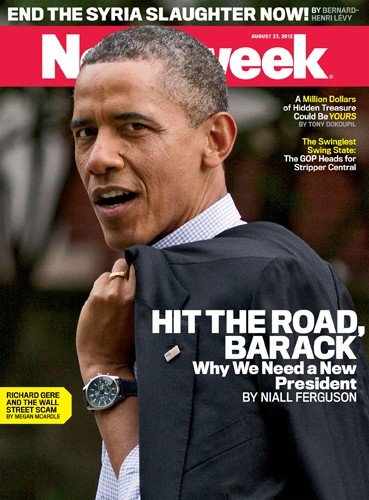
Prof. Niall Ferguson: Obama’s Gotta Go

Niall Ferguson, MA, D.Phil., is Laurence A. Tisch Professor of History at Harvard University. He is also a Senior Fellow at the Hoover Institution, Stanford University, and a Senior Research Fellow at Jesus College, Oxford.

His books include Paper and Iron: Hamburg Business and German Politics in the Era of Inflation 1897-1927 (1993), Virtual History: Alternatives and Counterfactuals (1997), The Pity of War: Explaining World War One (1998), The World’s Banker: The History of the House of Rothschild (1998), The Cash Nexus: Money and Power in the Modern World, 1700-2000 (2001), Empire: The Rise and Demise of the British World Order and the Lessons for Global Power (2003), Colossus: The Rise and Fall of the American Empire (2004), The War of the World: Twentieth-Century Conflict and the Descent of the West (2006) and The Ascent of Money: A Financial History of the World (2008).

Ferguson has written and presented five major television series, including The Ascent of Money, which won the 2009 International Emmy award for Best Documentary. His most recent books are High Financier: The Lives and Time of Siegmund Warburg (2010) and Civilization: The West and the Rest, also a major TV documentary series. Civilization will be published in the U.S. on November 1 and will air on PBS in 2012.

See our other Niall Ferguson coverage HERE.

Prof. Niall Ferguson:

Why does Paul Ryan scare the president so much? Because Obama has broken his promises, and it’s clear that the GOP ticket’s path to prosperity is our only hope.

I was a good loser four years ago. “In the grand scheme of history,” I wrote the day after Barack Obama’s election as president, “four decades is not an especially long time. Yet in that brief period America has gone from the assassination of Martin Luther King Jr. to the apotheosis of Barack Obama. You would not be human if you failed to acknowledge this as a cause for great rejoicing.”

Despite having been—full disclosure—an adviser to John McCain, I acknowledged his opponent’s remarkable qualities: his soaring oratory, his cool, hard-to-ruffle temperament, and his near faultless campaign organization.

Yet the question confronting the country nearly four years later is not who was the better candidate four years ago. It is whether the winner has delivered on his promises. And the sad truth is that he has not.

In his inaugural address, Obama promised “not only to create new jobs, but to lay a new foundation for growth.” He promised to “build the roads and bridges, the electric grids, and digital lines that feed our commerce and bind us together.” He promised to “restore science to its rightful place and wield technology’s wonders to raise health care’s quality and lower its cost.” And he promised to “transform our schools and colleges and universities to meet the demands of a new age.” Unfortunately the president’s scorecard on every single one of those bold pledges is pitiful.

In an unguarded moment earlier this year, the president commented that the private sector of the economy was “doing fine.” Certainly, the stock market is well up (by 74 percent) relative to the close on Inauguration Day 2009. But the total number of private-sector jobs is still 4.3 million below the January 2008 peak. Meanwhile, since 2008, a staggering 3.6 million Americans have been added to Social Security’s disability insurance program. This is one of many ways unemployment is being concealed.

In his fiscal year 2010 budget—the first he presented—the president envisaged growth of 3.2 percent in 2010, 4.0 percent in 2011, 4.6 percent in 2012. The actual numbers were 2.4 percent in 2010 and 1.8 percent in 2011; few forecasters now expect it to be much above 2.3 percent this year.

Unemployment was supposed to be 6 percent by now. It has averaged 8.2 percent this year so far. Meanwhile real median annual household income has dropped more than 5 percent since June 2009. Nearly 110 million individuals received a welfare benefit in 2011, mostly Medicaid or food stamps.

Welcome to Obama’s America: nearly half the population is not represented on a taxable return—almost exactly the same proportion that lives in a household where at least one member receives some type of government benefit. We are becoming the 50–50 nation—half of us paying the taxes, the other half receiving the benefits.

And all this despite a far bigger hike in the federal debt than we were promised. According to the 2010 budget, the debt in public hands was supposed to fall in relation to GDP from 67 percent in 2010 to less than 66 percent this year. If only. By the end of this year, according to the Congressional Budget Office (CBO), it will reach 70 percent of GDP. These figures significantly understate the debt problem, however. The ratio that matters is debt to revenue. That number has leapt upward from 165 percent in 2008 to 262 percent this year, according to figures from the International Monetary Fund. Among developed economies, only Ireland and Spain have seen a bigger deterioration.

Not only did the initial fiscal stimulus fade after the sugar rush of 2009, but the president has done absolutely nothing to close the long-term gap between spending and revenue.

His much-vaunted health-care reform will not prevent spending on health programs growing from more than 5 percent of GDP today to almost 10 percent in 2037. Add the projected increase in the costs of Social Security and you are looking at a total bill of 16 percent of GDP 25 years from now. That is only slightly less than the average cost of all federal programs and activities, apart from net interest payments, over the past 40 years. Under this president’s policies, the debt is on course to approach 200 percent of GDP in 2037—a mountain of debt that is bound to reduce growth even further.

And even that figure understates the real debt burden. The most recent estimate for the difference between the net present value of federal government liabilities and the net present value of future federal revenues—what economist Larry Kotlikoff calls the true “fiscal gap”—is $222 trillion.

The president’s supporters will, of course, say that the poor performance of the economy can’t be blamed on him. They would rather finger his predecessor, or the economists he picked to advise him, or Wall Street, or Europe—anyone but the man in the White House.

There’s some truth in this. It was pretty hard to foresee what was going to happen to the economy in the years after 2008. Yet surely we can legitimately blame the president for the political mistakes of the past four years. After all, it’s the president’s job to run the executive branch effectively—to lead the nation. And here is where his failure has been greatest.

On paper it looked like an economics dream team: Larry Summers, Christina Romer, and Austan Goolsbee, not to mention Peter Orszag, Tim Geithner, and Paul Volcker. The inside story, however, is that the president was wholly unable to manage the mighty brains—and egos—he had assembled to advise him.

According to Ron Suskind’s book Confidence Men, Summers told Orszag over dinner in May 2009: “You know, Peter, we’re really home alone … I mean it. We’re home alone. There’s no adult in charge. Clinton would never have made these mistakes [of indecisiveness on key economic issues].” On issue after issue, according to Suskind, Summers overruled the president. “You can’t just march in and make that argument and then have him make a decision,” Summers told Orszag, “because he doesn’t know what he’s deciding.” (I have heard similar things said off the record by key participants in the president’s interminable “seminar” on Afghanistan policy.)

This problem extended beyond the White House. After the imperial presidency of the Bush era, there was something more like parliamentary government in the first two years of Obama’s administration. The president proposed; Congress disposed. It was Nancy Pelosi and her cohorts who wrote the stimulus bill and made sure it was stuffed full of political pork. And it was the Democrats in Congress—led by Christopher Dodd and Barney Frank—who devised the 2,319-page Wall Street Reform and Consumer Protection Act (Dodd-Frank, for short), a near-perfect example of excessive complexity in regulation. The act requires that regulators create 243 rules, conduct 67 studies, and issue 22 periodic reports. It eliminates one regulator and creates two new ones.

It is five years since the financial crisis began, but the central problems—excessive financial concentration and excessive financial leverage—have not been addressed.

Today a mere 10 too-big-to-fail financial institutions are responsible for three quarters of total financial assets under management in the United States. Yet the country’s largest banks are at least $50 billion short of meeting new capital requirements under the new “Basel III” accords governing bank capital adequacy.

And then there was health care. No one seriously doubts that the U.S. system needed to be reformed. But the Patient Protection and Affordable Care Act (ACA) of 2010 did nothing to address the core defects of the system: the long-run explosion of Medicare costs as the baby boomers retire, the “fee for service” model that drives health-care inflation, the link from employment to insurance that explains why so many Americans lack coverage, and the excessive costs of the liability insurance that our doctors need to protect them from our lawyers.

Ironically, the core Obamacare concept of the “individual mandate” (requiring all Americans to buy insurance or face a fine) was something the president himself had opposed when vying with Hillary Clinton for the Democratic nomination. A much more accurate term would be “Pelosicare,” since it was she who really forced the bill through Congress.

Pelosicare was not only a political disaster. Polls consistently showed that only a minority of the public liked the ACA, and it was the main reason why Republicans regained control of the House in 2010. It was also another fiscal snafu. The president pledged that health-care reform would not add a cent to the deficit. But the CBO and the Joint Committee on Taxation now estimate that the insurance-coverage provisions of the ACA will have a net cost of close to $1.2 trillion over the 2012–22 period.

The president just kept ducking the fiscal issue. Having set up a bipartisan National Commission on Fiscal Responsibility and Reform, headed by retired Wyoming Republican senator Alan Simpson and former Clinton chief of staff Erskine Bowles, Obama effectively sidelined its recommendations of approximately $3 trillion in cuts and $1 trillion in added revenues over the coming decade. As a result there was no “grand bargain” with the House Republicans—which means that, barring some miracle, the country will hit a fiscal cliff on Jan. 1 as the Bush tax cuts expire and the first of $1.2 trillion of automatic, across-the-board spending cuts are imposed. The CBO estimates the net effect could be a 4 percent reduction in output.

The failures of leadership on economic and fiscal policy over the past four years have had geopolitical consequences. The World Bank expects the U.S. to grow by just 2 percent in 2012. China will grow four times faster than that; India three times faster. By 2017, the International Monetary Fund predicts, the GDP of China will overtake that of the United States.

Meanwhile, the fiscal train wreck has already initiated a process of steep cuts in the defense budget, at a time when it is very far from clear that the world has become a safer place—least of all in the Middle East.

For me the president’s greatest failure has been not to think through the implications of these challenges to American power. Far from developing a coherent strategy, he believed—perhaps encouraged by the premature award of the Nobel Peace Prize—that all he needed to do was to make touchy-feely speeches around the world explaining to foreigners that he was not George W. Bush.

In Tokyo in November 2009, the president gave his boilerplate hug-a-foreigner speech: “In an interconnected world, power does not need to be a zero-sum game, and nations need not fear the success of another … The United States does not seek to contain China … On the contrary, the rise of a strong, prosperous China can be a source of strength for the community of nations.” Yet by fall 2011, this approach had been jettisoned in favor of a “pivot” back to the Pacific, including risible deployments of troops to Australia and Singapore. From the vantage point of Beijing, neither approach had credibility.

His Cairo speech of June 4, 2009, was an especially clumsy bid to ingratiate himself on what proved to be the eve of a regional revolution. “I’m also proud to carry with me,” he told Egyptians, “a greeting of peace from Muslim communities in my country: Assalamu alaikum … I’ve come here … to seek a new beginning between the United States and Muslims around the world, one based … upon the truth that America and Islam are not exclusive and need not be in competition.”

Believing it was his role to repudiate neoconservatism, Obama completely missed the revolutionary wave of Middle Eastern democracy—precisely the wave the neocons had hoped to trigger with the overthrow of Saddam Hussein in Iraq. When revolution broke out—first in Iran, then in Tunisia, Egypt, Libya, and Syria—the president faced stark alternatives. He could try to catch the wave by lending his support to the youthful revolutionaries and trying to ride it in a direction advantageous to American interests. Or he could do nothing and let the forces of reaction prevail.

In the case of Iran he did nothing, and the thugs of the Islamic Republic ruthlessly crushed the demonstrations. Ditto Syria. In Libya he was cajoled into intervening. In Egypt he tried to have it both ways, exhorting Egyptian President Hosni Mubarak to leave, then drawing back and recommending an “orderly transition.” The result was a foreign-policy debacle. Not only were Egypt’s elites appalled by what seemed to them a betrayal, but the victors—the Muslim Brotherhood—had nothing to be grateful for. America’s closest Middle Eastern allies—Israel and the Saudis—looked on in amazement.

“This is what happens when you get caught by surprise,” an anonymous American official told The New York Times in February 2011. “We’ve had endless strategy sessions for the past two years on Mideast peace, on containing Iran. And how many of them factored in the possibility that Egypt moves from stability to turmoil? None.”

Remarkably the president polls relatively strongly on national security. Yet the public mistakes his administration’s astonishingly uninhibited use of political assassination for a coherent strategy. According to the Bureau of Investigative Journalism in London, the civilian proportion of drone casualties was 16 percent last year. Ask yourself how the liberal media would have behaved if George W. Bush had used drones this way. Yet somehow it is only ever Republican secretaries of state who are accused of committing “war crimes.”

The real crime is that the assassination program destroys potentially crucial intelligence (as well as antagonizing locals) every time a drone strikes. It symbolizes the administration’s decision to abandon counterinsurgency in favor of a narrow counterterrorism. What that means in practice is the abandonment not only of Iraq but soon of Afghanistan too. Understandably, the men and women who have served there wonder what exactly their sacrifice was for, if any notion that we are nation building has been quietly dumped. Only when both countries sink back into civil war will we realize the real price of Obama’s foreign policy.

America under this president is a superpower in retreat, if not retirement. Small wonder 46 percent of Americans—and 63 percent of Chinese—believe that China already has replaced the U.S. as the world’s leading superpower or eventually will.

It is a sign of just how completely Barack Obama has “lost his narrative” since getting elected that the best case he has yet made for reelection is that Mitt Romney should not be president. In his notorious “you didn’t build that” speech, Obama listed what he considers the greatest achievements of big government: the Internet, the GI Bill, the Golden Gate Bridge, the Hoover Dam, the Apollo moon landing, and even (bizarrely) the creation of the middle class. Sadly, he couldn’t mention anything comparable that his administration has achieved.

Now Obama is going head-to-head with his nemesis: a politician who believes more in content than in form, more in reform than in rhetoric. In the past days much has been written about Wisconsin Congressman Paul Ryan, Mitt Romney’s choice of running mate. I know, like, and admire Paul Ryan. For me, the point about him is simple. He is one of only a handful of politicians in Washington who is truly sincere about addressing this country’s fiscal crisis.

Over the past few years Ryan’s “Path to Prosperity” has evolved, but the essential points are clear: replace Medicare with a voucher program for those now under 55 (not current or imminent recipients), turn Medicaid and food stamps into block grants for the states, and—crucially—simplify the tax code and lower tax rates to try to inject some supply-side life back into the U.S. private sector. Ryan is not preaching austerity. He is preaching growth. And though Reagan-era veterans like David Stockman may have their doubts, they underestimate Ryan’s mastery of this subject. There is literally no one in Washington who understands the challenges of fiscal reform better.

Just as importantly, Ryan has learned that politics is the art of the possible. There are parts of his plan that he is understandably soft-pedaling right now—notably the new source of federal revenue referred to in his 2010 “Roadmap for America’s Future” as a “business consumption tax.” Stockman needs to remind himself that the real “fairy-tale budget plans” have been the ones produced by the White House since 2009.

I first met Paul Ryan in April 2010. I had been invited to a dinner in Washington where the U.S. fiscal crisis was going to be the topic of discussion. So crucial did this subject seem to me that I expected the dinner to happen in one of the city’s biggest hotel ballrooms. It was actually held in the host’s home. Three congressmen showed up—a sign of how successful the president’s fiscal version of “don’t ask, don’t tell” (about the debt) had been. Ryan blew me away. I have wanted to see him in the White House ever since.

It remains to be seen if the American public is ready to embrace the radical overhaul of the nation’s finances that Ryan proposes. The public mood is deeply ambivalent. The president’s approval rating is down to 49 percent. The Gallup Economic Confidence Index is at minus 28 (down from minus 13 in May). But Obama is still narrowly ahead of Romney in the polls as far as the popular vote is concerned (50.8 to 48.2) and comfortably ahead in the Electoral College. The pollsters say that Paul Ryan’s nomination is not a game changer; indeed, he is a high-risk choice for Romney because so many people feel nervous about the reforms Ryan proposes.

Mitt Romney is not the best candidate for the presidency I can imagine. But he was clearly the best of the Republican contenders for the nomination. He brings to the presidency precisely the kind of experience—both in the business world and in executive office—that Barack Obama manifestly lacked four years ago. (If only Obama had worked at Bain Capital for a few years, instead of as a community organizer in Chicago, he might understand exactly why the private sector is not “doing fine” right now.) And by picking Ryan as his running mate, Romney has given the first real sign that—unlike Obama—he is a courageous leader who will not duck the challenges America faces.

The voters now face a stark choice. They can let Barack Obama’s rambling, solipsistic narrative continue until they find themselves living in some American version of Europe, with low growth, high unemployment, even higher debt—and real geopolitical decline.

Or they can opt for real change: the kind of change that will end four years of economic underperformance, stop the terrifying accumulation of debt, and reestablish a secure fiscal foundation for American national security.

I’ve said it before: it’s a choice between les États Unis and the Republic of the Battle Hymn.

I was a good loser four years ago. But this year, fired up by the rise of Ryan, I want badly to win.

So of course, leftist bloggers had a cow, tried to get Prof. Ferguson fired etc, all without actually responding to his core arguments. They try to nitpick and vilify. The tactics of the far left have not changed in decades. They are in fact, laughable.

Prof Ferguson responds:

“We know no spectacle so ridiculous,” Lord Macaulay famously wrote, “as the British public in one of its periodical fits of morality.” But the spectacle of the American liberal blogosphere in one of its almost daily fits of righteous indignation is not so much ridiculous as faintly sinister. Why? Because what I have encountered since the publication of my Newsweek article criticizing President Obama looks suspiciously like an orchestrated attempt to discredit me.

My critics have three things in common. First, they wholly fail to respond to the central arguments of the piece. Second, they claim to be engaged in “fact checking,” whereas in nearly all cases they are merely offering alternative (often silly or skewed) interpretations of the facts. Third, they adopt a tone of outrage that would be appropriate only if I had argued that, say, women’s bodies can somehow prevent pregnancies in case of “legitimate rape.”

Their approach is highly effective, and I must remember it if I ever decide to organize an intellectual witch hunt. What makes it so irksome is that it simultaneously dodges the central thesis of my piece and at the same time seeks to brand me as a liar. The icing on the cake has been the attempt by some bloggers to demand that I be sacked not just by Newsweek but also by Harvard University, where I am a tenured professor. It is especially piquant to read these demands from people who would presumably defend academic freedom in the last ditch—provided it is the freedom to publish opinions in line with their own ideology.

***

Let me begin by restating my argument. President Obama should be judged on his record in office. In my view, he has not only failed to live up to the high expectations of those who voted for him, but also to the pledges he made in his inaugural address. (In order to be fair, I deliberately did not judge his performance against his campaign pledges.) The economy has performed less well than the White House led us to expect, despite a bigger increase in national debt than it led us to expect (exhibit 1).

1. FY2010 Budget and Outcomes / Latest Projections

Source

Note, however, that I cut the president some slack on the economy. He inherited a bigger mess than most people appreciated back in November 2008. And forces beyond his control (Europe) have clearly dampened the recovery. Here’s what I wrote:

It was pretty hard to foresee what was going to happen to the economy in the years after 2008. Yet surely we can legitimately blame the president for the political mistakes of the past four years. After all, it’s the president’s job to run the executive branch effectively—to lead the nation. And here is where his failure has been greatest.

Notice, then, that my central critique of the president is not that the economy has underperformed, but that he has not been an effective leader of the executive branch. I go on to detail his well-documented difficulties in managing his team of economic advisers and his disastrous decision to leave it to his own party in Congress to define the terms of his stimulus, financial reform, and health-care reform. I also argue that he has consistently failed to address the crucial issue of long-term fiscal balance, with the result that the nation is now hurtling toward a fiscal cliff of tax hikes and drastic spending cuts.

The second part of my argument is that these failures of domestic leadership have fed into a failure of foreign policy. As commander in chief, President Obama has earned a relatively strong public reputation mainly thanks to a campaign of assassination that liberal bloggers would have excoriated if it had been conducted by his predecessor. His withdrawal of U.S. forces from Iraq and Afghanistan will, in my view, prove to have been premature. More importantly, he has been indecisive in his responses to the revolutionary wave that has swept the Middle East since the Iranian “green” revolution of 2009. And, finally, he has been inconsistent and ineffective in his handling of the major strategic challenge of our times, the rise of China. (By the way, I base these judgments on a great many off-the-record conversations with influential policy-makers here and abroad. When a very senior military man asks you: “Have we any global strategy beyond just trying to hang on?,” you have a right to wonder if the answer might be “No.”)

I concluded by arguing that, for all these reasons, voters would be better advised to vote for Mitt Romney, especially now that he has picked Paul Ryan as his running mate. (Repeat disclosure: I made it clear in the piece that I was a John McCain supporter four years ago and am a friend of Ryan’s.)

So much for my argument, which not one of my critics has addressed. Instead, they have unleashed a storm of nit-picking and vilification. Well, let’s start with the nits.

I have already dealt with Paul Krugman’s opening salvo on the effects of the Affordable Care Act on the deficit. The point (still not grasped by Andrew Sullivan, who thinks I was just talking about the gross costs) is that the net effect of ACA on the deficit is not positive if you look at the likely costs and the likely revenues from the tax hikes that will finance it. To get to the Congressional Budget Office’s conclusion that, over 10 years, the ACA will reduce the deficit, you need to believe that the act will half the rate of growth of Medicare costs. I am not inclined to be optimistic about that.

Incidentally, while we are on the subject of the CBO’s projections, since March 2010 it has already increased its estimate of the gross costs over 10 years from $944 billion to $1,856 billion, its estimate of total revenue from $631 billion to $1,221 billion, and its estimate of total Medicare cuts from $454 billion to $743 billion. This really is a fast-moving target.

But the clincher is the CBO’s latest long-run budget forecast, according to which total federal government expenditure on health care is projected to rise from 4.9 percent of GDP this year to between 13.8 and 15.1 percent in 75 years’ time (see exhibit 2). The two scenarios the CBO presents imply either a massive tax hike, taking federal revenues from 15.8 to 29.8 percent of GDP, or a massive rise in the debt, to above 250 percent of GDP.

2. Health-Care Spending Projections

Matthew O’Brien followed up Krugman with “A Full Fact-Check.” Actually, this isn’t actually a fact check because O’Brien doesn’t successfully identify a single error. He just offers his own opinions.

Let’s take all 11 of them one by one. (It’s boring, I know, but necessary.)

1. NF: The total number of private-sector jobs is still 4.3 million below the January 2008 peak.

MO’B: The private sector has actually added jobs since Obama was sworn in.

Both these statements are true. I picked the high point of January 2008 because it seems to me reasonable to ask how much of the ground lost in the crisis have we actually made up under Obama. The answer is not much. You may not like that, but it’s a fact (exhibit 3).

3. Total Private Employment From the Current Employment Statistics Survey (National)

2. NF: Meanwhile real median annual household income has dropped more than 5 percent since June 2009.

MO’B: I can’t replicate this result. It’s difficult, because Ferguson does not cite his source.

Well, either Newsweek starts publishing footnotes or Matthew O’Brien reads a little more widely than just official statistics, which generally lag months behind. The monthly data for Median Household Income Index (HII) is produced by Sentier (exhibit 4).

4. Real Median Household Income, 2000–2012

3. NF: Nearly half the population is not represented on a taxable return–—almost exactly the same proportion that lives in a household where at least one member receives some type of government benefit.

MO’B: It is true that 46 percent of households did not pay federal income tax in 2011.

In other words, my fact is true. Because I specifically said “taxable return.” You don’t tend to record your sales tax payments on those.

4. NF: By the end of this year, according to the Congressional Budget Office (CBO), [debt-to-GDP ratio] will reach 70 percent of GDP. These figures significantly understate the debt problem, however. The ratio that matters is debt to revenue. That number has leapt upward from 165 percent in 2008 to 262 percent this year, according to figures from the International Monetary Fund.

MO’B: This is incorrect. Ferguson had it right the first time—the number that matters is debt-to-GDP, not debt-to-revenue. The former reflects our capacity to pay; the latter our willingness to pay right now.

Again, O’Brien is offering here an opinion as a fact. He should read my book The Cash Nexus (2001) to understand why he doesn’t know what he is talking about. Governments don’t pay interest and redemption with GDP but with tax revenues. If it were easy to increase the tax share of GDP, we wouldn’t be heading for a fiscal cliff. My numbers are correct and can be checked using the IMF’s World Economic Outlook online database.

5. NF: Not only did the initial fiscal stimulus fade after the sugar rush of 2009, but the president has done absolutely nothing to close the long-term gap between spending and revenue.

MO’B: Ferguson wasn’t always a critic of the stimulus. Back in August 2009, he wrote that “the stimulus clearly made a significant contribution to stabilizing the U.S. economy.”

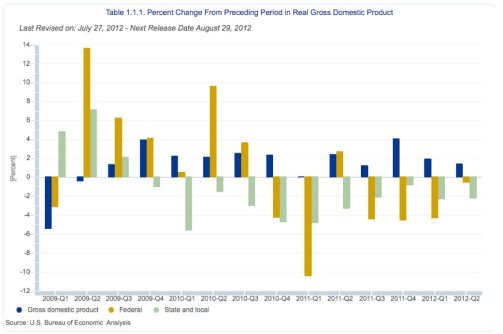
This earlier statement does not contradict my article. As anyone who looks at the data knows, the stimulus had a positive but very short-run impact and failed to achieve self-sustaining growth in the way Keynesians hoped (exhibit 5).

6. NF: The most recent estimate for the difference between the net present value of federal government liabilities and the net present value of future federal revenues—what economist Larry Kotlikoff calls the true “fiscal gap”—-is $222 trillion.

MO’B: That’s a lot of trillions! But if our fiscal gap is “really” this many trillions, why can we borrow for 30 years for a real rate of 0.64 percent? It’s because this number is meaningless.

Well, O’Brien is welcome to share his opinion with Larry Kotlikoff, the world’s leading authority on generational accounting and long-term fiscal stability. What he can’t claim is that my statement is factually inaccurate. As for the argument that current low borrowing costs mean we don’t need to worry about the debt—which is like saying that mortgage default rates in 2006 meant we didn’t need to worry about subprime—that has been comprehensively demolished in a new paper by Carmen and Vincent Reinhart and Ken Rogoff.

7. NF: The country’s largest banks are at least $50 billion short of meeting new capital requirements under the new ‘Basel III’ accords governing bank capital adequacy.

MO’B: This would be damning if we had already fully implemented the Basel III bank rules. We have not.

But I didn’t say that we had already implemented Basel III. So that’s another fact “checked” and found to be … correct.

8. NF: The Patient Protection and Affordable Care Act (ACA) of 2010 did nothing to address the core defects of the system: the long-run explosion of Medicare costs as the baby boomers retire, the “fee for service” model that drives health-care inflation, the link from employment to insurance that explains why so many Americans lack coverage, and the excessive costs of the liability insurance that our doctors need to protect them from our lawyers.

MO’B: There are reasons to think the ACA will fail to address the core defects of the health care system. But it’s wrong to say it does nothing to address them. Here’s a partial list of the things Obamacare does. It tackles the long-run explosion of Medicare costs. It tries to move away from the fee-for-service model that drives healthcare inflation. And it cuts the link between employment and insurance.

Now let’s check O’Brien’s facts. So the ACA “tackles the long-run explosion of Medicare costs.” Right. That’s why the net cost of Medicare is still projected by the CBO to treble from 3.2 percent of GDP to between 9 and 10 percent by 2087.

9. NF: Having set up a bipartisan National Commission on Fiscal Responsibility and Reform, headed by retired Wyoming Republican senator Alan Simpson and former Clinton chief of staff Erskine Bowles, Obama effectively sidelined its recommendations of approximately $3 trillion in cuts and $1 trillion in added revenues over the coming decade. As a result there was no “grand bargain” with the House Republicans—which means that, barring some miracle, the country will hit a fiscal cliff on Jan. 1 …

MO’B: Now, Obama did not push Congress to adopt Simpson-Bowles, but neither did Congress adopt it.

So that’s another fact “checked” and found to be correct. And if you want to gauge the president’s share of the responsibility for the failure of a fiscal grand bargain, read Matt Bai in The New York Times.

10. NF: The World Bank expects the U.S. to grow by just 2 percent in 2012. China will grow four times faster than that; India three times faster. By 2017 the International Monetary Fund predicts, the GDP of China will overtake that of the United States.

MO’B: China has 1.3 billion people. The United States has 300 million people. China’s GDP will pass ours when they are only four times poorer than us. That might happen in 2017; it might happen later … It doesn’t really matter if and when this happens. There’s nothing Obama can do to prevent China from catching up—nor should Obama want to!

Well, there you have it. It “doesn’t really matter” that for the first time since the 1880s the United States is about to cease being the world’s largest economy. Fact checked, found to be correct, and countered with an utterly naive opinion.

11. NF: In his notorious “you didn’t build that” speech, Obama listed what he considers the greatest achievements of big government: the Internet, the GI Bill, the Golden Gate Bridge, the Hoover Dam, the Apollo moon landing, and even (bizarrely) the creation of the middle class. Sadly, he couldn’t mention anything comparable that his administration has achieved.

MO’B: It’s bizarre that Ferguson thinks government policies didn’t help create America’s middle class. America was the first country to make high school compulsory.

Fact checked and—oh no! I really did get that wrong. It was the government that created the middle class, as well as the Golden Gate Bridge! Remind me to tell Karl Marx about this. It will come as news to him that, contrary to his life’s work, the superstructure in fact created the base. (Come to think of it, this is going to come as shock to a lot of American liberals too. Imagine! The state actually created the bourgeoisie! Who knew?)

***

Now, we come to the third part of the strategy. First, duck the argument. Second, nitpick. Third, vilify.

First prize goes to Berkeley professor Brad DeLong, whose blog opened with the headline “Fire-His-Ass-Now.” “He lied,” rants DeLong. “Convene a committee at Harvard to examine whether he has the moral character to teach at a university.” My own counter-suggestion would be to convene a committee at Berkeley to examine whether or not Professor DeLong is spending too much of his time blogging when he really should be conducting serious research or teaching his students. For example, why hasn’t Professor DeLong published that economic history of the 20th century he’s been promising for the past six years? It can’t be writer’s block, that’s for sure.

Runner up is James Fallows of The Atlantic for his hilariously pompous post “As a Harvard Alum, I Apologize.” Well, as an Oxford alum, I laugh.

In third place comes Krugman with his charge of “unethical commentary … a plain misrepresentation of the facts” requiring “an abject correction.” The idea of getting a lesson from Paul Krugman about the ethics of commentary is almost as funny as Fallows’s apologizing on behalf of Harvard. Both these paragons of the commentariat, by the way, shamelessly accused me of racism three years ago when I drew an innocent parallel between President Obama and “Felix the Cat.” I don’t know of many more unethical tricks than to brand someone who criticizes the president a racist.

And, finally, a consolation prize for righteous indignation goes to Dylan Byers of Politico (“ridiculous, misleading, ethically questionable”).

I could, of course, go on. By tonight there will doubtless be more. The art of the modern witch hunt is to get as many like-minded bloggers as possible to repeat and preferably exaggerate the claims until finally it becomes received opinion that you are on the brink of being fired and indeed deported in chains.

I don’t usually waste time on this kind of thing. In the Internet age, you can spend one week writing a piece and the next three responding to criticism, most of it (as we have seen) worthless.

But there comes a point when you have to ask yourself: has the American public sphere so degenerated that it is now impossible to make the case for a change of president without being set upon in cyberspace by a suspiciously well-organized gang of the current incumbent’s most ideologically committed supporters?

Now that really would be something to dislike about this country.

More energy price hikes and power shortages on the way due to government regulation

Government picking winners and losers and getting kickbacks in what has become “Greenscam”, an effort to funnel tax dollars into far left eco-extremists groups and the Democratic Party – LINK.

Read carefully – Marita Noon:

“Once real numbers have come out about renewable energy costs, people are having second thoughts,” reported Maureen Masten, Deputy Secretary of Natural Resources and Senior Advisor on Energy to Governor Bob McDonnell, VA,  while addressing his “all of the above energy” strategy to meet the state’s energy needs.

The real costs of renewable energy are coming out—both in dollars and daily impacts. After years of hearing about “free” energy from the sun and wind, people are discovering that they’ve been lied to.

On Tuesday, August 14, the New Mexico Public Regulation Commission (PRC) approved a new renewable energy rate rider that will allow the Public Service Company of New Mexico (PNM) to start recovering a portion of its recent development costs for building five solar facilities around the state, a pilot solar facility with battery storage, and wind resource procurements. The renewable rider could be on ratepayers’ bills by the end of the month—“depending on when the commission publishes its final order,” said PNM spokeswoman Susan Spooner.

The rate rider currently represents about a $1.34 increase for an average residence using 600 kilowatt hours of electricity per month—or a little more than $16 per year. This increase seems miniscule until you realize that this is only a small part of increases to come. PNM needs to recover $18.29 million in renewable expenditures in 2012 and the rate rider only addresses monies spent in the last four to five months. The remaining expense will be carried into 2013.

Like more than half of the states in the US, New Mexico has a Renewable Portfolio Standard (RPS) that mandates public utilities have set percentages of their electricity from renewable sources. In New Mexico the mandate is 10 percent this year, 15 percent by 2015 and 20 percent by 2020. Most states—with the exception of California (which is 33 percent by 2020)—have similar benchmarks. To meet the mandates, PNM will need considerably more renewable energy with dramatically more expense—all of which ultimately gets passed on to the customer. PNM acknowledges that the rider will increase next year and predicts the total cost recovery for 2013 to be about $23 million. By 2020, based on the current numbers of approximately $20 million a year invested, resulting in a $24 a year increase, consumers’ bills will go up about $200 a year just for the additional cost of inefficient renewable energy.

Had the PRC not approved the special rate rider, costs would be even higher. Typically rate increases are only approved at periodic rate case hearings, usually held every few years. The system of only allowing rate increases after a lengthy hearing, keeps the costs hidden from the consumer for longer but increases costs to the utility and, ultimately, the consumer, due to interest charges on the borrowed money. PNM believes the rider will allow for more “timely recovery of costs,” resulting in a $2.7 million savings.

Environmental groups, who’ve been pushing for the renewable energy increases, opposed the special renewable rate rider and have threatened a potential appeal of the PRC’s decision. It is hard to tout “free” energy when there is a special line on the utility bill that clearly points out the new charge for renewables.

So, renewable electricity is hardly free. It also isn’t there when you need it—like in the predictable summer heat of California.

To meet their 33 percent renewable mandate, California’s utility companies, like New Mexico, have been installing commercial renewable electricity facilities—with wind capable of providing about 6 percent, and solar 2 percent, of the state’s electric demand. But in the summer heat, the wind doesn’t blow much and the solar capacity drops by about 50 percent when the demand is the highest.

Despite increasing renewable capacity and an exodus of the population, California has been facing threats of rolling brown/blackouts due to potential shortages. TV and radio ads blanket the air waves begging consumers to limit electricity usage by setting their air conditioners at 78 degrees and using household appliances only after 6PM. “Flex Alerts” have been issued stating: “conservation remains critical.” “Consumers are urged to reduce energy use,” “California ISO balances high demand for electricity with tight power supplies” and “maintain grid reliability.”

Even with expedited permitting, California cannot build renewable electricity generation fast enough. Environmentalists block construction due to species habitat, such as that of the desert tortoise or the kit fox. If they oppose renewable energy construction, you can imagine the vitriol they extend toward coal, natural gas, and nuclear. There is a big push to shut down nuclear power plants and new natural-gas plants, which are ideal for meeting the needs of “peak demand,”are fought by the very same groups that are pushing electric cars.

San Diego-based, nationally syndicated radio talk show host Roger Hedgecock observed: “Right at the moment in California, building new electricity generating power plants of any kind is politically taboo. Electricity itself is becoming politically taboo.”

Texas has been faced with both increasing costs and fears of shortages. “Concerned about adequate electricity supplies,” the Texas Public Utility Commission recently voted to allow electricity generators to charge up to 50 percent more for wholesale power. The increase is to encourage the building of new power plants in the state with the highest capacity in the country for wind electricity generation.

Apparently new electricity-generating power plants are politically taboo in Texas, too—at least within the environmental community. Instead of encouraging new power plants to be built, Ken Kramer, the Texas head of the Sierra Club, said, “A better idea would be to encourage more energy-saving programs”—perhaps like setting the thermostat to 78 degrees and not turning on appliances until after 6PM.

When will Americans revolt over being forced to use less while paying more?

We know that high energy prices are just the beginning of inflation that raises the cost of everything from food to clothing to manufactured goods. When the cost of manufacturing goes up, industry moves to countries with lower-priced energy, cheaper labor, and more reasonable regulations. Jobs go overseas and we import more. The trade deficit grows, and America is less competitive.

The higher electricity costs are 100 percent due to government regulation and legislation that are unreasonably crushing American businesses and ratepayers—much like the pressure England imposed on the American colonies that launched the American Revolution.

Fact Check: Obama running against outdated version of Ryan Medicare plan

This is one of the big problems I have with the progressive secular left; if you read their heroes from Lenin, Walter Lippmann, almost anyone from the Frankfurt School, Antonio Gramsci, Max Weber, Saul Alinsky etc, they all advocate deception as a legitimate political tactic.

Leftism assumes that people cannot govern themselves and that freedom leaves too much to chance, and therefore the rabble must have rationality imposed upon them from above, preferably by incrementalism,  but eventually by force if need be. All forms of leftism, from liberalism, progressivism, socialism, communism, marxism, critical theory, grievance studies are all favor movement towards a leviathan state ran by an oligarchy, some of the flavors wish to maintain the illusion of limited government and a genuine democratic process, some don’t.

Fox News:

The Obama campaign would like voters to believe that Paul Ryan’s Medicare plan would “end Medicare as we know it” — privatizing the whole system and costing seniors more than $6,000 extra a year.

But the campaign, even before Ryan was selected as Mitt Romney’s running mate, has effectively been running against the wrong Ryan plan.

The president’s accusations largely refer to Ryan’s 2011 plan, ignoring the fact that the House Budget Committee chairman rolled out a different version in 2012 — taking into account Democratic critiques. Though the 2012 plan is more moderate, Obama and his surrogates have all but ignored the newer version as they amp up their accusations against the Romney-Ryan ticket.

Most glaringly, the campaign has omitted a key point.

While Ryan’s 2011 plan proposes to give seniors a government payment to buy private insurance, his 2012 plan offers seniors a choice.

Under the blueprint, seniors could use the payment to buy private insurance or stay in traditional Medicare.

Paul Ryan Addresses The Villages With His Mother Better Douglas (video)

Paul Ryan with mother Betty Douglas
Paul Ryan introduces his mother Betty Douglas at a campaign event at The Villages in Lady Lake, Florida August 18, 2012.

Mom, I am proud of you for going out, getting another degree. I’m proud of you for the small business that you created. And Mom — you did build that!! That’s what America is all about.

You know, my grandma moved in with us—with my mom and me—when I was in high school. She had advanced Alzheimer’s. My mom and I were her two primary caregivers. You learn a lot about life; you learn a lot about your elderly seniors in your family; you learn a lot about Alzheimer’s. Medicare was there for our family, for my grandma, when we needed it then; and Medicare is there for my mom while she needs it now, and we have to keep that guarantee.

Full Video:

Over 100 Million Now Receiving Federal Welfare

Related:

CIS: 57% of illegal immigrant households on welfare – LINK

Welfare grew by 19% under Obama! Total Obama Stimulus Bills $2.5 TRILLION – LINK

5.4 Million Join Disability Rolls Under Obama – LINK

Real GDP Tanked at 1.7%. Food Stamps and Welfare at Record Levels – LINK

Food Stamp Spending Doubled Since 2008. Welfare Spending Nearing $1 Trillion a Year – LINK


The Weekly Standard:

“The federal government administers nearly 80 different overlapping federal means-tested welfare programs,” the Senate Budget Committee notes. However, the committee states, the figures used in the chart do not include those who are only benefiting from Social Security and/or Medicare.

Food stamps and Medicaid make up a large–and growing–chunk of the more than 100 million recipients. “Among the major means tested welfare programs, since 2000 Medicaid has increased from 34 million people to 54 million in 2011 and the Supplemental Nutrition Assistance Program (SNAP, or food stamps) from 17 million to 45 million in 2011,” says the Senate Budget Committee. “Spending on food stamps alone is projected to reach $800 billion over the next decade.”

The data come “from the U.S. Census’s Survey of Income and Program Participation shows that nearly 110,000 million individuals received a welfare benefit in 2011. (These figures do not include other means-tested benefits such as the Earned Income Tax Credit or the health insurance premium subsidies included in the President’s health care law. CBO estimates that the premium subsidies, scheduled to begin in 2014, will cover at least 25 million individuals by the end of the decade.)”

Conservative Leader Pays George Obama’s Medical Bills

President Obama said that he believes that we should be our brother’s keeper and yet his real life brother lives in a shanty hut.

Conservative intellectual Dinesh D’Souza went to interview George Obama who has written a book. George is insightful, thoughtful, humble and very intelligent. He also rejects the collectivist, anti-colonialist ideology of his father and his brother.

George Obama’s son was very sick and the hospital bill was $1,000 so D’Souza paid the bill for him. See the video of the George Obama interview at The Blaze and read D’Souza’s column about the story HERE.