Category Archives: History

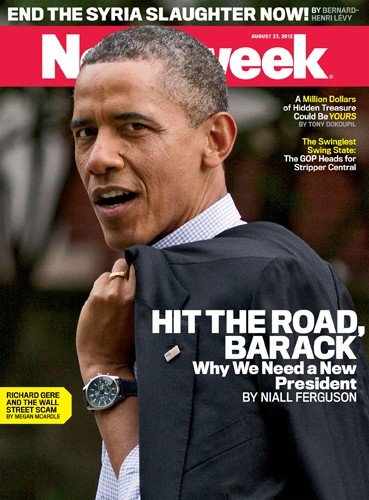
Prof. Niall Ferguson: Obama’s Gotta Go

Niall Ferguson, MA, D.Phil., is Laurence A. Tisch Professor of History at Harvard University. He is also a Senior Fellow at the Hoover Institution, Stanford University, and a Senior Research Fellow at Jesus College, Oxford.

His books include Paper and Iron: Hamburg Business and German Politics in the Era of Inflation 1897-1927 (1993), Virtual History: Alternatives and Counterfactuals (1997), The Pity of War: Explaining World War One (1998), The World’s Banker: The History of the House of Rothschild (1998), The Cash Nexus: Money and Power in the Modern World, 1700-2000 (2001), Empire: The Rise and Demise of the British World Order and the Lessons for Global Power (2003), Colossus: The Rise and Fall of the American Empire (2004), The War of the World: Twentieth-Century Conflict and the Descent of the West (2006) and The Ascent of Money: A Financial History of the World (2008).

Ferguson has written and presented five major television series, including The Ascent of Money, which won the 2009 International Emmy award for Best Documentary. His most recent books are High Financier: The Lives and Time of Siegmund Warburg (2010) and Civilization: The West and the Rest, also a major TV documentary series. Civilization will be published in the U.S. on November 1 and will air on PBS in 2012.

See our other Niall Ferguson coverage HERE.

Prof. Niall Ferguson:

Why does Paul Ryan scare the president so much? Because Obama has broken his promises, and it’s clear that the GOP ticket’s path to prosperity is our only hope.

I was a good loser four years ago. “In the grand scheme of history,” I wrote the day after Barack Obama’s election as president, “four decades is not an especially long time. Yet in that brief period America has gone from the assassination of Martin Luther King Jr. to the apotheosis of Barack Obama. You would not be human if you failed to acknowledge this as a cause for great rejoicing.”

Despite having been—full disclosure—an adviser to John McCain, I acknowledged his opponent’s remarkable qualities: his soaring oratory, his cool, hard-to-ruffle temperament, and his near faultless campaign organization.

Yet the question confronting the country nearly four years later is not who was the better candidate four years ago. It is whether the winner has delivered on his promises. And the sad truth is that he has not.

In his inaugural address, Obama promised “not only to create new jobs, but to lay a new foundation for growth.” He promised to “build the roads and bridges, the electric grids, and digital lines that feed our commerce and bind us together.” He promised to “restore science to its rightful place and wield technology’s wonders to raise health care’s quality and lower its cost.” And he promised to “transform our schools and colleges and universities to meet the demands of a new age.” Unfortunately the president’s scorecard on every single one of those bold pledges is pitiful.

In an unguarded moment earlier this year, the president commented that the private sector of the economy was “doing fine.” Certainly, the stock market is well up (by 74 percent) relative to the close on Inauguration Day 2009. But the total number of private-sector jobs is still 4.3 million below the January 2008 peak. Meanwhile, since 2008, a staggering 3.6 million Americans have been added to Social Security’s disability insurance program. This is one of many ways unemployment is being concealed.

In his fiscal year 2010 budget—the first he presented—the president envisaged growth of 3.2 percent in 2010, 4.0 percent in 2011, 4.6 percent in 2012. The actual numbers were 2.4 percent in 2010 and 1.8 percent in 2011; few forecasters now expect it to be much above 2.3 percent this year.

Unemployment was supposed to be 6 percent by now. It has averaged 8.2 percent this year so far. Meanwhile real median annual household income has dropped more than 5 percent since June 2009. Nearly 110 million individuals received a welfare benefit in 2011, mostly Medicaid or food stamps.

Welcome to Obama’s America: nearly half the population is not represented on a taxable return—almost exactly the same proportion that lives in a household where at least one member receives some type of government benefit. We are becoming the 50–50 nation—half of us paying the taxes, the other half receiving the benefits.

And all this despite a far bigger hike in the federal debt than we were promised. According to the 2010 budget, the debt in public hands was supposed to fall in relation to GDP from 67 percent in 2010 to less than 66 percent this year. If only. By the end of this year, according to the Congressional Budget Office (CBO), it will reach 70 percent of GDP. These figures significantly understate the debt problem, however. The ratio that matters is debt to revenue. That number has leapt upward from 165 percent in 2008 to 262 percent this year, according to figures from the International Monetary Fund. Among developed economies, only Ireland and Spain have seen a bigger deterioration.

Not only did the initial fiscal stimulus fade after the sugar rush of 2009, but the president has done absolutely nothing to close the long-term gap between spending and revenue.

His much-vaunted health-care reform will not prevent spending on health programs growing from more than 5 percent of GDP today to almost 10 percent in 2037. Add the projected increase in the costs of Social Security and you are looking at a total bill of 16 percent of GDP 25 years from now. That is only slightly less than the average cost of all federal programs and activities, apart from net interest payments, over the past 40 years. Under this president’s policies, the debt is on course to approach 200 percent of GDP in 2037—a mountain of debt that is bound to reduce growth even further.

And even that figure understates the real debt burden. The most recent estimate for the difference between the net present value of federal government liabilities and the net present value of future federal revenues—what economist Larry Kotlikoff calls the true “fiscal gap”—is $222 trillion.

The president’s supporters will, of course, say that the poor performance of the economy can’t be blamed on him. They would rather finger his predecessor, or the economists he picked to advise him, or Wall Street, or Europe—anyone but the man in the White House.

There’s some truth in this. It was pretty hard to foresee what was going to happen to the economy in the years after 2008. Yet surely we can legitimately blame the president for the political mistakes of the past four years. After all, it’s the president’s job to run the executive branch effectively—to lead the nation. And here is where his failure has been greatest.

On paper it looked like an economics dream team: Larry Summers, Christina Romer, and Austan Goolsbee, not to mention Peter Orszag, Tim Geithner, and Paul Volcker. The inside story, however, is that the president was wholly unable to manage the mighty brains—and egos—he had assembled to advise him.

According to Ron Suskind’s book Confidence Men, Summers told Orszag over dinner in May 2009: “You know, Peter, we’re really home alone … I mean it. We’re home alone. There’s no adult in charge. Clinton would never have made these mistakes [of indecisiveness on key economic issues].” On issue after issue, according to Suskind, Summers overruled the president. “You can’t just march in and make that argument and then have him make a decision,” Summers told Orszag, “because he doesn’t know what he’s deciding.” (I have heard similar things said off the record by key participants in the president’s interminable “seminar” on Afghanistan policy.)

This problem extended beyond the White House. After the imperial presidency of the Bush era, there was something more like parliamentary government in the first two years of Obama’s administration. The president proposed; Congress disposed. It was Nancy Pelosi and her cohorts who wrote the stimulus bill and made sure it was stuffed full of political pork. And it was the Democrats in Congress—led by Christopher Dodd and Barney Frank—who devised the 2,319-page Wall Street Reform and Consumer Protection Act (Dodd-Frank, for short), a near-perfect example of excessive complexity in regulation. The act requires that regulators create 243 rules, conduct 67 studies, and issue 22 periodic reports. It eliminates one regulator and creates two new ones.

It is five years since the financial crisis began, but the central problems—excessive financial concentration and excessive financial leverage—have not been addressed.

Today a mere 10 too-big-to-fail financial institutions are responsible for three quarters of total financial assets under management in the United States. Yet the country’s largest banks are at least $50 billion short of meeting new capital requirements under the new “Basel III” accords governing bank capital adequacy.

And then there was health care. No one seriously doubts that the U.S. system needed to be reformed. But the Patient Protection and Affordable Care Act (ACA) of 2010 did nothing to address the core defects of the system: the long-run explosion of Medicare costs as the baby boomers retire, the “fee for service” model that drives health-care inflation, the link from employment to insurance that explains why so many Americans lack coverage, and the excessive costs of the liability insurance that our doctors need to protect them from our lawyers.

Ironically, the core Obamacare concept of the “individual mandate” (requiring all Americans to buy insurance or face a fine) was something the president himself had opposed when vying with Hillary Clinton for the Democratic nomination. A much more accurate term would be “Pelosicare,” since it was she who really forced the bill through Congress.

Pelosicare was not only a political disaster. Polls consistently showed that only a minority of the public liked the ACA, and it was the main reason why Republicans regained control of the House in 2010. It was also another fiscal snafu. The president pledged that health-care reform would not add a cent to the deficit. But the CBO and the Joint Committee on Taxation now estimate that the insurance-coverage provisions of the ACA will have a net cost of close to $1.2 trillion over the 2012–22 period.

The president just kept ducking the fiscal issue. Having set up a bipartisan National Commission on Fiscal Responsibility and Reform, headed by retired Wyoming Republican senator Alan Simpson and former Clinton chief of staff Erskine Bowles, Obama effectively sidelined its recommendations of approximately $3 trillion in cuts and $1 trillion in added revenues over the coming decade. As a result there was no “grand bargain” with the House Republicans—which means that, barring some miracle, the country will hit a fiscal cliff on Jan. 1 as the Bush tax cuts expire and the first of $1.2 trillion of automatic, across-the-board spending cuts are imposed. The CBO estimates the net effect could be a 4 percent reduction in output.

The failures of leadership on economic and fiscal policy over the past four years have had geopolitical consequences. The World Bank expects the U.S. to grow by just 2 percent in 2012. China will grow four times faster than that; India three times faster. By 2017, the International Monetary Fund predicts, the GDP of China will overtake that of the United States.

Meanwhile, the fiscal train wreck has already initiated a process of steep cuts in the defense budget, at a time when it is very far from clear that the world has become a safer place—least of all in the Middle East.

For me the president’s greatest failure has been not to think through the implications of these challenges to American power. Far from developing a coherent strategy, he believed—perhaps encouraged by the premature award of the Nobel Peace Prize—that all he needed to do was to make touchy-feely speeches around the world explaining to foreigners that he was not George W. Bush.

In Tokyo in November 2009, the president gave his boilerplate hug-a-foreigner speech: “In an interconnected world, power does not need to be a zero-sum game, and nations need not fear the success of another … The United States does not seek to contain China … On the contrary, the rise of a strong, prosperous China can be a source of strength for the community of nations.” Yet by fall 2011, this approach had been jettisoned in favor of a “pivot” back to the Pacific, including risible deployments of troops to Australia and Singapore. From the vantage point of Beijing, neither approach had credibility.

His Cairo speech of June 4, 2009, was an especially clumsy bid to ingratiate himself on what proved to be the eve of a regional revolution. “I’m also proud to carry with me,” he told Egyptians, “a greeting of peace from Muslim communities in my country: Assalamu alaikum … I’ve come here … to seek a new beginning between the United States and Muslims around the world, one based … upon the truth that America and Islam are not exclusive and need not be in competition.”

Believing it was his role to repudiate neoconservatism, Obama completely missed the revolutionary wave of Middle Eastern democracy—precisely the wave the neocons had hoped to trigger with the overthrow of Saddam Hussein in Iraq. When revolution broke out—first in Iran, then in Tunisia, Egypt, Libya, and Syria—the president faced stark alternatives. He could try to catch the wave by lending his support to the youthful revolutionaries and trying to ride it in a direction advantageous to American interests. Or he could do nothing and let the forces of reaction prevail.

In the case of Iran he did nothing, and the thugs of the Islamic Republic ruthlessly crushed the demonstrations. Ditto Syria. In Libya he was cajoled into intervening. In Egypt he tried to have it both ways, exhorting Egyptian President Hosni Mubarak to leave, then drawing back and recommending an “orderly transition.” The result was a foreign-policy debacle. Not only were Egypt’s elites appalled by what seemed to them a betrayal, but the victors—the Muslim Brotherhood—had nothing to be grateful for. America’s closest Middle Eastern allies—Israel and the Saudis—looked on in amazement.

“This is what happens when you get caught by surprise,” an anonymous American official told The New York Times in February 2011. “We’ve had endless strategy sessions for the past two years on Mideast peace, on containing Iran. And how many of them factored in the possibility that Egypt moves from stability to turmoil? None.”

Remarkably the president polls relatively strongly on national security. Yet the public mistakes his administration’s astonishingly uninhibited use of political assassination for a coherent strategy. According to the Bureau of Investigative Journalism in London, the civilian proportion of drone casualties was 16 percent last year. Ask yourself how the liberal media would have behaved if George W. Bush had used drones this way. Yet somehow it is only ever Republican secretaries of state who are accused of committing “war crimes.”

The real crime is that the assassination program destroys potentially crucial intelligence (as well as antagonizing locals) every time a drone strikes. It symbolizes the administration’s decision to abandon counterinsurgency in favor of a narrow counterterrorism. What that means in practice is the abandonment not only of Iraq but soon of Afghanistan too. Understandably, the men and women who have served there wonder what exactly their sacrifice was for, if any notion that we are nation building has been quietly dumped. Only when both countries sink back into civil war will we realize the real price of Obama’s foreign policy.

America under this president is a superpower in retreat, if not retirement. Small wonder 46 percent of Americans—and 63 percent of Chinese—believe that China already has replaced the U.S. as the world’s leading superpower or eventually will.

It is a sign of just how completely Barack Obama has “lost his narrative” since getting elected that the best case he has yet made for reelection is that Mitt Romney should not be president. In his notorious “you didn’t build that” speech, Obama listed what he considers the greatest achievements of big government: the Internet, the GI Bill, the Golden Gate Bridge, the Hoover Dam, the Apollo moon landing, and even (bizarrely) the creation of the middle class. Sadly, he couldn’t mention anything comparable that his administration has achieved.

Now Obama is going head-to-head with his nemesis: a politician who believes more in content than in form, more in reform than in rhetoric. In the past days much has been written about Wisconsin Congressman Paul Ryan, Mitt Romney’s choice of running mate. I know, like, and admire Paul Ryan. For me, the point about him is simple. He is one of only a handful of politicians in Washington who is truly sincere about addressing this country’s fiscal crisis.

Over the past few years Ryan’s “Path to Prosperity” has evolved, but the essential points are clear: replace Medicare with a voucher program for those now under 55 (not current or imminent recipients), turn Medicaid and food stamps into block grants for the states, and—crucially—simplify the tax code and lower tax rates to try to inject some supply-side life back into the U.S. private sector. Ryan is not preaching austerity. He is preaching growth. And though Reagan-era veterans like David Stockman may have their doubts, they underestimate Ryan’s mastery of this subject. There is literally no one in Washington who understands the challenges of fiscal reform better.

Just as importantly, Ryan has learned that politics is the art of the possible. There are parts of his plan that he is understandably soft-pedaling right now—notably the new source of federal revenue referred to in his 2010 “Roadmap for America’s Future” as a “business consumption tax.” Stockman needs to remind himself that the real “fairy-tale budget plans” have been the ones produced by the White House since 2009.

I first met Paul Ryan in April 2010. I had been invited to a dinner in Washington where the U.S. fiscal crisis was going to be the topic of discussion. So crucial did this subject seem to me that I expected the dinner to happen in one of the city’s biggest hotel ballrooms. It was actually held in the host’s home. Three congressmen showed up—a sign of how successful the president’s fiscal version of “don’t ask, don’t tell” (about the debt) had been. Ryan blew me away. I have wanted to see him in the White House ever since.

It remains to be seen if the American public is ready to embrace the radical overhaul of the nation’s finances that Ryan proposes. The public mood is deeply ambivalent. The president’s approval rating is down to 49 percent. The Gallup Economic Confidence Index is at minus 28 (down from minus 13 in May). But Obama is still narrowly ahead of Romney in the polls as far as the popular vote is concerned (50.8 to 48.2) and comfortably ahead in the Electoral College. The pollsters say that Paul Ryan’s nomination is not a game changer; indeed, he is a high-risk choice for Romney because so many people feel nervous about the reforms Ryan proposes.

Mitt Romney is not the best candidate for the presidency I can imagine. But he was clearly the best of the Republican contenders for the nomination. He brings to the presidency precisely the kind of experience—both in the business world and in executive office—that Barack Obama manifestly lacked four years ago. (If only Obama had worked at Bain Capital for a few years, instead of as a community organizer in Chicago, he might understand exactly why the private sector is not “doing fine” right now.) And by picking Ryan as his running mate, Romney has given the first real sign that—unlike Obama—he is a courageous leader who will not duck the challenges America faces.

The voters now face a stark choice. They can let Barack Obama’s rambling, solipsistic narrative continue until they find themselves living in some American version of Europe, with low growth, high unemployment, even higher debt—and real geopolitical decline.

Or they can opt for real change: the kind of change that will end four years of economic underperformance, stop the terrifying accumulation of debt, and reestablish a secure fiscal foundation for American national security.

I’ve said it before: it’s a choice between les États Unis and the Republic of the Battle Hymn.

I was a good loser four years ago. But this year, fired up by the rise of Ryan, I want badly to win.
So of course, leftist bloggers had a cow, tried to get Prof. Ferguson fired etc, all without actually responding to his core arguments. They try to nitpick and vilify. The tactics of the far left have not changed in decades. They are in fact, laughable.

Prof Ferguson responds:

“We know no spectacle so ridiculous,” Lord Macaulay famously wrote, “as the British public in one of its periodical fits of morality.” But the spectacle of the American liberal blogosphere in one of its almost daily fits of righteous indignation is not so much ridiculous as faintly sinister. Why? Because what I have encountered since the publication of my Newsweek article criticizing President Obama looks suspiciously like an orchestrated attempt to discredit me.

My critics have three things in common. First, they wholly fail to respond to the central arguments of the piece. Second, they claim to be engaged in “fact checking,” whereas in nearly all cases they are merely offering alternative (often silly or skewed) interpretations of the facts. Third, they adopt a tone of outrage that would be appropriate only if I had argued that, say, women’s bodies can somehow prevent pregnancies in case of “legitimate rape.”

Their approach is highly effective, and I must remember it if I ever decide to organize an intellectual witch hunt. What makes it so irksome is that it simultaneously dodges the central thesis of my piece and at the same time seeks to brand me as a liar. The icing on the cake has been the attempt by some bloggers to demand that I be sacked not just by Newsweek but also by Harvard University, where I am a tenured professor. It is especially piquant to read these demands from people who would presumably defend academic freedom in the last ditch—provided it is the freedom to publish opinions in line with their own ideology.

***

Let me begin by restating my argument. President Obama should be judged on his record in office. In my view, he has not only failed to live up to the high expectations of those who voted for him, but also to the pledges he made in his inaugural address. (In order to be fair, I deliberately did not judge his performance against his campaign pledges.) The economy has performed less well than the White House led us to expect, despite a bigger increase in national debt than it led us to expect (exhibit 1).

1. FY2010 Budget and Outcomes / Latest Projections

Source

Note, however, that I cut the president some slack on the economy. He inherited a bigger mess than most people appreciated back in November 2008. And forces beyond his control (Europe) have clearly dampened the recovery. Here’s what I wrote:

It was pretty hard to foresee what was going to happen to the economy in the years after 2008. Yet surely we can legitimately blame the president for the political mistakes of the past four years. After all, it’s the president’s job to run the executive branch effectively—to lead the nation. And here is where his failure has been greatest.

Notice, then, that my central critique of the president is not that the economy has underperformed, but that he has not been an effective leader of the executive branch. I go on to detail his well-documented difficulties in managing his team of economic advisers and his disastrous decision to leave it to his own party in Congress to define the terms of his stimulus, financial reform, and health-care reform. I also argue that he has consistently failed to address the crucial issue of long-term fiscal balance, with the result that the nation is now hurtling toward a fiscal cliff of tax hikes and drastic spending cuts.

The second part of my argument is that these failures of domestic leadership have fed into a failure of foreign policy. As commander in chief, President Obama has earned a relatively strong public reputation mainly thanks to a campaign of assassination that liberal bloggers would have excoriated if it had been conducted by his predecessor. His withdrawal of U.S. forces from Iraq and Afghanistan will, in my view, prove to have been premature. More importantly, he has been indecisive in his responses to the revolutionary wave that has swept the Middle East since the Iranian “green” revolution of 2009. And, finally, he has been inconsistent and ineffective in his handling of the major strategic challenge of our times, the rise of China. (By the way, I base these judgments on a great many off-the-record conversations with influential policy-makers here and abroad. When a very senior military man asks you: “Have we any global strategy beyond just trying to hang on?,” you have a right to wonder if the answer might be “No.”)

I concluded by arguing that, for all these reasons, voters would be better advised to vote for Mitt Romney, especially now that he has picked Paul Ryan as his running mate. (Repeat disclosure: I made it clear in the piece that I was a John McCain supporter four years ago and am a friend of Ryan’s.)

So much for my argument, which not one of my critics has addressed. Instead, they have unleashed a storm of nit-picking and vilification. Well, let’s start with the nits.

I have already dealt with Paul Krugman’s opening salvo on the effects of the Affordable Care Act on the deficit. The point (still not grasped by Andrew Sullivan, who thinks I was just talking about the gross costs) is that the net effect of ACA on the deficit is not positive if you look at the likely costs and the likely revenues from the tax hikes that will finance it. To get to the Congressional Budget Office’s conclusion that, over 10 years, the ACA will reduce the deficit, you need to believe that the act will half the rate of growth of Medicare costs. I am not inclined to be optimistic about that.

Incidentally, while we are on the subject of the CBO’s projections, since March 2010 it has already increased its estimate of the gross costs over 10 years from $944 billion to $1,856 billion, its estimate of total revenue from $631 billion to $1,221 billion, and its estimate of total Medicare cuts from $454 billion to $743 billion. This really is a fast-moving target.

But the clincher is the CBO’s latest long-run budget forecast, according to which total federal government expenditure on health care is projected to rise from 4.9 percent of GDP this year to between 13.8 and 15.1 percent in 75 years’ time (see exhibit 2). The two scenarios the CBO presents imply either a massive tax hike, taking federal revenues from 15.8 to 29.8 percent of GDP, or a massive rise in the debt, to above 250 percent of GDP.

2. Health-Care Spending Projections

Matthew O’Brien followed up Krugman with “A Full Fact-Check.” Actually, this isn’t actually a fact check because O’Brien doesn’t successfully identify a single error. He just offers his own opinions.

Let’s take all 11 of them one by one. (It’s boring, I know, but necessary.)

1. NF: The total number of private-sector jobs is still 4.3 million below the January 2008 peak.

MO’B: The private sector has actually added jobs since Obama was sworn in.

Both these statements are true. I picked the high point of January 2008 because it seems to me reasonable to ask how much of the ground lost in the crisis have we actually made up under Obama. The answer is not much. You may not like that, but it’s a fact (exhibit 3).

3. Total Private Employment From the Current Employment Statistics Survey (National)

2. NF: Meanwhile real median annual household income has dropped more than 5 percent since June 2009.

MO’B: I can’t replicate this result. It’s difficult, because Ferguson does not cite his source.

Well, either Newsweek starts publishing footnotes or Matthew O’Brien reads a little more widely than just official statistics, which generally lag months behind. The monthly data for Median Household Income Index (HII) is produced by Sentier (exhibit 4).

4. Real Median Household Income, 2000–2012

3. NF: Nearly half the population is not represented on a taxable return–—almost exactly the same proportion that lives in a household where at least one member receives some type of government benefit.

MO’B: It is true that 46 percent of households did not pay federal income tax in 2011.

In other words, my fact is true. Because I specifically said “taxable return.” You don’t tend to record your sales tax payments on those.

4. NF: By the end of this year, according to the Congressional Budget Office (CBO), [debt-to-GDP ratio] will reach 70 percent of GDP. These figures significantly understate the debt problem, however. The ratio that matters is debt to revenue. That number has leapt upward from 165 percent in 2008 to 262 percent this year, according to figures from the International Monetary Fund.

MO’B: This is incorrect. Ferguson had it right the first time—the number that matters is debt-to-GDP, not debt-to-revenue. The former reflects our capacity to pay; the latter our willingness to pay right now.

Again, O’Brien is offering here an opinion as a fact. He should read my book The Cash Nexus (2001) to understand why he doesn’t know what he is talking about. Governments don’t pay interest and redemption with GDP but with tax revenues. If it were easy to increase the tax share of GDP, we wouldn’t be heading for a fiscal cliff. My numbers are correct and can be checked using the IMF’s World Economic Outlook online database.

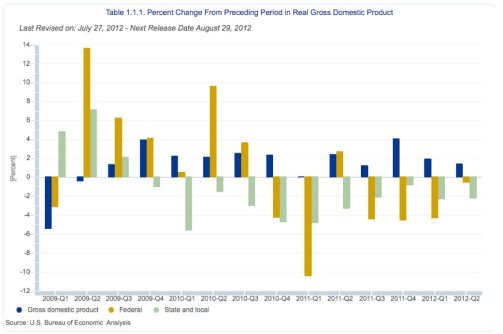
5. NF: Not only did the initial fiscal stimulus fade after the sugar rush of 2009, but the president has done absolutely nothing to close the long-term gap between spending and revenue.

MO’B: Ferguson wasn’t always a critic of the stimulus. Back in August 2009, he wrote that “the stimulus clearly made a significant contribution to stabilizing the U.S. economy.”

This earlier statement does not contradict my article. As anyone who looks at the data knows, the stimulus had a positive but very short-run impact and failed to achieve self-sustaining growth in the way Keynesians hoped (exhibit 5).
6. NF: The most recent estimate for the difference between the net present value of federal government liabilities and the net present value of future federal revenues—what economist Larry Kotlikoff calls the true “fiscal gap”—-is $222 trillion.

MO’B: That’s a lot of trillions! But if our fiscal gap is “really” this many trillions, why can we borrow for 30 years for a real rate of 0.64 percent? It’s because this number is meaningless.

Well, O’Brien is welcome to share his opinion with Larry Kotlikoff, the world’s leading authority on generational accounting and long-term fiscal stability. What he can’t claim is that my statement is factually inaccurate. As for the argument that current low borrowing costs mean we don’t need to worry about the debt—which is like saying that mortgage default rates in 2006 meant we didn’t need to worry about subprime—that has been comprehensively demolished in a new paper by Carmen and Vincent Reinhart and Ken Rogoff.

7. NF: The country’s largest banks are at least $50 billion short of meeting new capital requirements under the new ‘Basel III’ accords governing bank capital adequacy.

MO’B: This would be damning if we had already fully implemented the Basel III bank rules. We have not.

But I didn’t say that we had already implemented Basel III. So that’s another fact “checked” and found to be … correct.

8. NF: The Patient Protection and Affordable Care Act (ACA) of 2010 did nothing to address the core defects of the system: the long-run explosion of Medicare costs as the baby boomers retire, the “fee for service” model that drives health-care inflation, the link from employment to insurance that explains why so many Americans lack coverage, and the excessive costs of the liability insurance that our doctors need to protect them from our lawyers.

MO’B: There are reasons to think the ACA will fail to address the core defects of the health care system. But it’s wrong to say it does nothing to address them. Here’s a partial list of the things Obamacare does. It tackles the long-run explosion of Medicare costs. It tries to move away from the fee-for-service model that drives healthcare inflation. And it cuts the link between employment and insurance.

Now let’s check O’Brien’s facts. So the ACA “tackles the long-run explosion of Medicare costs.” Right. That’s why the net cost of Medicare is still projected by the CBO to treble from 3.2 percent of GDP to between 9 and 10 percent by 2087.

9. NF: Having set up a bipartisan National Commission on Fiscal Responsibility and Reform, headed by retired Wyoming Republican senator Alan Simpson and former Clinton chief of staff Erskine Bowles, Obama effectively sidelined its recommendations of approximately $3 trillion in cuts and $1 trillion in added revenues over the coming decade. As a result there was no “grand bargain” with the House Republicans—which means that, barring some miracle, the country will hit a fiscal cliff on Jan. 1 …

MO’B: Now, Obama did not push Congress to adopt Simpson-Bowles, but neither did Congress adopt it.

So that’s another fact “checked” and found to be correct. And if you want to gauge the president’s share of the responsibility for the failure of a fiscal grand bargain, read Matt Bai in The New York Times.

10. NF: The World Bank expects the U.S. to grow by just 2 percent in 2012. China will grow four times faster than that; India three times faster. By 2017 the International Monetary Fund predicts, the GDP of China will overtake that of the United States.

MO’B: China has 1.3 billion people. The United States has 300 million people. China’s GDP will pass ours when they are only four times poorer than us. That might happen in 2017; it might happen later … It doesn’t really matter if and when this happens. There’s nothing Obama can do to prevent China from catching up—nor should Obama want to!

Well, there you have it. It “doesn’t really matter” that for the first time since the 1880s the United States is about to cease being the world’s largest economy. Fact checked, found to be correct, and countered with an utterly naive opinion.

11. NF: In his notorious “you didn’t build that” speech, Obama listed what he considers the greatest achievements of big government: the Internet, the GI Bill, the Golden Gate Bridge, the Hoover Dam, the Apollo moon landing, and even (bizarrely) the creation of the middle class. Sadly, he couldn’t mention anything comparable that his administration has achieved.

MO’B: It’s bizarre that Ferguson thinks government policies didn’t help create America’s middle class. America was the first country to make high school compulsory.

Fact checked and—oh no! I really did get that wrong. It was the government that created the middle class, as well as the Golden Gate Bridge! Remind me to tell Karl Marx about this. It will come as news to him that, contrary to his life’s work, the superstructure in fact created the base. (Come to think of it, this is going to come as shock to a lot of American liberals too. Imagine! The state actually created the bourgeoisie! Who knew?)

***

Now, we come to the third part of the strategy. First, duck the argument. Second, nitpick. Third, vilify.

First prize goes to Berkeley professor Brad DeLong, whose blog opened with the headline “Fire-His-Ass-Now.” “He lied,” rants DeLong. “Convene a committee at Harvard to examine whether he has the moral character to teach at a university.” My own counter-suggestion would be to convene a committee at Berkeley to examine whether or not Professor DeLong is spending too much of his time blogging when he really should be conducting serious research or teaching his students. For example, why hasn’t Professor DeLong published that economic history of the 20th century he’s been promising for the past six years? It can’t be writer’s block, that’s for sure.

Runner up is James Fallows of The Atlantic for his hilariously pompous post “As a Harvard Alum, I Apologize.” Well, as an Oxford alum, I laugh.

In third place comes Krugman with his charge of “unethical commentary … a plain misrepresentation of the facts” requiring “an abject correction.” The idea of getting a lesson from Paul Krugman about the ethics of commentary is almost as funny as Fallows’s apologizing on behalf of Harvard. Both these paragons of the commentariat, by the way, shamelessly accused me of racism three years ago when I drew an innocent parallel between President Obama and “Felix the Cat.” I don’t know of many more unethical tricks than to brand someone who criticizes the president a racist.

And, finally, a consolation prize for righteous indignation goes to Dylan Byers of Politico (“ridiculous, misleading, ethically questionable”).

I could, of course, go on. By tonight there will doubtless be more. The art of the modern witch hunt is to get as many like-minded bloggers as possible to repeat and preferably exaggerate the claims until finally it becomes received opinion that you are on the brink of being fired and indeed deported in chains.

I don’t usually waste time on this kind of thing. In the Internet age, you can spend one week writing a piece and the next three responding to criticism, most of it (as we have seen) worthless.

But there comes a point when you have to ask yourself: has the American public sphere so degenerated that it is now impossible to make the case for a change of president without being set upon in cyberspace by a suspiciously well-organized gang of the current incumbent’s most ideologically committed supporters?

Now that really would be something to dislike about this country.

Larry Pratt: Gun control creates victims

Larry Pratt in the Washington Times:

The nation has witnessed two very high-profile shootings in recent weeks — one at a Colorado theater and another at a Sikh temple in Wisconsin.

While gun-control fanatics have jumped on these events to promote their cause, the truth is that each of these tragic incidents demonstrates the failure of gun control.

In Colorado, the Century 16 theaters in Aurora are “gun free” zones where people are prohibited from carrying weapons for self-defense.

If this sad scenario sounds familiar, it should — as almost every large-scale massacre in this country has occurred in an area where guns are outlawed: Columbine High School, Virginia Tech, Fort Hood, etc.

In all of these shootings, the victims were disarmed by law or regulation — yes, even at Fort Hood. They were made mandatory victims by restrictions that never stop the bad guys from getting or using guns.

In Wisconsin, Wade Michael Page bought his guns legally at a gun store before killing six people at a Sikh temple. This underscores the obvious: No background check in the world can stop a hate-filled person like Page, who had a clean record, from acquiring firearms. Nor can the checks stop determined criminals, who only have to acquire fake IDs to conceal their identities.

In fact, many countries that have much stricter gun controls than the United States have failed to prevent gun-related massacres from occurring. In Norway last year, 69 people were gunned down by one person. In England, a taxi driver used an illegal gun to murder 12 people in 2010.

Those shootings are just the tip of the iceberg, as massacres have occurred all over the world in gun-control havens.

Nevertheless, some think curtailing our “easy access to firearms” will make us safer. If that were true, how does one explain El Paso, Texas, which was ranked by CQ Press as America’s safest big city in 2010 — even though residents there can carry concealed firearms (and live quite peacefully)?

Right across the border, Juarez City, Mexico, has very stringent gun-control laws and one of the highest murder rates in the world. Any sensible person would choose El Paso over the “gun free” zone in Juarez.

Despite these obvious lessons, there have been calls on Capitol Hill to punish the millions of American citizens who have not — and will not — ever commit crimes. Among other things, gun-control advocates want to limit the size of magazines, arguing, “No one needs that many rounds of ammunition.”

This is a dangerous argument. If we turn the Bill of Rights into a “Bill of Needs,” our liberties will be short-lived for sure. After all, who needs the dozens of newspapers and magazines that line the shelves of supermarkets? Or who needs a car that drives more than 100 mph?

Still, some ask, who really needs a magazine that holds lots of ammunition? How about the displaced people who, in the wake of Hurricane Katrina in 2005, had to fend for themselves against roving gangs?

How about the Korean merchants who armed themselves with “assault” weapons and large-capacity magazines during the Los Angeles riots in 1992? Their stores remained standing while others around them burned to the ground.

This shows that when one is facing gang or mob violence and the police are nowhere to be found (as occurred in both examples above) you need more than just a six-shooter. There are, literally, millions of examples where good people had to protect themselves long before the police could reach them.

Take the shooting at the New Life Church in Colorado Springs in 2007. A gunman armed with 1,000 rounds of ammunition entered the church intending to commit the greatest slaughter on U.S. soil using a gun.

But he was able to kill just two people because he was met by an armed woman, Jeanne Assam, who used her concealed firearm to incapacitate the gunman, thus saving hundreds of lives at the church before the police could arrive.

Even recently, the nation has been treated to a couple of very dramatic self-defense shootings. One occurred at an Ocala, Fla., Internet cafe, the other at a jewelry store in Garden Grove, Calif.

In both cases, security cameras captured the shootings, and the videos show peaceful, armed people sending the bad guys fleeing — even tripping over themselves — as they storm out the door.

All of this shows that gun owners want politicians to focus their efforts on punishing bad guys and to leave their guns alone.

Voters do not vote for gun control. This was President Bill Clinton’s conclusion after he lost control of Congress in 1994, and it was the conclusion of the Al Gore campaign after he lost his bid for the presidency in 2000.

According to polling organizations Rasmussen in 2007 and Gallup in 2009, more Americans oppose gun control than support it.

Considering all this data, any candidate who supports gun control should be asked the old Dirty Harry question: “Do you feel lucky, punk?”

Larry Pratt is executive director of Gun Owners of America. Erich Pratt, GOA’s director of communications, contributed to this article.

President of Poland: Obama Betrayed Us

It is true. In order to suck up to Putin for nothing in return, Obama scrapped a missile defense deal with Poland that our government had already promised. On top of that Obama has mistreated Poland at every opportunity.

I wrote about this on my old college blog back in 2009:

Obama Throws Allies Under the Bus: Scraps Missile Defense for Poland and Czech Republic. UPDATE – Poles and Czech’s say they have been betrayed! – LINK

Obama Lied about Reason to Renege on Eastern European Missile Shield – LINK


Heritage:

This week, Polish President Bronislaw Komorowski accused the Obama Administration of betrayal, saying, “Our mistake was that by accepting the American offer of a [missile defense] shield we failed to take into account the political risk associated with a change of president.… We paid a high political price. We do not want to make the same mistake again. We must have a missile system as an element of our defences.”

In 2009, President Obama cancelled the deal the U.S. had with Poland and the Czech Republic to build an interceptor site and radar that would provide protection of the U.S. homeland and allies from rogue ballistic missiles. Polish and Czech leaders took on the task of educating their populations of the necessity of defending their populations from Iranian missiles, of collaborating with the U.S. to do this, of having American soldiers on their territory, and—the hardest of all—that the blowback from Russia over the sites was worth it.

It is an American tradition—and not a uniquely Republican or Democratic one—to resolutely stand with America’s friends and confront, if necessary, those who threaten them. It was President John F. Kennedy who said, “Let every nation know, whether it wishes us well or ill, that we shall pay any price, bear any burden, meet any hardship, support any friend, oppose any foe to assure the survival and the success of liberty.”

The last several years, starting with the abandonment of the missile defense site, President Obama has taken the U.S. down a path that takes a sudden departure from this policy.

Taking Your Citizenship Seriously Is a Matter of Life and Death – UPDATED

by Chuck Norton

By happenstance I found myself helping a kind young lady get her car ready for a trip. I asked her where she was going and she said “Texas”. I asked “Anything fun?” and she  answered, “I hope so. I am going to a retreat for military widows”. Something had taken away my breath. Then she let it all come out. Her husband was killed in Iraq and she has two young children, the youngest never got to meet her father.

I was crushed.

Why?

I was in the military during the first Gulf War under President George H.W. Bush. This was my generation’s war and it didn’t seem right that this sweet young lady standing in front of me had to pay the price.

How is this related to citizenship?

During my time our military was in Iraq with 500,000 men led by General “Stormin'” Norman Schwarzkopf. We were in a MUCH better position to finish the job than President Bush the younger. But Bush the elder wanted to make the United Nations happy. You see the UN did not want to offend some Islamic countries by “allowing” the Christian United States oust an Arab dictator, no matter how bad he was. Since all George H.W. Bush could talk about in speeches was “the vision of the UN’s Founders” he complied with the UN and had our military pull out with the job unfinished.

Understand; “everyone” in the military knew that some day, some way, we would have to come back to finish the job. This was the topic of many a conversation between officer and enlisted alike.

President Bush the elder encouraged Saddam Hussien’s domestic enemies to try to oust him, but without our help they were simply outgunned. Saddam slaughtered many of the Kurds in the North and genocided the Marsh Arabs in the South. He want on a reign of terror rooting out his internal enemies. The result was hundreds of mass graves and it is estimated that his reign of terror resulted in 680,000 dead – and that is only counting Kurds and Shiites. Saddam went on to fund terrorist groups including the PLO and Al-Qaeda.

You cannot do evil and expect good to come of it. Take a moment to consider the suffering brought about by a decision to just make the easy choice.

George H.W. Bush was an “establishment guy”. The “establishment” GOP had always opposed Ronald Reagan and Reagan probably would have had a convention fight on his hands if he had rejected their insistence that George H.W. Bush be brought on to the ticket as Vice President. When Vice President Bush became President Bush (41) it did not take him long to abandon the Reagan legacy, raise taxes, get all “internationalist” on us and pretty much go back to big government business as usual, which is why he ended up being a one term president. So damaging was President Bush’s single term that even Mitt Romney was saying on television that “I don’t want to go back to the time of Reagan/Bush”.

It is my generation that let this happen and the consequences of our lazy citizenship was standing in front of me in the form of this sweet, heart broken young lady who is raising two children on her own. She told me of the fights she had with the VA and other benefits the government tried to deny her and her children. It took everything I had to hold back the tears. All I could do was apologize to her and take responsibility as I explained to her how my generation had dropped the ball. She graciously accepted my apology, but of course, she had figured out long ago the reality that had just hit me in the face.

Get along to go along, big government business as usual, can never be allowed to happen again. The consequences of allowing it to happen are dire and very real. I am grateful that a new generation of Americans is at trying to get the Republican Party back on track.

UPDATE – A reader sent us the following message:

Bigger factors were happening and had to be considered before we went against the UN mandate to get Iraq out of Kuwait. Don’t think if we would have gone in and removed him that the situation would have solved itself. WW3 was diverted by not going in in which saved thousands of lives. By containing him and restricting air space proved the best course of action. Remember at that time, The UN mandate was to get military forces out of Kuwait, not to overthrow a government. This was a joint action with members. ANY aggressive action with forces in the field would have prompted a HOLY war against western aggression. The surrounding countries to Iraq, were already at this time planning the breakup of Iraq and there oil reserves. This would have caused a power vacuum in the region as it did in the second gulf war. They knew this, so they avoided the aftermath by containment not invasion.

Also consider Israel which was another BIG factor in this. In the further study of tactics used and not used in desert storm need to be looked at but not by military means but by the other political, economical, territorial and cultural aspects of the region. The Pres did what he had to do and he did it.

Political Arena Editor responds – This was the spin and conventional thinking at the time, but as a matter of political science, and as a matter of history such a case is not very convincing. How often have “containment” policies stopped madmen from being madmen? With that said, while my piece was philosophical in nature, the challenge is more policy directed so I offered this policy response:

In other words, President H.W. Bush made a political decision to please the wrong people. Sir, there are five reasons in history, mostly recognized by international law, that cause a country to lose its sovereignty:

1 – If you invade other countries – /check

2 – If you screw around with the Nuclear Non-Proliferation Treaty (NNPT) – /check
3 – If you mass slaughter your own people – /check
4 – If you fund terrorism/piracy – /check5 – If you violate a cease fire agreement – which Saddam did later

And then Saddam invented a 6th – Mass eco-terrorism when he lit up the oil wells and made a huge mess that the rest of the world had to clean up.

It would have been better to let a few countries in “the coalition” drop off and finish the job. I was in the military during that time as well, and “everybody” knew that we would have to go back. Why? because it was obvious that letting such an evil to fester was going to be a problem; understanding this even at the time wasn’t rocket science. I got out of the military in ’94 and I cannot count how many conversations I had about when circumstances would cause us to come back and finish the job.

I am well aware that we asked Israel to stand down – the whole Israeli angle –  I get it. Sir it is called making a trough, but correct political decision when there are no “clean” answers.

The UN Mandate? Really? Really? Was this about defending an ally we had a treaty with (Kuwait) and preserving the Straight of Hormuz and preventing Saddam from invading Saudi Arabia and toppling the House of Saud – OR was it about trying to make the UN the super-sovereign?

So let us examine the consequences of President H.W. Bush’s decision and just look at what happened before the 2003 invasion.

1 – We left and Saddam wiped out the Marsh Arabs in the south (where was the UN then huh?)

2 – He made war on the pro-Western Kurds in the North of Iraq and even used chemical WMD’s on them – for which later we had to institute the no fly zone.

3 – Saddam continued to fund terror multiple terror groups including Al-Qaeda

4 – While Saddam destroyed and/or shipped out most of his WMD cache, he continued to actively pursue a long range missile program, preserved his WMD programs in static and was stockpiling raw materials in violation of the sanctions and the cease fire agreement, so he could go back into WMD production any time he wanted (I read the David Kay and Charles Duelfer Inspection Team Reports).

5 – After we left we encouraged elements inside Iraq to try and overthrow Saddam, but without much support from us, so they got wiped out. Saddam went on a purge that would have made Stalin green with envy. There are several estimates that Saddam killed up to 680,000 people he considered political enemies – NOTE – many of those people killed threw in their hat with us and/or were sympathetic to our first war with Iraq – and now they are in thousands of mass graves that are STILL being found to this day in Iraq. Of course there were also the political prisons and torture camps.

This is why history shows us time and time again that it is beyond foolish to let evil fester. I said this before the 2003 invasion and I am saying it now and I was far from the only one.

Quite simply – George H.W. Bush’s head was misguided from the get-go, his often stated desire of achieving the goals of the U.N.’s Founders was wrong headed to put it mildly. He broke the first rule of foreign policy, which is that there are no permanent allies, just permanent interests; and look at the good people who have been made to pay the price for that one very bad decision.

Newt Gingrich Defends Bachmann about Muslim Brotherhood and Huma Abedin (video)

Let us be clear. Huma Abadin  is not under allegation. Her brother is a big shot in the Egyptian Muslim Brotherhood (her mother is also a prominent figure) and has stated that the pyramids and such in Egypt should be blown up because they are idols and he says that all Christians are mentally ill – LINK  [Note – the source for this is Walid Shoebat who is an Arab Palestinian so claims that this is some sort of racist play is nonsense – Editor].  The Muslim Brotherhood wants Sharia Law through any means, be it an election, or take over by force in Jihad. They say so when speaking in their native language, but in English they talk about peace, love and social justice.

Why does it matter who her brother is? Because, according to security regulations which have been in place for decades, if you have had contact with an enemy or sworn enemy of an ally your security clearance is limited. The greater the contact the greater the limits. For national security reasons conflicts of interests have to be nipped in the bud. The question is, and this is just one question asked, why was she not properly vetted?

By the way, notice how agitated and hostile the clearly biased reporter from Politico is. This is just a single example of many why Politico has not well respected as a news organization.

Andrew C. McCarthy has two very informative articles on this issue that should be read before anyone can have a truly informed opinion on this issue:

Questions about Huma Abedin: A State Department adviser has ties to the Muslim Brotherhood – LINK

Huma Abedin’s Muslim Brotherhood Ties: Michele Bachmann has every right to ask questions – LINK

Note: Frank Gaffney and John Bolton also agree – LINK and the Center for Security Policy has a piece on this issue HERE.

Highest Ranking Soviet Defector: Marxism is on the rise again, and people are not paying attention…

Lt. Gen. Ion Mihai Pacepa:

“Communism is dead,” people shouted in 1989, when the Berlin Wall began to come down. Soviet Communism is indeed dead as a form of government. But Marxism is on the rise again, and people are not paying attention. Why not? Because most people do not seem to be familiar with the undercover forms of Marxism we are facing today.

Absolutely. When the wall came down 100,000 million dedicated communists didn’t suddenly become libertarians. They took over tax free foundations, took control of most public universities, environmental pressure groups, most union leadership positions and much of Hollywood. Not to mention the leadership of the Democratic Party.

I usually do not publish articles from WND, because what appears there is not as reliable as I would like, but some pieces there are still very good and this is one of them. This interview is an important piece of history so we are glad to help preserve it here.

WND:

Please tell me, did America win the Cold War? If so, why are we fighting Marxism in our own country today? And if not, what really happened?

Pacepa: Yes, we won the Cold War, but unlike other wars the Cold War did not end with an act of surrender and with the defeated enemy throwing down his weapons. But no, we are not fighting Marxism in our country, because the American people have not yet been warned that their country is being contaminated by Marxism. A few conservative luminaries like Glenn Beck, Rush Limbaugh and Bill O’Reilly have warned that Marxism is infecting the United States, but neither the Republicans’ “Pledge to America” nor the Tea Party’s “Contract from America” has mentioned the word Marxism.

So far, to the best of my knowledge, only your “Marxism, American-Style” (June 2012 Whistleblower magazine) and PJ Media’s “Say No To Socialism” have called attention to the looming dangers of Marxism, a heresy that killed some 94 million people and transformed a third of the world into feudal societies in the middle of the 20th century.

There is still a widely popular belief in the U.S. and Western Europe that the nefarious Marxist legacy was uprooted in 1991 when the Soviet Union was abolished, just as the Nazi legacy was extirpated in 1945 when World War II ended. That is simply wishful thinking. There is a considerable difference between these two historical events.

In the 1950s, when I headed Romania’s foreign intelligence station in West Germany, I witnessed how Hitler’s Third Reich had been demolished, its war criminals put on trial, its military and police forces disbanded and the Nazis removed from public office. I also saw how West Germany’s economy was being rebuilt with the help of Marshall Plan money and how the country had become a multi-party democracy and a close friend of the United States. In 1959, when I returned to Romania, West Germany’s Wirtschaftswunder (economic miracle) made it the leading industrial power in Europe.

None of those things have happened in the former Soviet Union. No individual has been put on trial, although its Marxist regime killed many more millions than the Nazis did. Most Soviet institutions, under new names, have been left in place and are now run by many of the same people who guided the Marxist state. The KGB and the Red Army, which instrumented the Cold War, have also remained in place with new nameplates at their doors.

“Communism is dead,” people shouted in 1989, when the Berlin Wall began to come down. Soviet Communism is indeed dead as a form of government. But Marxism is on the rise again, and people are not paying attention. Why not? Because most people do not seem to be familiar with the undercover forms of Marxism we are facing today.

Hiding the ugly face of Marxism behind a smiling mask has become a Marxist science, which I described in a large piece recently published in PJ Media. Here let me just say that until 1963, Marxism was mostly camouflaged as “socialism.” The 1962 missile crisis generated by the socialist República de Cuba gave the socialist mask of Marxism a dirty name in the West and few Marxists wanted to be openly associated with it anymore. They therefore began hiding their Marxism under a new cover called “economic determinism,” which became all the rage among leftists who no longer wanted to be labeled socialists.

Economic determinism is a theory of survival rooted in Marx’s “Manifesto” (another theory of survival), but it pretends that the economic organization of a society, not the class war, determines the nature of all other aspects of life. Over the years, economic determinism has assumed different names. Khrushchev’s dogonyat i peregonyat (catching up with and overtaking the West in 10 years) and Gorbachev’s perestroika are the best known.

I wrote the script of Nicolae Ceausescu’s determinism, which was hidden behind the nickname “New Economic Order.” Most Americans, who are not used to dealing with undercover Marxists, have problems recognizing one. In April 1978, President Carter publicly hailed Ceausescu as a “great national and international leader who [had] taken on a role of leadership in the entire international community.” At the time, I was standing next to Ceausescu at the White House – and I just smiled.

Three months later, I was granted political asylum in the United States, and I informed President Carter how Ceausescu had been feeding him a pack of lies. The admiration for Ceausescu’s undercover Marxism had, however, taken on such a life of its own that the U.S. Congress, dominated by President Carter’s Democratic Party, brought the United States a sui-generis version of Ceausescu’s economic determinism. That move generated double-digit inflation. The U.S. prime rate hit 21.5 percent, the highest in U.S. history, and people had to spend long hours in line waiting to buy gas for their cars.

Laura D’Andrea Tyson, former chairman of the Council of Economic Advisers under President Clinton and later an economic adviser to President Obama, has kept that undercover Marxism alive in the U.S. She even wrote her Ph.D. dissertation on the merits of the allegedly “mixed” socialist-capitalist economies in Ceausescu’s Romania and Tito’s Yugoslavia. Two American presidents went to Bucharest to pay tribute to Ceausescu’s Marxism disguised as economic determinism. None had ever gone there before.

A few months ago, when the devastating economic crisis in Greece exploded, economic determinism lost credibility and our Democratic Party replaced it with “progressivism,” which is the current cover name for American Marxism. The real Progressive Movement was born after the U.S. financial crisis of 1893, which the country tried to solve by redistributing America’s wealth. The progressives pushed through the first federal income tax and they created a string of labor standards that opened up the floodgates of corruption and financial excess that generated the Great Depression. A new Progressive Movement, dubbed the New Deal, led to steep top tax rates, strict financial regulations, Social Security, Medicare and Medicaid, eventually generating the current economic crisis.

Today’s Progressive Movement was born in New York’s Zuccotti Park. It was first known as the “Occupy Wall Street” movement and advocated the abolition of “capitalist America.” The Democratic Party strongly embraced it and made “Progressive” its new byword. “God bless them,” House Minority Leader Nancy Pelosi told the U.S. Congress. “It’s young, it’s spontaneous, it’s focused and it’s going to be effective.”

WND: You have said, “In the Soviet Union, the KGB was a state within a state. Now the KGB is the state.” Please explain that.

Pacepa: General Aleksandr Sakharovsky, the Soviet gauleiter of Romania, who afterwards rose to head the almighty Soviet espionage service for 15 years of the Cold War, used to tell me that “every society reflects its own past.” Sakharovsky, who was a Russian to the marrow of his bones, believed that someday “our socialist camp” might wear an entirely different face, and that even the Communist Party might have become history, but that would not matter. The party was a foreign organism introduced by Lenin into the Russian body, and sooner or later it would be rejected. One thing, though, was certain to remain unchanged: “our gosbezopasnost” (the state security service).

Sakharovsky used to point out that “our gosbezopasnost” had kept Russia alive for the past 500 years, “our gosbezopasnost” would guide her helm for the next 500 years, “our gosbezopasnost” would win the war with “our main enemy, American Zionism,” and “our gosbezopasnost” would eventually make Russia the leader of the world.

Sakharovsky was right. Marxism triumphed in feudal Russia, which had been a police state since the 16th century’s Ivan the Terrible. There Marxism evolved into a secret samoderzhaviye or autocracy, the historical Russian form of one-man totalitarian dictatorship, in which the new Marxist tsar’s political police first exterminated the entire leadership of Lenin’s Communist Party and then, behind a facade of Marxism, quietly took precedence over the original tools of ideology and the Communist Party for running their country.

Only a handful of people working in extremely close proximity to the Soviet and East European rulers knew that after Lenin died his Communist Party gradually became a scramble of bureaucrats, playing no greater role in the Soviet Union than did Lenin’s embalmed corpse in the Kremlin mausoleum.

So far, Sakharovsky has proved to be a dependable prophet. His successor, Vladimir Kryuchkov, who later authored the August 1991 coup that briefly deposed Soviet leader Mikhail Gorbachev, clearly shared the same fanatical belief in gosbezopasnost. Kryuchkov’s successor, Yevgeny Primakov, who was an undercover KGB officer under Sakharovsky, rose to become Russia’s prime minister.

On Dec. 31, 1999, Russia’s first freely elected president, Boris Yeltsin, stunned the world by announcing his resignation.

“I shouldn’t be in the way of the natural course of history,” Yeltsin explained, speaking in front of a gaily decorated New Year’s tree and blue, red and white Russian flag with a golden Russian eagle.

“I understand that I must do it and Russia must enter the new millennium with new politicians, with new faces, with new intelligent, strong, energetic people.”

Yeltsin then signed a decree “On the execution of the powers of the Russian president,” which stated that under Article 92 Section 3 of the Russian Constitution, the power of the Russian president should be temporarily performed by Prime Minister Vladimir Putin.

Yeltsin also announced that a special presidential election would be held around March 27, 2000, and he made a strong appeal for people to vote for Putin, who was “a strong person worthy of becoming president.” For his part, the newly appointed president signed a decree pardoning Yeltsin, who was rumored to be connected to massive bribery scandals, “for any possible misdeeds” and granted him “total immunity” from being prosecuted (or even searched and questioned) for “any and all” actions committed while in office. Putin also gave Yeltsin a lifetime pension and a state dacha.

To me, that had all the appearances of a KGB palace putsch.

Indeed, as of June 2003, some 6,000 former KGB officers were holding positions in Russia’s central and regional governments. Among them:

Vladimir Putin, elected president of Russia; Vladimir Osipov, head of the Presidential Personnel Directorate; Sergey Ivanov, defense minister; Igor Sergeyevich Ivanov, minister of foreign affairs; Viktor Ivanov and Igor Sechin, deputy directors in the Presidential Administration; Vyacheslav Soltaganov, deputy secretary of the Security Council; Viktor Vasilyevich Cherkesov, chairman of the State Committee on Drug Trafficking; Vyacheslav Trubinkov, deputy foreign minister; Vladimir Kozlov, deputy media minister; Gennady Moshkov, first deputy transport minister; Nikolay Negodov, deputy transport minister; Vladimir Strzhalkovsky, deputy minister for economic development; Vladimir Makarov, Leonid Lobzenko and Igor Mezhakov, deputy chairmen of the State Customs Committee; Sergey Verevkin-Rokhalsky and Anatoly Sedov, deputy taxes and duties ministers; Anatoly Tsybulevsky and Vladimir Lazovsky, deputy directors of the of the Federal Tax Police Service; Alexander Grigoriev, general director of the Russian Agency for State Reserves; Alexander Spiridonov, deputy chairman of Russia’s Financial Monitoring Committee; Vladimir Kulakov, Voronezh governor; Viktor Maslov, Smolensk governor.

Can you imagine a democratic Germany run by Gestapo officers?

Putin is indeed trying to make Russia the first intelligence dictatorship in history. In 2004, nearly half of all top governmental positions were held by former officers of the KGB. The Soviet Union had had one KGB officer for every 428 citizens. In 2004, Russia had one intelligence officer for every 297 citizens.

A new generation of Russians is now struggling to demolish the barriers Soviet Marxism spent over 70 years erecting between themselves and the rest of the world, and to develop a new national identity. If history – including that of the last 22 years – is any guide, these Russians, who are now enjoying their regained nationalism, will not truly turn westward. They will struggle to rebuild a kind of an Old Russian Empire by inspiring themselves from old Russian traditions and by using old Russian ways and means.

This does not mean Russia cannot change, but for that to happen, it will need help. In order for us to help, we should first fully understand what is now going on behind the veil of secrecy that still surrounds the Kremlin. Man would not have learned to walk on the moon if he had not first studied what the moon was really made of and where it lay in the universe.

WND: Gen. Pacepa, you are credited with playing a pivotal role in waking up the Romanian people and inspiring the overthrow of the tyrant Nicolae Ceausescu. Why is it that a communist nation like Romania could hear and heed your message, but not America?

Pacepa: Emil Constantinescu, the second post-Communist president of Romania, once said:

The missiles that destroyed Communism were launched from Radio Free Europe, and this was Washington’s most important investment during the Cold War. I do not know whether the Americans themselves realize this now, seven years after the fall of Communism, but we understand it perfectly.

The serialization of my book “Red Horizons” by Radio Free Europe was just one of the missiles fired against the Romanian version of Marxism during the Cold War years. We need a kind of Radio Free America. Let’s hope that others, many others, will join our efforts to help the new generation of Americans – who have no longer been taught real history in schools and know little if anything about America’s 44 years of war against Marxism – to understand the deadly danger of this heresy.

American essayist George Santayana, an immigrant like me, used to say that those who cannot remember the past are condemned to repeat it. Let’s hope that others, many others, will help America understand this truism.

WND: Many Americans would roll their eyes at the phrase “Marxism in America,” even though with every passing year we are becoming more and more Marxist. Why are so many Americans so blind?

Pacepa: They are not blind. They just do not really know what Marxism is. Few Americans will roll their eyes hearing the world “Nazism.” Why? Because the hideous crimes committed by Nazism were publicly exposed and their main authors were publicly tried and hanged. Unfortunately, there was no trial of Communism, although this Marxist heresy had killed 10 times more people than Nazism killed. Nazi archives have been opened to the public, who could learn about Nazism’s atrocities from the horse’s mouth. Most Soviet archives are still sealed.

Stalin was famously quoted as saying: If it is not written, it did not happen. But Marxism did happen, it generated a dreadful empire of gulags and it spawned a 44-year Cold War. Let’s open that Pandora’s box. The United States of America is a unique country of freedom, built by people who came to this land of opportunity in search of religious, economic and personal freedom. Once Americans know the truth, they will never allow themselves to become puppets of Marxism.

WND: General, you were the head of Romania’s Presidential House – the equivalent in the U.S. of being White House chief of staff and director of the CIA, the FBI and the Department of Homeland Security – but you ultimately defected to the West. You radically changed, and gave your loyalty to America. What woke you up? What changed you?

Pacepa: Michelle Obama once confessed in front of television cameras broadcasting her statement worldwide: “For the first time in my adult life, I am proud of my country because it feels like hope is finally making a comeback.” When I was Michelle’s age I also liked to believe that history started with me. It took me a very long time to see the light. Power can generate blindness and it did in my case. It took me many more years to find the courage to renounce my exorbitantly luxurious existence and to face up to the truth about the hidden face of Marxism. Communist rulers have always been very generous with their spy chiefs – that is until they tire of them and kill them off.

It was noon when the U.S. military plane that was bringing me to freedom landed at Andrews Air Force Base outside of Washington, D.C., on that memorable July 28, 1978, and I was sitting up front in the cockpit with the pilots. It was a glorious, sunny day outside, which only magnified the fireworks popping off inside of me. For many, many years I had learned to hide my personal feelings. For that was the way of life in a Marxist society, where the government had its informants everywhere and where microphones covered you everyplace you went, from the office to the bedroom. But on that unforgettable day I had an overwhelming desire to dance around in a jig all by myself.

I was a free man! I was in America! The joy of finally becoming part of this magnanimous land of liberty, where nothing was impossible, was surpassed only by the joy of simply being alive.

It was my desperate hunger for freedom that woke me up.

WND: What will it take for Americans to wake up?

Pacepa: A “Campaign of Truth” like the one unleashed by President Harry Truman in 1950. I still keep the declassified version of his NSC 68/1950 on my desk. That 58-page document put together by the U.S. National Security Council set forth the strategy of exposing and containing Marxism and Soviet Communism.

“The issues that face us are momentous,” the document stated, “involving the fulfillment or destruction not only of this Republic but of civilization itself.” Truman reasoned that Marxism and Soviet Communism were the mortal enemies of freedom and religion – of all religions – and he believed their expansion could be stopped only “through a concerted effort” that would place the superiority and strength of what he called “truth and freedom” before the peoples of the world.

Marxism is now threatening our country again. Let’s unleash another Truman-style campaign of truth. Let’s remind the leaders of the Democratic Party that Truman was a Democrat. Let also remind them that John F. Kennedy, another Democrat, was ready to start a nuclear war in order to protect the United States from the danger of Marxism. And let’s remind America that the peace and freedom of the world depend on the economic power of United States and the united resolve of its public opinion, as was always the case.

If our capitalist economy and national unity go, so will our prosperity, our security and the peace of the world.

The 1993 Clinton Tax Increases Did Not Cause an Economic Boom…

The constant blurring of distinctions and the rewriting of history in political communications get really old.

The economy suffered after the Clinton tax increases and that is one reason why the Republican Revolution hit him in 1994 (along with gays in the military and HillaryCare which featured federal health care police with guns). Bill Clinton had campaigned on a tax cut to help get the economy growing again. He delivered just the opposite.

It is important to keep in mind that President Bush 41 went along with Democrats in increasing taxes in violation of his “read my lips no new taxes” promise. At the time Democrats praised President Bush saying “he had grown”, but when the tax increase resulted in a short 1-2 quarter recession the Democrats blasted him for reneging on his no new taxes pledge. Clinton ran against that tax increase and promised to lower them again.

But what about the Clinton economy and the surplus? Well that was in Clinton’s second term when Newt and the House Republicans balanced the budget, passed welfare reform over Clinton’s initial VETO threats and of course, the new GOP majority in Congress cut taxes.

Forbes:

The Dangerous Myth About the Clinton Tax Increase

One of the most dangerous myths that has infected the current debate over the direction of tax policy is the oft repeated claim that the tax increases under President Bill Clinton led to the boom of the 1990s.  In their Wall Street Journal Op-Ed last Friday, for example, Clinton campaign manager James Carville and Democratic pollster and Clinton advisor Stanley Greenberg write the increase in the top tax rate to 39.6% “produced the one period of shared prosperity in this past era (since 1980).”

While this myth is now a central part of liberal Democratic folklore, it is contradicted by the political disaster and poor economic results that followed the tax increase.  The real lesson of the Clinton Presidency is the way back to prosperity lies not through increased taxes on “the rich,” but through tax and regulatory reform and a return to a rules based monetary policy that produces a strong and stable dollar.

The 1993 Clinton tax increase raised the top two income tax rates to 36% and 39.6%, with the top rate hitting joint returns with incomes above $250,000 ($400,000 in 2012 dollars).  In addition, it removed the cap on the 2.9% Medicare payroll tax, raised the corporate tax rate to 35% from 34%, increased the taxable portion of Social Security benefits, and imposed a 4.3 cent per gallon increase in transportation fuel taxes.

If these tax increases were good for the middle class, then they should have been popular.  Yet, in the 1994 elections, the Democratic Party suffered historic losses. Even though Senate Majority Leader George Mitchell had declared the unpopular HillaryCare dead in September of that year, the Republican Party gained 54 seats in the House and 8 seats in the Senate to win control of both the House and the Senate for the first time since 1952.

Second, Messrs. Carville and Greenberg are contradicted by their former boss.  Speaking at a fund raiser in 1995, President Clinton said:  ”Probably there are people in this room still mad at me at that budget because you think I raised your taxes too much. It might surprise you to know that I think I raised them too much, too.”

During the first four years of his Presidency, real GDP growth average 3.2%, respectable relative to today’s economy, but disappointing coming as it did following just one year of recovery from the 1991 recession, the end of the Cold War and the reduction in consumer price inflation below 3% for the first time (with the single exception of 1986) since 1965.

For example, it was a half a percentage point slower than under Reagan during the four years following the first year of the recovery from the 1982 recession.

Employment growth was a respectable 2 million a year.  But real hourly wages continued to stagnate, rising only 2 cents to 7.43 an hour in 1996 from $7.41 in 1992.  No real gains for the middle class there.

However, with his masterful 1995 flip-flop on taxes, President Clinton took the first step toward a successful campaign for re-election and a shift in policy that produced the economic boom that occurred during his second term.

  • Welfare reform, which he signed in the summer of 1996, led to a massive reduction in the effective tax rates on the poor by ameliorating the rapid phase out of benefits associated with going to work.
  • The phased reduction in tariff and non-tariff barriers between the U.S., Mexico and Canada under the North American Free Trade Agreement continued, leading to increased trade.
  • In 1997, Clinton signed a reduction in the (audible liberal gasp) capital gains tax rate to 20% from 28%.
  • The 1997 tax cuts also included a phased in increase in the death tax exemption to $1 million from $600,000, and established Roth IRAs and increased the limits for deductible IRAs.
  • Annual growth in federal spending was kept to below 3%, or $57 billion.
  • The Clinton Administration also maintained its policy of a strong and stable dollar.  Over his entire second term, consumer price inflation averaged only 2.4% a year.

The boom was on.  Between the end of 1996 and the end of 2000:

  • Economic growth accelerated a full percentage point to 4.2% a year.
  • Employment growth nudged higher, to 2.1 million jobs per year as the unemployment rate fell to 4.0% from 5.4%.
  • As the tax rate on capital gains came down, real wages made their biggest advance since the implementation of the Reagan tax rate reductions in the mid 1980s.  Real average hourly earnings were (in 1982 dollars) $7.43 in 1996, $7.55 in 1997, $7.75 in 1998, $7.86 in 1999, and $7.89 in 2000.
  • Millions of Americans shared in the prosperity as the value of their 401(k)s climbed along with the stock market, which saw the price of the S&P 500 index rise 78%.
  • Revenue growth accelerated an astounding 59%, increasing on average $143 billion a year.  Combined with continued restraint on government spending, that produced a $198 billion budget surplus in 2000.

Shared prosperity indeed!  But one created not by raising tax rates on high income but not yet rich middle class families, and certainly not by raising the capital gains tax rate or by imposing the equivalent of the Buffett rule, a new alternative minimum tax of 30% on incomes over $1 million, nor by massively increasing federal spending.

Rather, it was a prosperity produced by freeing America’s poor from a punitive welfare system, lowering tariffs, reducing tax rates on the creators of wealth, limiting the growth of federal government expenditures, and providing a strong and stable dollar to businesses and families in America and throughout the world.

TWA Flight 800 16 Years Later….

This is not something I often talk about, nor am I one who buys into most conspiracy theories, but every once in a while such a theory has merit because the evidence is just too strong. In the interests of full disclosure this writer is an expert on the subject of airborne munitions. I have loaded and unloaded them, assembled and disassembled them, armed and disarmed them, repaired armament systems on military aircraft etc.

The government said that the plane was too high to be intercepted by a mobile ground to air missile – a lie.

The government said that a heat seeking missile would have gone after the engine – again another lie. In fact heat seeking missiles are designed to fly next to a specific temperature range as they intercept the target such as the heat from it going over the body of the aircraft so it can explode next to it and let the shrapnel weaken the airframe so that the stress of flight will cause the aircraft to break apart. Going after such a hot object as jet exhaust would allow the missile to be too easily fooled by countermeasures. I also saw a photo pf the aircraft that was put back together as best as possible by the recovery team and the damage to the plane is consistent with the shrapnel pattern of such a heat seeking missile.

President Clinton revoked the Whistle-blower Act for the military recovery team working the crash site. Boeing insists to this day that TWA 800 was shot down.

I am reposting this article from Jack Cashill here mainly to help preserve it.

Jack Cashill:

TWA Flight 800: 16 Years and Still No Questions

I got involved in one of the two great media scandals of our time — the Obama ascendancy being the other — fully by happenstance.

In the year 2000, investigative reporter James Sanders came to Kansas City to talk about his research into the fate of TWA flight 800, the plane that crashed into the waters off Long Island on July 17, 1996, sixteen years ago today.

Sanders chose Kansas City because the town had historically been the headquarters for TWA. As a result, many pilots, mechanics, and flight attendants still lived there. The audience was filled with them. Almost to a person, they believed what he was saying — the plane had been shot out of the sky.

Afterwards, I went out to dinner with James and his wife, Elizabeth, and a dozen other people. I sat next to Elizabeth, a sweet, unassuming former TWA flight attendant and trainer of Philippine descent. She told me in painful detail how at one of the many memorials she attended after the crash — 53 TWA employees were among the 230 killed — she ran into an old friend, Captain Terrell Stacey.

Stacey had flown the 747 that would become TWA Flight 800 from Paris to New York the night before it was destroyed. In fact, he was in charge of all TWA 747 pilot activity within the airline. So it was logical that he would be among the first TWA employees assigned to the crash investigation.

Elizabeth thought of Stacey as “a straight arrow, go-by-the-rules kind of guy” and respected him for it. After a phone introduction arranged by Elizabeth, James Sanders and Terrell Stacey agreed to meet. “What he told me over those first hours,” Sanders would later tell me, “was one thing: ‘I know there’s a cover-up in progress.'”

As a result of that one introduction, the FBI arrested Elizabeth and oversaw her conviction on federal conspiracy charges. James and Stacey had been arrested, too. The crime? Stacey had sent Sanders a tiny piece of foam rubber to have tested. The Sanderses were still on probation when I met them. When I heard this story from Elizabeth, I thought maybe there was something there worth pursuing.

As a video producer, I talked to the Sanders about creating a documentary, but, as I explained, I had no interest unless they could prove to me beyond a doubt that the plane was shot down.  They could, and they did.  The result was a documentary called Silenced, which has been inexplicably removed from YouTube.  It is still available, however, through my website.  To explain how I know the plane was shot down would take a book, which James Sanders and I proceeded to write.  The result, First Strike, is available through Amazon, including on the Kindle.

In the way of summary, on the night of July 17, 1996, and into the early morning hours of the 18th, Bill and Hillary Clinton and Deputy National Security Adviser Sandy Berger huddled fretfully in the family quarters of the White House.

The election they thought was in the bag no longer was.

The air-traffic controllers had already reported in. The radar data told a story of an unknown object striking the plane seconds before it exploded. And now, eyewitness reports were flooding in.

The explosion had taken place right at sunset, just 10 miles off the coast, on a perfect night, with thousands of people looking out over the sea from Long Island’s popular south shore. FBI witness No. 73, an aviation buff, watched a “red streak” with a “light gray smoke trail” move up toward the airliner, and then go “past the right side and above the aircraft before arcking [sic] back down toward the aircrafts [sic] right wing.” She even reported the actual breakup sequence before the authorities figured it out on their own.

High-school principal Joseph Delgado told the FBI that he had seen an object like “a firework” ascend “fairly quick,” then “slow” and “wiggle,” then “speed up” and get “lost.” Then he saw a second object that “glimmered” in the sky, higher than the first, then a red dot move up to that object, then a puff of smoke, then another puff, then a “firebox.” He drew a precise image of the same.

Mike Wire, a no-nonsense millwright and U.S. Army vet, watched events unfold from the Beach Lane Bridge in Westhampton on Long Island. Wire had seen a white light traveling skyward from the ground at approximately a 40-degree angle, sparkling and zigzagging before culminating in a massive fireball.

To control the information flow, the White House hit upon a strategy that dazzled in its simplicity and in its sheer nerve. The Clintons’ trusted point person, Deputy Attorney General Jamie Gorelick, took the investigation away from the professionals in the National Transportation Safety Board and gave it to the amateurs of the FBI. There was one reason why. The FBI reported to Gorelick. The NTSB did not.

This was illegal, of course, but the media had a president to re-elect soon enough, and they were not about to scruple over details. The second part of the strategy was as simple as the first. The FBI would talk only to The New York Times. This essentially made the Times Gorelick’s Ministry of Truth.

Of the 270 eyewitnesses who told the FBI they saw what looked like a missile strike on TWA Flight 800, the Times would interview exactly none. Fearing perhaps the loss of their privileged status and trusting the FBI more than they should have, the Times people followed the FBI lead. The other media, some grudgingly, followed the Times.

Four weeks after the disaster, the Times would report, “Now that investigators say they think the center fuel tank did not explode, they say the only good explanations remaining are that a bomb or a missile brought down the plane.” Likely under White House pressure, and without any new evidence, the FBI immediately shifted its storyline away from a missile to a bomb, and a month later, from a bomb to a center fuel tank explosion.

As each week passed, the Clintons had to be stunned that so obvious a truth remained so thoroughly ignored. To sustain the lie, however, insiders had to tell more lies still.

The FBI would fabricate a second interview with Witness No. 73 that never took place. The CIA — the CIA? — would fabricate a second interview with Mike Wire that also never took place. NTSB insiders would lie outright about what Joseph Delgado saw, but the election came and went without anyone even knowing who these people were.

Gorelick could not have slept easily through all of this, but the lotto was around the corner, and she knew she had the winning ticket. In May 1997, the White House called her number. The Fannie Mae Board picked her, a lawyer with no relevant experience, to be its new vice chair. Gorelick would earn more than $4 million a year for the next six years, and no one in the media asked why.

They did not even ask why when she stepped down. Always the patriot, Gorelick resigned to take one of five Democratic seats on the Sept. 11 Commission. Who knew where talk of aviation terrorism might lead? Someone had to keep talk of TWA Flight 800 off the table, just as someone had kept it off from 1996 to 2001.

And lest some messy scraps of information find their way to the committee’s Republicans, the Clintons dispatched their most trusted adviser to do a little cleanup work. Alas, Sandy Berger got caught stuffing evidence in his underwear, but this proved much easier to bury than TWA 800. Democrat staffers in the Bush Justice Department arranged for a wrist slap on a Friday, the day after Terry Schiavo died and the day before Pope John Paul II did.

The media did not want to know anyhow, and sixteen years later, they still do not want to know. Not one mainstream journalist has ever bothered to ask why the CIA was recruited to make the preposterous video that would seemingly discredit all of the eyewitness testimony. This is a shame, especially for the family members who have been left only with their grief and their unanswered questions.

Those questions, alas, will likely never be answered for the simple reason that they have never been asked.

Did the Bush tax cuts fail?

Via the RSC:

Why weren’t even more jobs created during the Bush years? Because we were at full employment for 5.5 years. John Merline says “A key attack line in President Obama’s campaign stump speech these days is to claim that the country has tried Mitt Romney’s economic policies already, and they were a dismal failure. ‘The truth is,’ Obama says, ‘we tried (that) for almost a decade, and it didn’t work.’ . . .

“The month after Bush signed that 2003 law, jobs and the economy finally started growing again. From June 2003 to December 2007, the economy added 8.1 million jobs, according to the Bureau of Labor Statistics.

“The unemployment rate fell to 5% from 6.3%. Real GDP growth averaged close to 3% in the four-plus years after that, and the budget deficit fell steadily from 2004 to 2007.

“What’s more, the rich ended up paying a larger chunk of the federal income tax burden after Bush’s tax cuts went into effect [This is true, I wrote about this in 2006 HERE – PoliticalArena Editor]. Obama is correct that the country has tried a combination of deregulation and tax cuts before; that took place under President Reagan.

“Reagan aggressively deregulated entire industries, while putting the brakes on new federal rules. As a result, regulatory compliance costs fell 8% during his time in office, and staffing dropped almost 7%. At the same time, Reagan’s tax cuts knocked taxes as a share of GDP down by 6%.

“The result was an almost eight-year economic boom in which real quarterly GDP growth averaged 4.3%. That’s nearly double the average growth rate Obama’s economic policies produced during the 3-year-old recovery.”

Poland unveils new statue of President Reagan with the Pope

Several Reagan statues have appeared in Poland. It makes you wonder what the Poles know that too many of our public school teachers don’t.

A new statue of President Ronald Reagan and Pope John Paul II that was unveiled in Gdansk, Poland, on Saturday, July 14, 2012. Both late leaders are highly revered in Poland for their role in helping to topple communism.

Poland Reagan and Pope Statue

Michelle Malkin has commentary:

George Santayana said those who cannot remember the past are condemned to repeat it, and the people of Poland have not forgotten:

Polish officials unveiled a statue of former President Ronald Reagan and Pope John Paul II on Saturday, honoring two men widely credited in this Eastern European country with helping to topple communism 23 years ago.

The statue was unveiled in Gdansk, the birthplace of Lech Walesa’s Solidarity movement, in the presence of about 120 former Solidarity activists, many of whom were imprisoned in the 1980s for their roles in organizing or taking part in strikes against the communist regime.

The bronze statue, erected in the lush seaside President Ronald Reagan Park, is a slightly larger-than-life rendering of the two late leaders. It was inspired by an Associated Press photograph taken in 1987 on John Paul’s second pontifical visit to the U.S.
[…]
Reagan and John Paul shared a conviction that communism was a moral evil, not just a bad economic system. And Lech Walesa, founder of the Solidarity movement that led the anti-communist struggle in Poland, has often paid homage to both men and told the AP in a recent interview that he deeply respected Reagan.

“Reagan should have a monument in every city,” Walesa said.

The money for the statues (about $59,000 US dollars) was raised from former Solidarity members, “many of whom are today living on small pensions and could only afford the smallest of donations” according to the AP.

Megyn Kelly: Does Truth Matter in Politics Anymore? (video & commentary)

This is what bothers me about these two candidates. While Obama’s attacks are far less honest today, Mitt Romney is not innocent either and in the primary Romney’s attacks on the other GOP candidates were often sickeningly dishonest.

Interesting how the Democrat brings up the Swiftboat Vets Ads from when John Kerry ran for President as an example of a distraction. But he leaves out a fundamental truth – John Kerry made the three months he spent in Vietnam in the Navy a cornerstone of his campaign. At the convention Kerry had it military themed and he was saluting and the whole nine yards. The problem is that John Kerry misrepresented his service in his campaign and the people he served with and other veterans took issue with it. John Kerry, in a most unpatriotic way in the view of many war heroes, took the side of Jane Fonda when he came back and the North Vietnamese used John Kerry’s actions for great propaganda value.

With that said, the economy at the end of President Bush’s first term was doing rather well and national security and military policy was front and center which is another reason why the Swiftboat ads were no mere attempt at distraction. The economy today is a disaster and the Obama campaign wants to talk about anything but. And why the Obama Administration is declaring executive privilege to delay the release of documents relation to huge scandals such as “Fast & Furious” and is still hiding all sorts of documents form his past, all they want to talk about is how Mitt Romney had not released his tax returns from ten years ago? THAT is a distraction.

The simple truth is that most people are outraged at what Obama and the Democrats have done with our money and are not overly concerned with what Mitt Romney did with his own money ten years ago.

Corrupt banks still paying Democrats….

In 2008 I wrote a long series of articles about the mortgage collapse, who engineered it, who got paid and who is lying.

Related: House Oversight Committee: Members of Congress Received Special Favors from Mortgage Lenders – LINK

Our dear friend Michelle Malkin has put out a column that takes us through memory lane on who was getting paid by the big banks, who was peddling influence, and who was engaging in a pattern of government corruption that is becoming all too familiar. And what is below is only HALF of her column as the examples are almost unending….


Michelle Malkin:

Your guide to sleazy Democratic Party-backed banks
Obama campaign adviser David Axelrod and his hatchet people are still yammering about GOP presidential rival Mitt Romney’s overseas investments. It’s time for the Romney campaign to educate voters about all the shady financial institutions embraced by Democrats right here on American soil.

The fat-cat narrative attacks on Republicans won’t go away by making nice with the White House — or by relying on Beltway journalists to drop their double standards and vet the president’s own bad bank entanglements. Indeed, The New York Times admitted this week that their staff and other political journalists from every major media outlet submit their work to the White House for unprecedented review, editing and “veto power.”

Fortunately, the truth manipulators and message massagers haven’t gotten to this column yet. So, let’s talk sleazy Democratic Party-backed banks, shall we?

Fannie Mae/Freddie Mac. Forget Switzerland. The mother and father of all financial industry outrages are rooted in Washington, D.C. And Obama Democrats are among the biggest winners of lavish, out-of-control compensation packages from fraud-plagued Fannie Mae and Freddie Mac. Obama confidante James Johnson raked in $21 million. Former Obama chief of staff and current Chicago Mayor Rahm Emanuel “earned” at least $320,000 for a brief 14-month gig at Freddie Mac. And Clinton Fannie Mae head and Obama economic confidante Franklin Raines bagged some $90 million in pay and stock options earned during the government-sponsored institution’s Enron-style accounting scandal on the public dime.

Self-appointed banking policewoman and DNC Chair Debbie Wasserman Schultz has, uncharacteristically, kept her mouth shut about these wealthy barons.

Superior Bank. One of the Obamas’ oldest Chicago friends and wealthiest billionaire bundlers, former Obama national finance chairwoman Penny Pritzker, headed up this subprime lender. Even after it went under in 2001 and left 1,400 customers destitute, Pritzker was pushing to expand its toxic subprime loan business. Pritzker and her family escaped accountability by forking over $460 million over 15 years. Obama happily accepted the nearly $800 million in campaign and inaugural funding Pritzker drummed up for him. To protect her family’s multibillion dollar fortune, Pritzker’s enterprises park their money in the very same kind of offshore trusts her candidate is attacking Romney over.

Broadway Bank. In 2010, President and Mrs. Obama personally raised money for their Chicago friend and fundraiser Alexi Giannoulias, who ran unsuccessfully for Obama’s old Illinois Senate seat. As I reported then, Giannoulias’ Greek immigrant family founded Chicago-based Broadway Bank, a now-defunct financial institution that loaned tens of millions of dollars to convicted mafia felons and faced bankruptcy after decades of engaging in risky, high-flying behavior. It’s the place where Obama parked his 2004 U.S. Senate campaign funds. And it’s the same place where a mutual friend of Obama and Giannoulias — convicted Obama fundraiser and slumlord Tony Rezko — used to bounce nearly $500,000 in bad checks written to Las Vegas casinos.

Chicago’s former inspector general blasted Giannoulias and his family for tapping $70 million worth of dividends in 2007 and 2008 as the real estate crash loomed. Broadway Bank was sitting on an estimated $250 million in bad loans. The cost to taxpayers after the bank was shut down two years ago: an estimated $390 million.

ShoreBank. The “progressive” Chicago-based community development bank, a “green” financial institution whose mission was to “create economic equity and a healthy environment,” folded in August 2010. Obama personally had endorsed the politically connected bank and appeared in a video promoting its Kenyan microlending project. But it was a doomed social justice experiment. After regulators shut it down, Obama crony companies including Bank of America and Goldman Sachs took over the mess courtesy of taxpayer subsidies.

Countrywide/Bank of America. Earlier this month, the House Oversight and Government Reform Committee released a report on corruption-plagued Countrywide Financial Corp., which was bailed out by taxpayer-bailed-out Bank of America. The House investigation confirmed the notorious favor-trading scheme, which involved sweetheart home loan deals for members of Congress and their staff, top government officials and executives of doomed mortgage giant Fannie Mae.

“These relationships helped (Countrywide CEO and Democratic subprime loan king Angelo) Mozilo increase his own company’s profits while dumping the risk of bad loans on taxpayers,” according to the new report. Mozilo copped a $67.5 million plea to avert a high-stakes public trial in the heat of the 2010 midterm election season. Since then, Obama’s Justice Department has taken no action to prosecute Countrywide officials on federal bribery charges.

Among the influence-peddling operation’s most prominent beneficiaries: the aforementioned Obama top adviser Jim Johnson, who accepted more than $7 million in below-market-rate Countrywide loans, and former Senate Banking Committee Chairman Chris Dodd, whose ill-fated 2010 re-election bid was personally endorsed by Obama. Obama stood by Dodd even as sordid details of his two discounted Countrywide loans and record Countrywide PAC donations mounted.

Bank of Democratic America, which raked in $45 billion in Obama-supported TARP bailout funds and billions more in secret emergency federal loans, footed the $50 million restitution payment bill for Mozilo and another Countrywide official. In 2008, BofA’s political action committee gave its biggest contributions to Obama, totaling $421,000. And as I noted in January, Bank of America supplied the Democrats with a $15 million revolving line of credit, along with an additional $17 million loan during the 2010 midterms.

Embarrassed by the party’s ties to shady Bank of America, progressives are now trying to rebrand the Bank of America Stadium in Charlotte, N.C., where Obama will give his nomination acceptance address. They’re referring to it as “Panthers Stadium” instead.

George Romney – A Republic No More (video)

Wow, what a guy. I would like to see Mitt live up to that. Do you see how the language of conservatism comes to him so easily? It does so because that is who George Romney was. What a difference.

George Romney explains how America has transmogrified from a republic to special interest democracy. He also explains how social problems are the first major crisis that caused the federal government to expand.

House Oversight Committee: Members of Congress Received Special Favors from Mortgage Lenders

Including the Democrat Chair of the Senate Banking Committee Chris Dodd who was in a position to block mortgage reform legislation, either in Committee or through filibuster and so he did. Republican Senators and the Bush Administration tried repeatedly since 2001 to get such legislation passed Chris Dodd and were unable to do so.

Here’s a quote from the House Oversight Committee’s staff report on Countrywide Mortgage influence-peddling:

http://oversight.house.gov/wp-content/uploads/2012/07/Countrywide-112th-Report-7.3.12-1207-PM.pdf

“Considering the cost to taxpayers of the failure to reform the GSEs, Congress should consider legislation prohibiting companies from offering discounts and other forms of preferential treatment to Members of Congress and congressional staff. In addition to mortgage lenders like Countrywide, such legislation should cover banks, auto dealerships, jewelry stores, and any other company that offers financing to customers.To foreclose the possibility that a lender might apply a discount to a loan without their knowledge, Members of Congress and congressional staff should consider notifying all parties to complex financial transactions that they must not receive discounts due to congressional ethics rules, as Congressman Sessions did.”

Flashback 2008: Obama Trashed Hillary for Proposing Health Care “Penalty” (video)

Via The Blaze:

White House chief of staff Jack Lew repeatedly insisted Sunday that those who fail to buy health insurance will be assessed a “penalty” — not a tax.

But just four years ago, then-candidate Barack Obama ran an ad attacking rival Hillary Clinton for her health plan that it said would do just that.


Juctice Scalia book: Landmark Supreme Court decision in 1942 expanded Commerce Clause “beyond all reason”

Since FDR’s court packing threat the Commerce Clause interpretation has gone off the deep end. Everyone who has studied law seriously knows that the “modern” expansionist view of the commerce clause started to become interpreted that way not because the court had a legal epiphany, but rather they feared the Democratic Party would pack the court with 18 or so new justices all of whom would be political hacks. These new interpretations that were done under duress took the entire notion of limited government and tossed it out the window. I am glad to see Justice Scalia come to this point of view.

NYT:

With a Supreme Court decision on the fate of President Obama’s health care law expected in the next two weeks, every wisp of a hint about the justices’ thinking is getting the scrutiny usually reserved for CAT scans.

Justice Antonin Scalia picked the right moment, then, to deliver more than 500 pages of hints, in a book to be published next week. He wrote it with Bryan A. Garner, and it is an overview and summation of the justice’s approach to making sense of statutes and the Constitution.

It is also studded with telling asides and intimations about past and future decisions.

Justice Scalia writes, for instance, that he has little use for a central precedent the Obama administration has cited to justify the health care law under the Constitution’s commerce clause, Wickard v. Filburn.

In that 1942 decision, Justice Scalia writes, the Supreme Court “expanded the Commerce Clause beyond all reason” by ruling that “a farmer’s cultivation of wheat for his own consumption affected interstate commerce and thus could be regulated under the Commerce Clause.”

That position is good evidence, particularly when coupled with Justice Scalia’s skeptical questioning at the arguments in the health care case in March, that the administration will not capture his vote.

Justice Scalia’s treatment of the Wickard case had been far more respectful in his judicial writings. In the book’s preface, he explains (referring to himself in the third person) that he “knows that there are some, and fears that there may be many, opinions that he has joined or written over the past 30 years that contradict what is written here.” Some inconsistencies can be explained by respect for precedent, he writes, others “because wisdom has come late.”

“Worse still,” he writes, he “does not swear that the opinions that he joins or writes in the future will comply with what is written here,” for the first two reasons “or because a judge must remain open to persuasion by counsel.”

Mr. Garner, a prominent lexicographer and authority on usage, also collaborated with Justice Scalia on an earlier book, “Making Your Case: The Art of Persuading Judges.” He said the timing of the new one was happenstance.

How Obama and friends help bankrupt black homneowners

Read every last word of the text below.

When I was in college finishing my latest degree I wrote a series of articles on the mortgage crisis (mid 2008). This is a good summary of this section of the scandal and what led to the collapse. This is by no means the whole story but as I said, a good summary of this layer of what gave us this mess.

Investors Business Daily:

The Obama Record

The Obama Record: The Obama camp’s running a new ad reminding African-Americans of all he’s done for them as they weather an economic crisis he “inherited.” Left out is his own role in their predicament.

The press has never questioned the president about his involvement. But his fingerprints are there.

Before the crisis, Obama pushed thousands of credit-poor blacks into homes they couldn’t afford. As a civil-rights attorney, he sued banks to rubberstamp mortgages for urban residents.

Many are now in foreclosure. In fact, the lead client in one of his class-action suits has since lost her home and filed bankruptcy.

First some background: Obama focused on “housing rights” when he worked as a lawyer-activist and community organizer in South Side Chicago. His mentor — the man who placed him in his first job there — was the father of the anti-redlining movement: John McKnight. He coined the term “redlining” to describe the mapping off of minority neighborhoods from home loans.

McKnight wrote a letter for Obama that helped him get into Harvard. After he graduated, he worked for a Chicago civil-rights law firm that worked closely with McKnight’s radical Gamaliel Foundation and National People’s Action, as well as Acorn, to solicit lending-discrimination cases.

At the time, NPA and Acorn were lobbying the Clinton administration to tighten enforcement of anti-redlining laws.

They also dispatched bus loads of goons trained by Obama to the doorsteps of bankers to demand more home loans for minorities. Acorn even crashed the lobby of Citibank’s headquarters in New York and accused it of discriminating against blacks.

The pressure worked. In 1994, Clinton’s top bank regulators signed a landmark anti-redlining policy that declared traditional mortgage underwriting standards racist and mandated banks apply easier lending rules for minorities.

Also that year, Attorney General Janet Reno and her aide Eric Holder filed a mortgage discrimination case against a Washington-area bank that forced it to target minority neighborhoods for subprime loans.

Reno and Holder also encouraged civil-rights lawyers like Obama to file local lending-bias cases against banks.

The next year, Obama led a class-action suit against Citibank on behalf of several Chicago minorities who claimed they were rejected for home loans because of the color of their skin. It was one of 11 such suits filed against the financial giant in Chicago and New York in the 1990s.

As first reported in Paul Sperry’s “The Great American Bank Robbery,” the plaintiffs’ claim lacked merit. Factors other than race figured in the bank’s decision to turn them down for loans.

One of Obama’s clients had “inadequate collateral” and “an incomplete application,” while another had “delinquent credit obligations and other adverse credit history.”

Obama argued such facts miss the point: that Citibank’s neutral underwriting criteria may have adversely impacted his clients as a class of people. He demanded it turn over loan files from the entire Chicago metro area to prove it regularly engaged in a pattern of discrimination.

The court didn’t award him the files. But Citibank eventually settled, despite the weak case. Under the 1998 settlement, Citibank vowed to pay the alleged victims $1.4 million and launch a program to boost home lending to poor blacks in the metro area.

In the run-up to the crisis, Citibank underwrote thousands of shaky subprime mortgages to satisfy the court in Obama’s case. Defaults were common. When home prices collapsed, most of the loans went bust.

His lead African-American client, Selma Buycks-Roberson, who was denied a loan due to bad credit and low income, got her mortgage only to default on it years later.

She got a foreclosure notice in 2008, according to The Daily Caller website, along with many of her Chicago neighbors.

By putting them on the hook for loans they couldn’t pay, Obama did them no favors. Blacks have been hit hardest by foreclosures. But what does Obama care? The Caller reports he pocketed at least $23,000 from the Citibank case.

Today, he blames the devastating wealth drain in black communities on subprime mortgages. He says “greedy,” “predatory” lenders tricked poor minorities into paying higher fees and interest rates.

But Obama was for subprime loans before he was against them. “Subprime loans started off as a good idea,” he said as those loans began to sour in 2007.

His closest economic advisers also promoted subprime lending. Several months earlier, Chicago pal Austan Goolsbee, who later became his top economist, sang the praises of subprime loans in a New York Times column. He argued they allowed poor blacks “access to mortgages.”

One of Obama’s top bank regulators, Gary Gensler, once bragged that thanks to subprime mortgages, banks made home loans to minorities at “twice the rate” they made to other borrowers, according to “Bank Robbery.” “A subprime loan is a good option when the alternative is no access to credit,” he said years before the crisis.

Obama hasn’t learned from his mistakes.

Far from it, IBD has learned the mammoth credit watchdog agency he created (with input from NPA radicals) will dust off Clinton’s 1994 minority lending guidelines to crack down on stingy lenders. And he’s ordered Holder, now acting as his attorney general, to prosecute banks that don’t open branches in blighted urban areas.

Not only has Obama scapegoated banks for the crisis he helped cause, he’s exploited minority suffering to continue reckless policies that hurt those he claims to champion.