Two-thirds of likely voters say President Obama has kept his 2008 campaign promise to change America — but it’s changed for the worse, according to a sizable majority.
A new poll for The Hill found 56 percent of likely voters believe Obama’s first term has transformed the nation in a negative way, compared to 35 percent who believe the country has changed for the better under his leadership.
The results signal broad voter unease with the direction the nation has taken under Obama’s leadership and present a major challenge for the incumbent Democrat as he seeks reelection this fall.
Conducted for The Hill by Pulse Opinion Research, the poll comes in the wake of last month’s Supreme Court decision that upheld the primary elements of Obama’s signature healthcare legislation.
It found 68 percent of likely voters — regardless of whether they approve or disapprove of Obama — believe the president has substantially transformed the country since his 2009 inauguration.
Category Archives: 2012 Primary
Obama’s Transportation Secretary Wants Us to Be Like Communist China
President Obama’s former Communications Director Anita Dunn said that Mao (the largest communist mass murderer in world history) was the philosopher she looked to most. Former Green jobs Czar Van Jones is a self admitted communist revolutionary and the list goes on…
China’s attempt at a high-speed rail network is fraught with corrupt officials, impossible costs, and deadly safety failures. But U.S. Transportation Secretary Ray LaHood wishes America would follow it as a model.
LaHood told The Cable last week:
The Chinese are more successful [in building infrastructure] because in their country, only three people make the decision. In our country, 3,000 people do, 3 million. In a country where only three people make the decision, they can decide where to put their rail line, get the money, and do it. We don’t do it that way in America.
His comments are stunning. Yes, that’s how Communists do it: A few people make decisions for the country and control the money, land, resources, and workers. And how has that worked out?
“Rather than demonstrating the advantages of centrally planned long-term investment, as its foreign admirers sometimes suggested, China’s bullet-train experience shows what can go wrong when an unelected elite, influenced by corrupt opportunists, gives orders that all must follow — without the robust public discussion we would have in the states.” That sounds like a direct rebuttal to LaHood, but Washington Post editorial writer Charles Lane wrote that back in April 2011.
The Telegraph (U.K.) reported in February that 70 percent of China’s railway projects had been suspended, as its railways ministry attempted to continue deficit financing while facing slow ticket sales. Last year, a deadly train crash brought safety concerns and corruption at the highest levels of the railway to light.
The bottom line is that high-speed rail is like pouring money down a hole. China’s official institutions aren’t known for transparency, but according to the Voice of America, “Even the [Chinese] national research institution, the Academy of Science, reported last year that at current investment and estimated passenger numbers, the trains will never collect enough in fares to repay construction loans.”
LaHood—and President Obama—advocate high-speed rail in America by evoking the image of thousands of workers on the project. It’s part of their stimulus-funded plan to get America back to work. But once again, China’s experience demonstrates that government spending on infrastructure has not helped the Chinese economy.
TSA Agents at Louisville Airport Call Deaf Man “Fucking Deafie”, Steal His Candy and Eat It In Front of Him.
And now the victim has pulled his blog down because he fears retaliation. And he is right to fear it.
A group of students leaving the annual conference of the National Association of the Deaf in Louisville had a rather awful experience courtesy of the Transportation Security Administration in that city’s airport. One of the travelers wrote about it on his blog:
It was a very public week-long event downtown, make no bones about it. As such, the shirt very clearly identified me as deaf.
While I was going through the TSA, some of them started laughing in my direction. I thought it might’ve been someone behind me, but I found out otherwise.
They went through my bag (for no reason), and found a couple bags of candy I brought. I was told I wasn’t allowed to fly with that (wtf? I’ve flown with food before — these were even sealed still because I brought them right in the airport). I was then asked if I would like to donate the candy “To the USO”. Since I know the airport there has an Air National Guard base, and I figured it would go to the soldiers, I (annoyed) said sure, why not?
The guards, as I was getting scanned, started eating the candy they just told me was for the soldiers. In front of me, still laughing at me (very clearly now). One of them asked why they were laughing, and one of them came up to me, pointed at my shirt, laughed at me and said, “Fucking deafie”. The Louisville TSA called me a “fucking deafie” and laughed at me because I was deaf, and they expected wouldn’t say anything back (or wouldn’t hear them). Make no bones about it — she was facing me and I read her lips. There was no mistake. I would later find out that they had called at least 4 other individuals the same thing.
Governor Rick Perry tells Chief Obamacare Bureaucrat where to put ObamaCare…
If you didn’t vote for Rick Perry you may wish you had after reading his awesome letter to ObamaCare Chief Bureaucrat Kathleen Sebelius. Get ready to start cheering and enjoy the letter below!

http://governor.state.tx.us/files/press-office/O-SebeliusKathleen201207090024.pdf
New GOP Web Ad on Obama’s Top 10 Broken Promises

Unemployment dropped in every state the elected a Republican Governor in 2010
Via Breitbart News and Examiner.com:
In 2010, influenced by the Tea Party and its focus on fiscal issues, 17 states elected Republican governors. And, according to an Examiner.com analysis, every one of those states saw a drop in their unemployment rates since January of 2011. Furthermore, the average drop in the unemployment rate in these states was 1.35%, compared to the national decline of .9%, which means, according to the analysis, that the job market in these Republican states is improving 50% faster than the national rate.
Since January of 2011, here is how much the unemployment rate declined in each of the 17 states that elected Republican governors in 2010, according to the Examiner:
Kansas – 6.9% to 6.1% = a decline of 0.8%
Maine – 8.0% to 7.4% = a decline of 0.6%
Michigan – 10.9% to 8.5% = a decline of 2.4%
New Mexico – 7.7% to 6.7% = a decline of 1.0%
Oklahoma – 6.2% to 4.8% = a decline of 1.4%
Pennsylvania – 8.0% to 7.4% = a decline of 0.6%
Tennessee – 9.5% to 7.9% = a decline of 1.6%
Wisconsin – 7.7% to 6.8% = a decline of 0.9%
Wyoming – 6.3% to 5.2% = a decline of 1.1%
Alabama – 9.3% to 7.4% = a decline of 1.9%
Georgia – 10.1% to 8.9% = a decline of 1.2%
South Carolina – 10.6% to 9.1% = a decline of 1.5%
South Dakota – 5.0% to 4.3% = a decline of 0.7%
Florida – 10.9% to 8.6% = a decline of 2.3%
Nevada – 13.8% to 11.6% = a decline of 2.2%
Iowa – 6.1% to 5.1% = a decline of 1.0%
Ohio – 9.0% to 7.3% = a decline of 1.7%
On the other hand, the unemployment rate in states that elected Democrats in 2010 dropped, on average, as much as the national rate decline and, in some states such as New York, the unemployment rate has risen since January of 2011.
“Rich white liberal Democrats more important to Obama than the poor black victims of Katrina” (video)
Americans Making Over $50,000 a Year Paid 93.3 % of All Taxes in 2010
Always keep in mind the difference between the productive middle class, the rich and the super rich – LINK – LINK – LINK – LINK. The Democrat leadership makes like there is no difference for reasons you will discover in that list of links.
Americans making over $50,000 paid most of the federal taxes that were paid in the U.S. in 2010.
According to statistics compiled from the Internal Revenue Service (IRS) by the Tax Foundation, those people making above $50,000 had an effective tax rate of 14.1 percent, and carried 93.3 percent of the total tax burden.
In contrast, Americans making less than $50,000 had an effective tax rate of 3.5 percent and their total share of the tax burden was just 6.7 percent.
Americans making more than $250,000 had an effective tax rate of 23.4 percent and their total share of the tax burden was 45.7 percent.
Out of the 143 million tax returns that were filed with the IRS in 2010, 58 million – or 41 percent – of those filers were non-payers.
In other words, only 85 million actually paid taxes.
But Tax Foundation data also shows that people who didn’t pay any income tax received $105 billion in refundable tax credits from the IRS.
Additionally, statistics from the Tax Foundation shows that the federal tax code is 3.8 million words long – 3.5 times longer than all seven books of J.K. Rowling’s famous Harry Potter series combined.
According to Scholastic.com, the total word count of all seven Harry Potter books is 1,083,594 words with Harry Potter and the Sorcerer’s Stone being the shortest (76,944 words) and Harry Potter and the Order of the Phoenix the longest (257,045).
In contrast, the federal tax code is 3.8 million words, almost a tripling of its size since 2001 when the Joint Committee on Taxation estimated the tax code to be 1,395,000, and almost doubling its size since the Tax Foundation’s estimates in 2001.
ObamaCare creates 13,000 pages of new regulations and they aren’t done yet…
And some people are still foolish enough to believe that adding such a bureaucratic overhead will eventually lower healthcare costs and premiums, of course the CBO and the Medicare Actuary have already said that ObamaCare makes the problem worse.
With the Supreme Court giving President Obama’s new health care law a green light, federal and state officials are turning to implementation of the law — a lengthy and massive undertaking still in its early stages, but already costing money and expanding the government.
The Health and Human Services Department “was given a billion dollars implementation money,” Republican Rep. Denny Rehberg of Montana said. “That money is gone already on additional bureaucrats and IT programs, computerization for the implementation.”
“Oh boy,” Stan Dorn of the Urban Institute said. “HHS has a huge amount of work to do and the states do, too. There will be new health insurance marketplaces in every state in the country, places you can go online, compare health plans.”
The IRS, Health and Human Services and many other agencies will now write thousands of pages of regulations — an effort well under way:
“There’s already 13,000 pages of regulations, and they’re not even done yet,” Rehberg said.
“It’s a delegation of extensive authority from Congress to the Department of Health and Human Services and a lot of boards and commissions and bureaus throughout the bureaucracy,” Matt Spalding of the Heritage Foundation said. “We counted about 180 or so.”
There has been much focus on the mandate that all Americans obtain health insurance, but analysts say that’s just a small part of the law — covering only a few pages out of the law’s 2700.
“The fact of the matter is the mandate is about two percent of the whole piece of the legislation,” Spalding said. “It’s a minor part.”
Much bigger than the mandate itself are the insurance exchanges that will administer $681 billion in subsidies over 10 years, which will require a lot of new federal workers at the IRS and health department.
“They are asking for several hundred new employees,” Dorn said. “You have rules you need to write and you need lawyers, so there are lots of things you need to do when you are standing up a new enterprise.”
For some, though, the bottom line is clear and troubling: The federal government is about to assume massive new powers.
According to James Capretta of the Ethics and Public Policy Center, federal powers will include designing insurance plans, telling people where they can go for coverage and how much insurers are allowed to charge.
“Really, how doctors and hospitals are supposed to practice medicine,” he said.
Read more HERE.
MUST SEE: ObamaCare’s Impact on YOU (video)
You know that the elite media in the United States has failed us when Russia Today (AKA “RT”) – the mouthpiece for Vladimir Putin – gives the best analysis I have yet seen on a major network (granted RT isn’t huge in the United States, but around the world it is). Russia Today not only explains why the Roberts ruling is preposterous as a matter of law, and then explains several of the economic consequences of ObamaCare. This very writer has called out Russia Today as a mouthpiece for Putin before, but with that said, in this segment Russia Today displays one of the finest pieces of television journalism I have ever seen.
Russia Today has an agenda of showing the United States as authoritarian, silly, corrupt, willing to break its own laws, and anything but small government. Russia Today doesn’t have to make it up any more with the Obama Administration because all they have to do is highlight and accurately cover the stories the elite media will not to accomplish Putin’s goals.
Our friend Samantha Frederickson has a GREAT post explaining the consequences of ObamaCare that will impact you after the clip from Russia Today below. Start the video at the 2:00 mark:
Now consider this — the PPACA sets forth a “fine” (tax) of $2,000 per employee for a business that has 50 or more and does not provide “at least” the minimum “insurance” to all.
There is no health care plan I’m aware of that a business can buy today that costs less than $2,000 per employee per year, and which also meets the requirements in the law. None. That was almost impossible to meet back in 1995 for a healthy, 18 year old insured single male. It’s flatly impossible now and it’s doubly-so if your workforce has other than 18-year old single, healthy males in it. I know this to be factual because I was responsible for buying it for our employees as a CEO of a company.
Therefore the incentive is for all businesses to drop health care.
Period.
Second, your choice is to either (1) buy and have said plan (whether through employment or individually) or pay a “fine” (tax) of 1% of income (increasing to 2.5% of AGI in 2016.) The minimum “fine” is $95 starting in 2013, rising to $695 in 2016. The average family income is about $50,000/year, which means that the fine (tax) will be $1,250 in 2016. It’s less now.
You cannot buy health insurance at their “minimum level” for anything approaching $1,250 a year no matter how healthy you are at any age.
The law prohibits insurance companies from charging you more if you’re sick, or refusing to cover you at all. They must accept everyone on equal terms.
Therefore:
- Businesses will drop coverage; it’s cheaper (by far) for them to pay the fine and, for those under 133% of the federal poverty level, those employees can go onto Medicaid. This is a “family of four” income of $31,900 (as of today; it will go up of course.) That’s roughly the second quintile.
- Individuals will drop coverage and pay the fine, since it’s far cheaper than to buy the “insurance.”
Both will buy the “insurance” only when they get sick, since they cannot be upcharged.
The cost of “insurance” will thus skyrocket to 10x or more what it costs now, just as it would if you bought auto insurance only after you wrecked or homeowners insurance only after you had a fire.
At the higher price nobody will be able to afford to buy the insurance at all, since that will be indistinguishable from just paying for whatever is wrong with you, plus the insurance company markup.
In very short order the entire medical system and health insurance scheme will collapse, leaving only two choices — either a return to free market principles (including all I’ve argued for since this debate began) or a single-payer, fully-socialized system ala Canada.
You can bet the government will continue to try to change the terms of the deal — including ramping up the tax/fine and other games, to prevent this outcome, but they will fail.
Now the question becomes this:
Which Presidential political candidates have told you the above, and what are their answers to this dilemma?
Let’s go down the list.
- We know what Obama’s is — he passed it. You will lose your private health care under Obama. Period. We are headed for a fully-socialized medical system and a collapse of the current medical paradigm under Obama.
- We know what Gary Johnson’s position is — he wants to “block grant” all Medicare and Medicaid to the states, cut the amount of money in the budget (all line items) 43% and repeal Obamacare (including the mandate.) But he refuses to demand an end to the cost-shifting where Juanita the illegal Mexican immigrant who is 7-1/2 months pregnant while drug and alcohol dependent shows up in the hospital, in labor, and foists off a $2.5 million NICU and birth expense bill on you! He also refuses to stop the drug companies from effectively forcing Americans to bear the cost of all drug and device development and he has refused to put a stop to differential billing. The latter two only exist because of explicit federal laws that make lawful in the health industry market behaviors that are illegal in virtually every other line of work (see The Sherman Act, The Clayton Act, and Robinson-Patman for starters.) All of these facts are why the costs are ramping in the first place, which means his plan will simply force the States into bankruptcy and continue screwing you at the same time.
- We don’t know what Romney’s plan is in detail. He’s been oddly silent in that regard. He says “Obamacare is not the answer” but he passed it as Governor on a state basis! He too advocates nothing to put a stop to the cost-shifting and anti-competitive acts of drug and device makers nor hospitals and other medical providers. He too wants to block grant Medicaid but that does nothing to address the problem and will simply bankrupt the state budgets (as noted for Johnson.) Conspicuously absent from Romney’s plan (as is true for Johnson) is (1) a repeal of EMTALA, (2) a demand for level, consistent pricing irrespective of how one pays for a service (3) and a demand to remove anti-competitive laws protecting differential billing across state and national boundaries (e.g. Viagra for $2 in Canada .vs. $20 here) so that Americans are not forced to subsdize everyone else in the world and you pay the same price as the guy next to you in the hospital for the same product or service, instead of 2x, 3x, 5x, or even 100x as much.
So we have three Presidential candidates, none of which will do a damn thing to fix what’s wrong with health care. All three are promoting a path that will bankrupt the States, bankrupt the Federal Government, bankrupt you or all three.
All three are promoting mathematical impossibilities. All three are protecting monopolistic behavior and refusing to address specific laws that were passed to protect that behavior and special government-granted privilege; without those protections that monopolistic behavior would immediately collapse.
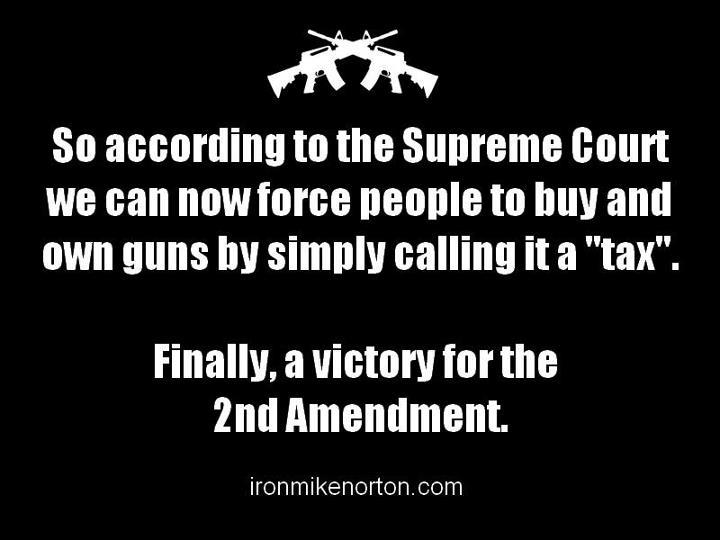
And worse, none of them has proposed a damn thing to deal with what the Supreme Court just did, which is grant a permanent ability to the Federal Government to compel any behavior by linking it to a tax. Some examples of where this can (and might in the near future!) go include:
- You make cars. You’re told to sell a car to anyone who makes under $25,000 a year for $5,000. This is of course under your cost of production. If you refuse, every car you make is subject to a $5,000 tax. This is now Constitutional, as of this last week.
- You would like to have three kids. The government decides that you may have only two. If you have get pregnant with a third and refuse to have an abortion you must pay $10,000 a year in additional tax forever. This is now Constitutional, as of last week.
- You may have all the abortions you want, but each costs $10,000 in tax. This is Constitutional, as of last week.
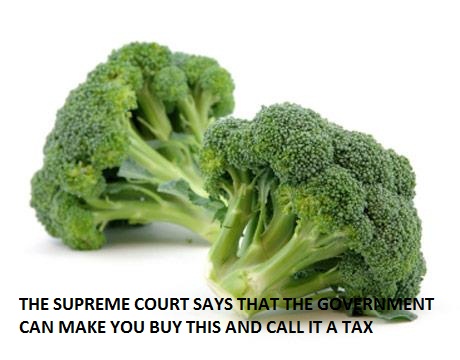
- You must eat Broccoli and submit receipts with your 1040 proving you bought 1lb of Broccoli per person in your household per week. If you do not, you must pay $5,000 in additional tax. This is Constitutional, as of last week.
- If you are more than 10lbs overweight you must pay $2,000 of additional tax for every 10lbs overweight you are, with no cap. This is Constitutional, as of last week.
You probably think I’m kidding on this. I’m not. This is what the Roberts Court held. There is literally nothing that Congress cannot mandate that you do, or not do, under penalty of paying a tax. All that was unconstitutional before the ruling now is explicitly constitutional if the only “compulsion” to do (or not do) a given thing is that you will be taxed if you refuse. The court promised to review “reasonableness” of any such taxes in the future, but note that at the same time the court ignored two other problems with the Health Care law, making a lie of their claim of “future reasonableness” tests right up front:
- Direct taxes are unconstitutional without being apportioned. This is clearly a direct tax and it is not apportioned. It is therefore unconstitutional, but the USSC simply ignored this. (The 16th Amendment was required to make income taxes constitutional for this reason.)
- The Anti-Injunction Act prohibits suing the government over a tax until you have actually paid it. This means that if the PPACA “penalty” is a tax then the entire lawsuit that went to the USSC is moot as it’s not yet “ripe” (since nobody has yet paid the tax.) If they were going to find that this was a tax they were thus bound to dismiss the entire complaint as unripe. They ignored that too.
In short the USSC has become no more legitimate than the North Korean government and is unworthy of your respect.
Prof. Paul Moreno: A Short History of Congress’s Power to Tax
The case against Roberts’ preposterous ruling just keeps building.
The Supreme Court has long distinguished the regulatory from the taxing power.
In 1935, Secretary of Labor Frances Perkins was fretting about finding a constitutional basis for the Social Security Act. Supreme Court Justice Harlan Fiske Stone advised her, “The taxing power, my dear, the taxing power. You can do anything under the taxing power.”
Last week, in his ObamaCare opinion, NFIB v. Sebelius, Chief Justice John Roberts gave Congress the same advice—just enact regulatory legislation and tack on a financial penalty, as in failure to comply with the individual insurance mandate. So how did the power to tax under the Constitution become unbounded?
The first enumerated power that the Constitution grants to Congress is the “power to lay and collect taxes, duties, imposts, and excises, to pay the debts and provide for the common defense and general welfare of the United States.” The text indicates that the taxing power is not plenary, but can be used only for defined ends and objects—since a comma, not a semicolon, separated the clauses on means (taxes) and ends (debts, defense, welfare).
This punctuation was no small matter. In 1798, Pennsylvania Rep. Albert Gallatin said that fellow Pennsylvania Rep. Gouverneur Morris, chairman of the Committee on Style at the Constitutional Convention, had smuggled in the semicolon in order to make Congress’s taxing power limitless, but that the alert Roger Sherman had the comma restored. The altered punctuation, Gallatin said, would have turned “words [that] had originally been inserted in the Constitution as a limitation to the power of levying taxes” into “a distinct power.” Thirty years later, Virginia Rep. Mark Alexander accused Secretary of State John Quincy Adams of doing the same thing after Congress instructed the administration to print copies of the Constitution.
The punctuation debate simply reinforced James Madison’s point in Federalist No. 41 that Congress could tax and spend only for those objects enumerated, primarily in Article I, Section 8.
Congress enacted very few taxes up to the end of the Civil War, and none that was a pretext for regulating things that the Constitution gave it no power to regulate. True, the purpose of tariffs was to protect domestic industry from foreign competition, not raise revenue. But the Constitution grants Congress a plenary power to regulate commerce with other nations.
Congress also enacted a tax to destroy state bank notes in 1866, but this could be seen as a “necessary and proper” means to stop the states from usurping Congress’s monetary or currency power. It was upheld in Veazie Bank v. Fenno (1869).
The first unabashed use of the taxing power for regulatory purposes came when Congress enacted a tax on “oleomargarine” in 1886. Dairy farmers tried to drive this cheaper butter substitute from the market but could only get Congress to adopt a mild tax, based on the claim that margarine was often artificially colored and fraudulently sold as butter. President Grover Cleveland reluctantly signed the bill, saying that if he were convinced the revenue aspect was simply a pretext “to destroy . . . one industry of our people for the protection and benefit of another,” he would have vetoed it.
Congress imposed another tax on margarine in 1902, which the Supreme Court upheld (U.S. v. McCray, 1904). Three justices dissented, but without writing an opinion.
Then, in 1914, Congress imposed taxes on druggists’ sales of opiates as a way to regulate their use. Five years later, in U.S. v. Doremus , the Supreme Court upheld the levy under Congress’s express power to impose excise taxes.
Then, in 1922, the court rejected Congress’s attempt to prohibit child labor by imposing a tax on companies that employed children. An earlier attempt to accomplish this, by prohibiting the interstate shipment of goods made by child labor, was struck down as unconstitutional—since it was understood since the earliest days of the republic that Congress had the power to regulate commerce but not manufacturing. “A Court must be blind not to see that the so-called tax is imposed to stop the employment of children within the age limits prescribed,” Chief Justice William Howard Taft wrote in Bailey v. Drexel Furniture Co. “Its prohibitory and regulatory effect and purpose are palpable.” Even liberal justices Oliver Wendell Holmes and Louis D. Brandeis concurred in Taft’s opinion.
Things came to a head in the New Deal, when Congress imposed a tax on food and fiber processors and used those tax dollars to provide benefits to farmers. Though in U.S. v. Butler (1936) the court adopted a more expansive view of the taxing power—allowing Congress to tax and spend for the “general welfare” beyond the powers specifically enumerated in the Constitution—it still held the ends had to be “general” and not transfer payments from one group to another. After President Franklin D. Roosevelt threatened to “pack” the Supreme Court in 1937, it accepted such transfer payments in Mulford v. Smith (1939), so long as the taxes were paid into the general treasury and not earmarked for farmers.
And now, in 2012, Justice Roberts has confirmed that there are no limits to regulatory taxation as long as the revenue is deposited in the U.S. Treasury.
Are there any other limits? Article I, Section 2 says that “direct taxes shall be apportioned among the states” according to population. This is repeated in Article I, Section 9, which says that “no capitation, or other direct tax, shall be laid,” unless apportioned.
The Supreme Court struck down income taxes in 1895 (Pollock v. Farmers’ Loan & Trust Co.), on the ground that they were “direct” taxes but not apportioned by population. Apportioning an income tax would defeat the purpose of the relatively poorer Southern and Western states, who wanted the relatively richer states of the Northeast to pay the bulk of the tax. The 16th Amendment gave Congress the power to tax incomes without apportionment.
Other direct taxes should presumably have to be apportioned according to the Constitution. Justice Roberts quickly dismissed the notion that the individual mandate penalty-tax is not a direct tax “under this Court’s precedents.” To any sentient adult, it looks like a “capitation” or head tax, imposed upon individuals directly. Unfortunately, having plenty of other reasons to object to ObamaCare, the four dissenting justices in NFIB v. Sebelius did not explore this point.
Some conservatives have cheered that part of Justice Roberts’s decision that limits Congress’s Commerce Clause power. But an unlimited taxing power is equally dangerous to constitutional government.
Mr. Moreno is a professor of history at Hillsdale College and the author of “The American State from the Civil War to the New Deal,”
Mark Steyn: A lie makes Obamacare legal
Three months ago, I quoted George Jonas on the 30th anniversary of Canada’s ghastly “Charter of Rights and Freedoms”: “There seems to be an inverse relationship between written instruments of freedom, such as a Charter, and freedom itself,” wrote Jonas. “It’s as if freedom were too fragile to be put into words: If you write down your rights and freedoms, you lose them.”
For longer than one might have expected, the U.S. Constitution was a happy exception to that general rule – until, that is, the contortions required to reconcile a republic of limited government with the ambitions of statism rendered U.S. constitutionalism increasingly absurd. As I also wrote three months ago (yes, yes, don’t worry, there’s a couple of sentences of new material in amongst all the I-told-you-so stuff), “The United States is the only Western nation in which our rulers invoke the Constitution for the purpose of overriding it – or, at any rate, torturing its language beyond repair.”
Thus, the Supreme Court’s Obamacare decision. No one could seriously argue that the Framers’ vision of the Constitution intended to provide philosophical license for a national government (“federal” hardly seems le mot juste) whose treasury could fine you for declining to make provision for a chest infection that meets the approval of the Commissar of Ailments. Yet on Thursday, Chief Justice John Roberts did just that. And conservatives are supposed to be encouraged that he did so by appeal to the Constitution’s taxing authority rather than by a massive expansion of the Commerce Clause. Indeed, several respected commentators portrayed the Chief Justice’s majority vote as a finely calibrated act of constitutional seemliness.
Great. That and $4.95 will get you a decaf macchiato in the Supreme Court snack bar. There’s nothing constitutionally seemly about a court decision that says this law is only legal because the people’s representatives flat-out lied to the people when they passed it. Throughout the Obamacare debates, Democrats explicitly denied it was a massive tax hike: “You reject that it’s a tax increase?” George Stephanopoulos demanded to know on ABC. “I absolutely reject that notion,” replied the President. Yet “that notion” is the only one that would fly at the Supreme Court. The jurists found the individual mandate constitutional by declining to recognize it as a mandate at all. For Roberts’ defenders on the right, this is apparently a daring rout of Big Government: Like Nelson contemplating the Danish fleet at the Battle of Copenhagen, the Chief Justice held the telescope to his blind eye and declared, “I see no ships.”
If it looks like a duck, quacks like a duck, but a handful of judges rule that it’s a rare breed of elk, then all’s well. The Chief Justice, on the other hand, looks, quacks and walks like the Queen in Alice In Wonderland: “Sentence first – verdict afterwards.” The Obama administration sentences you to a $695 fine, and a couple of years later the queens of the Supreme Court explain what it is you’re guilty of. A. V. Dicey’s famous antipathy to written constitutions and preference for what he called (in a then-largely unfamiliar coinage) the “rule of law” has never looked better.
Instead, constitutionalists argue that Chief Justice Roberts has won a Nelson-like victory over the ever-expanding Commerce Clause. Big deal – for is his new, approved, enhanced taxing power not equally expandable? And, in attempting to pass off a confiscatory penalty as a legitimate tax, Roberts inflicts damage on the most basic legal principles.

Bingo on that last line. To read the rest of Mark Steyn’s excellent column click HERE.
John Kartch: Five major ObamaCare taxes that will impact you in 2013
There are 21 new taxes in ObamaCare several of which target the chronically ill and disabled – LINK – LINK – LINK.
Six months from now, in January 2013, five major ObamaCare taxes will come into force:
1. The ObamaCare Medical Device Manufacturing Tax
This 2.3 percent tax on medical device makers will raise the price of (for example) every pacemaker, prosthetic limb, stent, and operating table. Can you remind us, Mr. President, how taxing medical devices will reduce the cost of health care? The tax is particularly destructive because it is levied on gross sales and even targets companies who haven’t turned a profit yet.
These are often small, scrappy companies with less than 20 employees who pioneer the next generation of life-prolonging devices. In addition to raising the cost of health care, this $20 billion tax over the next ten years will not help the country’s jobs outlook, as the industry employs nearly 400,000 Americans. Several companies have already responded to the looming tax by cutting research and development budgets and laying off workers.
2. The ObamaCare High Medical Bills Tax
This onerous tax provision will hit Americans facing the highest out-of-pocket medical bills. Currently, Americans are allowed to deduct medical expenses on their 1040 form to the extent the costs exceed 7.5 percent of one’s adjusted gross income.
The new ObamaCare provision will raise that threshold to 10 percent, subjecting patients to a higher tax bill. This tax will hit pre-retirement seniors the hardest. Over the next ten years, affected Americans will pony up a minimum total of $15 billion in taxes thanks to this provision.
3. The ObamaCare Flexible Spending Account Cap
The 24 million Americans who have Flexible Spending Accounts will face a new federally imposed $2,500 annual cap. These pre-tax accounts, which currently have no federal limit, are used to purchase everything from contact lenses to children’s braces. With the cost of braces being as high as $7,200, this tax provision will play an unwelcome role in everyday kitchen-table health care decisions.
The cap will also affect families with special-needs children, whose tuition can be covered using FSA funds. Special-needs tuition can cost up to $14,000 per child per year. This cruel tax provision will limit the options available to such families, all so that the federal government can squeeze an additional $13 billion out of taxpayer pockets over the next ten years.
The targeting of FSAs by President Obama and congressional Democrats is no accident. The progressive left has never been fond of the consumer-driven accounts, which serve as a small roadblock in their long-term drive for a one-size-fits-all government health care bureaucracy.
For further proof, note the ObamaCare “medicine cabinet tax” which since 2011 has barred the 13.5 million Americans with Health Savings Accounts from purchasing over-the-counter medicines with pre-tax funds.
4. The ObamaCare Surtax on Investment Income
Under current law, the capital gains tax rate for all Americans rises from 15 to 20 percent in 2013, while the top dividend rate rises from 15 to 39.6 percent. The new ObamaCare surtax takes the top capital gains rate to 23.8 percent and top dividend rate to 43.4 percent. The tax will take a minimum of $123 billion out of taxpayer pockets over the next ten years.
And, last but not least…
5. The ObamaCare Medicare Payroll Tax increase
This tax soaks employers to the tune of $86 billion over the next ten years.
As you can understand, there is a reason why the authors of ObamaCare wrote the law in such a way that the most brutal tax increases take effect conveniently after the 2012 election. It’s the same reason President Obama, congressional Democrats, and the mainstream media conveniently neglect to mention these taxes and prefer that you simply “move on” after the Supreme Court ruling.
Stroke of Obama’s pen and an entire industry is eliminated
Philip Morris does not like competition, even if it is small time boutique competition that really is no competition at all. In this case a big business and its lobbyists say “JUMP!” in an effort to stick it to a tiny small time competitor and the Congress and the President ask Philip-Morris “How high?” Don’t you wish that your Member of Congress was this responsive to you and our problems? This is why we need new leadership in BOTH parties. Prepare to be made ill by what you are about to read.
They say it is about tax revenues, suuuure, and Philip Morris paid big money to buy off politicians and engage in a massive lobbying effort because, you know, they just can’t stand to see the government maybe miss out on the statistically insignificant lower taxes from roll your own boutique tobacco? Gimme a break. What this is about is a big wealthy company snuffing out a tiny boutique one because the tiny one cannot afford a huge lobbying effort. Anyone who claims that “it’s about taxes” is insulting your intelligence.
There should be a concerted effort to see to it that Boehner is not re-elected Speaker.
Roll-your-own cigarette operations to be snuffed out.
A tiny amendment buried in the federal transportation bill to be signed today by President Barack Obama will put operators of roll-your-own cigarette operations in Las Vegas and nationwide out of business at midnight.
Robert Weissen, with his brothers and other partners, own nine Sin City Cigarette Factory locations in Southern Nevada, including six in Las Vegas, and one in Hawaii. He said when the bill is signed their only choice is to turn off their 20 RYO Filling Station machines and lay off more than 40 employees.
“We’ll stay open for about another week to sell tubes and tobacco just to get through our inventory, but without the use of the RYO machines, we won’t be staying open,” he said.
The machines are used by customers who buy loose tobacco and paper tubes from the shop and then turn out a carton of finished cigarettes in as little as 10 minutes, often varying the blend to suit their taste. Savings are substantial – at $23 per carton, half the cost of a name-brand smoke – in part because loose tobacco is taxed at a lower rate.
“These cigarettes are different because there are benefits in saving money and in how they make you feel,” said Amy Hinds, a partner who operates the Sin City Cigarette Factory at Craig and Decatur.
“These cigarettes don’t have any of the chemicals in them, and the papers are chemical-free, unlike the cartons people buy from Philip Morris.”
But a few paragraphs added to the transportation bill changed the definition of a cigarette manufacturer to cover thousands of roll-your-own operations nationwide. The move, backed by major tobacco companies, is aimed at boosting tax revenues.
Faced with regulation costs that could run to hundreds of thousands of dollars, RYO machine owners nationwide are shutting down more than 1,000 of the $36,000 machines.
“I feel it’s kind of shaky,” Wiessen said. “The man who pushed for this bill is Sen. (Max) Baucus from Montana, and he received donations from Altria, a parent company of Philip Morris. Interestingly enough, there are also no RYO machines in the state of Montana. It really makes me question the morals and values of our elected speakers.”
Sierra Bawden, a single mom with two kids who started rolling her own smokes at Hind’s shop three months ago, said cost is only one factor.
“It saves me time and money, and in the end I feel better because I don’t get all of the chemicals that the other cigarettes have,” Bawden said. “With the brand-name cigarettes, we pay for the chemicals and the name, and I don’t want any of that, so I don’t even know what I’ll do when the shop closes down.”
Megyn Kelly Calls Out Obama: Your lawyer called it a tax in court and now your campaign people are lying about it (video)
Obama and the Democrat Party leadership after saying it was not a tax, directed their lawyers in court to argue that it is a legal tax and now the Obama campaign is saying that they never said it was a tax and that the SDupreme Court got it wrong when they agreed wih the argument form Obama’s own lawyer.
[Actually there are 21 new taxes in ObamaCare several of which target the chronically ill and disabled – LINK – LINK – LINK – Editor]
Allen West on new outrageous federal regulations and the Roberts’ ruling (video)
Water efficiency standards for urinals….
UPDATE – More from Allen West on this issue with Neil Cavuto and the recent preposterous Supreme Court Ruling (video) – LINK
Dick Morris: Obama to Sign Gun Control Treaty on July 27! (video)
This is an effort to get around the Second Amendment. In essence some “scholars” who try to reinterpret their way around the Constitution’s limits is going to sign a treaty and send it to the Senate to mandate certain gun control laws.
Flashback 2008: Obama Trashed Hillary for Proposing Health Care “Penalty” (video)
Via The Blaze:
White House chief of staff Jack Lew repeatedly insisted Sunday that those who fail to buy health insurance will be assessed a “penalty” — not a tax.
But just four years ago, then-candidate Barack Obama ran an ad attacking rival Hillary Clinton for her health plan that it said would do just that.
Obama Denies Waiver for Innovative Cost Saving Indiana Medicaid Program
I mean, we cant have incentives that are deigned to help people make smart health care choices and actually save money, not when we are trying to bankrupt the country…
I first reported on this story on my old college blog when our friend Amity Shleas wrote an article about Obama moving to kill the popular and budget saving program called HIP. Why? Well Mitch Daniels is our governor and the Obama Administration did not want such a successful program written by a popular Republican governor to get any publicity.
Indiana once again tried to save HIP by asking for a waiver and Obama once again is determined to kill the program.
Obama Administration Denies Waiver for Indiana’s Popular Medicaid Program
In 2007, under Gov. Mitch Daniels (R.), Indiana enacted the Healthy Indiana Plan, an expansion of Medicaid that used consumer-driven health plans to encourage low-income beneficiaries to take a more active role in their own care. Today, Healthy Indiana is the most innovative and successful reform of Medicaid in the history of the program. Today, we learn that the Obama Administration has rejected the state’s request to extend its federal waiver, which means that over 45,000 Indianans who get their insurance through the program are out of luck.
Medicaid, of course, is the nation’s government-run health insurance program for the poor. In theory, it’s jointly run by the federal government and the states, but in reality, any time a state wants to make the tiniest changes in its Medicaid program, it has to go hat-in-hand to the U.S. Department of Health and Human Services with a formal request for a waiver, and these waivers are usually denied.
Indiana succeeded in gaining a waiver in 2007 because it was seeking to expand Medicaid to a group of people who weren’t then eligible for the program, and because the state’s effort required no additional outlays from the federal government (the Medicaid expansion was paid for with a 44-cent increase in the state’s cigarette tax.)
Structure of Indiana’s consumer-driven Medicaid plan
Beneficiaries get a high-deductible health plan and a health savings account, called a POWER account, to which individuals must make a mandatory monthly contribution between 2 to 5 percent of income, up to $92 per month. Participants lose their coverage if they don’t make their contributions within 60 days of their due date. After making this contribution, beneficiaries have no other cost-sharing requirements (co-pays, deductibles, etc.) except for non-urgent use of emergency rooms. The state chips in $1,100, which corresponds to the size of the would-be deductible.
Those who have money remaining in their POWER accounts at the end of the year can apply the balance to the following year’s contribution requirements, if they have obtained a specified amount of preventive care: annual physical exams, pap smears and mammograms for women, cholesterol tests, flu shots, blood glucose screens, and tetanus-diphtheria screens.
“We did a lot of reading on criticism of health savings accounts,” says Seema Verma, who was the architect of the Indiana program. “One of the criticisms was that people didn’t have enough money to pay for preventive care. So we took preventive care out, made that first-dollar coverage. Also, people said that people didn’t have enough for the deductible, so we fully funded it. Then, you have to make your contribution every month, with a 60-day grace period. If you don’t make the contribution, you’re out of the program for 12 months. It’s a strong personal responsibility mechanism.”
Indiana’s Medicaid successes
The program has been, by many measures, a smashing success. “What we’re finding out is that, first of all, low-income people are just as capable as anybody else of making wise decisions when it’s their own money that they’re spending,” Mitch Daniels explains in a Heritage Foundation video. “And they’re also acting more like good consumers. They’re visiting emergency rooms less, they’re using more generic drugs, they’re asking for second opinions. And some real money is starting to accumulate in their [health savings] accounts.”
The program has been overwhelmingly popular in Indiana. There’s a large waiting list—in the tens of thousands—to enroll in Healthy Indiana; enrollment was capped in order to ensure that the program’s costs remain predictable. 90 percent of enrollees are making their required monthly contributions. “The program’s level of satisfaction is at an unheard-of 98 percent approval rating,” Verma told Kenneth Artz. Employers didn’t dump their workers onto the program, crowding others out, because you needed to be uninsured for six months in order to be eligible for it.
A 2010 study by Mathematica Policy Research found that the program dramatically increased the percentage of beneficiaries who obtained preventive care, from 39 percent in the first six months of enrollment to 59 percent after one year. Of the members who had money left in the POWER accounts at the end of the year, 71 percent met the preventive care requirement and were able to roll the balances over to the following year. (The remaining 29 percent could roll over their personal contributions, but not the state contributions to their POWER accounts.)
This is an astounding achievement, given that the biggest problem with Medicaid is the way that it ghettoizes its participants, preventing them from gaining access to routine medical and dental care. This lack of physician access is the biggest reason why health outcomes for Medicaid patients lag far behind those of individuals with private insurance, and even behind those with no insurance at all. Healthy Indiana has completely reversed this trend, achieving preventive care participation rates that are higher than the privately-insured population.
Forbes: ObamaCare Responsible for Health Insurance Premium Increases that Tripled in 2011

Higher Health Insurance Premiums This Year? Blame ObamaCare.
Most Americans saw their insurance bills jump this year, according to a new study from the Kaiser Family Foundation. The average employer-based premium for a family increased a startling 9% in 2011. Over the next decade, rates are expected to double.
The Kaiser report is only the latest piece of research to indicate that ObamaCare isn’t driving down health care costs, as its proponents promised, but is instead accelerating their rise.
This year, the average premium for a family hit $15,073 — $1,303, or 9%, higher than the year before. And that’s on top of increases of 5% in 2009 and 3% in 2010.
Employees are picking up a substantial portion of that tab. They paid an average of $4,129 for their family insurance premiums this year — more than double what they shelled out 10 years ago. And that figure doesn’t include out-of-pocket health expenses.
These premium hikes have outpaced general inflation and salary increases — and thus are swallowing a greater share of American households’ budgets. A study published in the September 2011 issue of Health Affairs found that burgeoning health costs have decimated nearly an entire decade’s worth of income gains. In 2009, the average American family had just $95 more to spend at will than it did in 1999.
Worse, there’s no relief in sight. Next year, employers expect premiums to rise 7.2%, according to the National Business Group on Health.
Over the next ten years, American families can expect rising health costs to continue to offset pay raises. According to the Kaiser study, premiums are set to reach a whopping $32,175 by 2021. And more than 50% of employers have stated that they plan to shift a greater share of health-insurance costs onto their employees.
ObamaCare is to blame for much of these impending increases. Richard Foster, the Chief Actuary for the Centers for Medicare and Medicaid Services (CMS), reports that America will spend an additional $311 billion on health care in the next decade because of the law.
CMS estimates the growth in health insurance costs will increase 10 extra percentage points in 2014 because of ObamaCare — a 14% increase, versus 3.5% without the law.
ObamaCare drives up the cost of insurance by piling mandates and required coverage benefits onto every single policy.
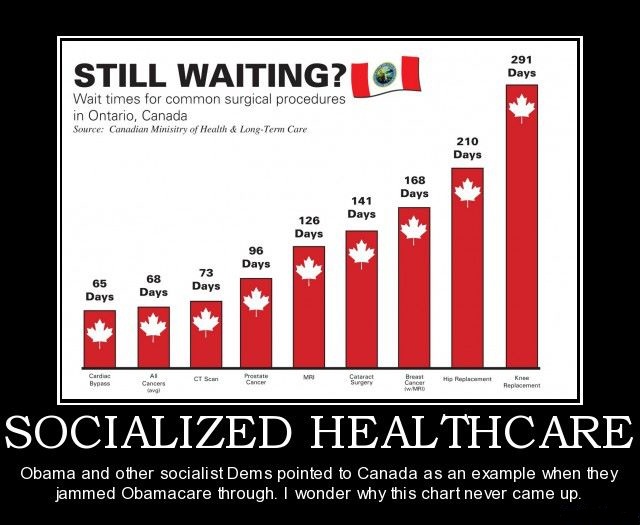
“The Lemon” – Why Canada Is Now Reforming Their Socialized Health Care System (video)
….and moving back to privatization.
IBD: 21 ObamaCare Taxes Already Causing Job Losses

Here is another source for the list of 21 ObamaCare taxes coming your way courtesy of Investors Business Daily:
Taxation: The high bench has confirmed that ObamaCare’s individual mandate is a massive tax on the American middle class. But let’s not forget the 20 other new taxes that are embedded in the law.
Though President Obama never sold it as a tax hike, the Supreme Court ruled the mandate is exactly that. Unfortunately, the majority argued it’s legal under Congress’ taxing authority.
Forcing citizens to buy health insurance “is absolutely not a tax increase,” Obama insisted in 2009. Earlier, he assured the public that raising taxes on the middle class to support his health care plan was “the last thing we need in an economy like this.” “Folks are already having a tough enough time,” Obama added.
Indeed they are. But his plan, which subsidizes some 30 million uninsured, amounts to a $1.8 trillion whammy on working families. And that’s just for starters.
The court was silent about the 20 other different taxes hidden in ObamaCare, more than half of which affect families earning less than $250,000 a year.
The new taxes, which cost some $675 billion over the next decade, include:
• A 2.3% excise tax on U.S. sales of medical devices that’s already devastating the medical supply industry and its workforce. The levy is a $20 billion blow to an industry that employs roughly 400,000.
Several major manufacturers have been roiled, including: Michigan-based Stryker Corp., which blames the tax for 1,000 layoffs; Indiana-based Zimmer Corp., which cites the tax in laying off 450 and taking a $50 million charge against earnings; Indiana-based Cook Medical Inc., which has scrubbed plans to open a U.S. factory; Minnesota-based Medtronic Inc., which expects an annual charge against earnings of $175 million, and Boston Scientific Corp., which has opted to open plants in tax-friendlier Ireland and China to help offset a $100 million charge against earnings.
• A 3.8% surtax on investment income from capital gains and dividends that applies to single filers earning more than $200,000 and married couples filing jointly earning more than $250,000.
• A $50,000 excise tax on charitable hospitals that fail to meet new “community health assessment needs,” “financial assistance” and other rules set by the Health and Human Services Dept.
• A $24 billion tax on the paper industry to control a pollutant known as black liquor.
• A $2.3 billion-a-year tax on drug companies.
• A 10% excise tax on indoor tanning salons.
• An $87 billion hike in Medicare payroll taxes for employees, as well as the self-employed.
• A hike in the threshold for writing off medical expenses to 10% of adjusted gross income from 7.5%.
• A new cap on flexible spending accounts of $2,500 a year.
• Elimination of the tax deduction for employer-provided prescription drug coverage for Medicare recipients.
• An income surtax of 1% of adjusted gross income, rising to 2.5% by 2016, on individuals who refuse to go along with ObamaCare by buying a policy not OK’d by the government.
• A $2,000 tax charged to employers with 50 or more workers for every full-time worker not offered health coverage.
• A $60 billion tax on health insurers.
• A 40% excise tax on so-called Cadillac, or higher cost, health insurance plans.
All told, there are 21 new or higher taxes imposed by Obama’s health care law — and 21 more reasons to repeal it.
WSJ Chief Economist: 75% of all ObamaCare taxes impact those who make less than $120,000 a year (video)
“It’s a big punch in the stomach to middle class families.” – Stephen Moore, WSJ Chief Economist
Via Human Events:
Take Your Medicine, America…
Stephen Moore, Senior Economics Writer with the Wall Street Journal, told FOX and Friends this morning that nearly 75% of Obamacare costs will fall on the backs of those Americans making less than $120,000 a year.
It is true and the CBO confirmed it:

Jim Hoft comments on the following video where the White House Chief of Staff was trying to lie about the Supreme Court ruling, and then lied about it being some form of tax. So Fox News’ Chris Wallace played the audio from Obama’s Lawyer in the Supreme Court saying it is a tax. It is clear that the Obama Administration plan is to lie about ObamaCare and lie about the tax.
In the video below the White House calls those who pay the penalty tax “free riders”, because they will have to pay because of all of the new taxes ObamaCare puts on health insurance and care which will price health insurance out of the reach of the young and the working lower middle class. They are not the free riders, the young and working poor/middle class aren’t getting anything, they are the ones who are PAYING! The free riders are the few who will get their health insurance subsidized in part from that money paid. They are the free riders because they are getting at least a part of their insurance paid for by others who are forced to pay the penalty because they can’t afford health insurance any longer under ObamaCare mandates and taxes which are already causing rates to skyrocket.
Democrats told us Obamacare was not a tax.
Then they argued in front of the Supreme Court that it was a tax.
Now they want to tell us again that Obamacare is not a tax.Jack Lew, the Obama White House Chief of Staff, was trying to persuade Chris Wallace on FOX News Sunday that Obamacare was not a tax. But it didn’t work out so well for Lew when Wallace played audio of the Obama lawyer arguing that Obamacare was a tax in front of the Supreme Court.
Lew was stunned after being caught in the lie.
15th Green Energy Company (UPDATE – Make that 36th) Funded by Obama Goes Under
UPDATE IV – Make that 50… – LINK
UPDATE III – October 18th 2012 – the number is 36 either filing for bankruptcy or about to – LINK
The latest “Solyndra” is Abound Solar. With so many of these green energy boondoggles it looks like this: Obama gives big taxpayer money to a campaign donor who is an owner in a junk “green energy company”. Said owners pay themselves in a big way, give big money to Democrats and go out of business. “Scheming that the right people got their loan guarantees” – LINK.
Abound Solar Inc., a U.S. solar manufacturer that was awarded a $400 million U.S. loan guarantee, will suspend operations and file for bankruptcy because its panels were too expensive to compete.
Abound borrowed about $70 million against the guarantee, the Loveland, Colorado-based company said today in a statement. It plans to file for bankruptcy protection in Wilmington, Delaware, next week.
The failure will follow that of Solyndra LLC, which shut down in August after receiving a $535 million loan guarantee from the same U.S. Energy Department program. Abound stopped production in February to focus on reducing costs after a global oversupply and increasing competition from China drove down the price of solar panels by half last year.
Ouch –
U.S. taxpayers may lose $40 million to $60 million on the loan after Abound’s assets are sold and the bankruptcy proceeding closes, Damien LaVera, an Energy Department spokesman, said in a statement today.
For more coverage of green energy boondoggles and corruption see our Alarmism category.
Aside from Finnish car company (and Stimulus money recipient) Fiskar already having troubles, here is the list:
UPDATE – Make that 16 – Amonix Corp near Las Vegas closes doors after 14 months and $20 million in Green Energy grants – LINK
Solyndra
Abound Solar
Energy Conversion Devices
BrightSource
LSP
Evergreen Solar
Ener1
SunPower
Beacon Power
ECOtality
Uni-Solar
Azure Dynamics
Solar TrustA123 – Being handed to the Chinese after they got our money? – LINK.
UPDATE II – A123 now filing for bankruptcy and selling assets to Johnson Controls – LINK.
President Obama statement praising A123
The Truth About Pre-Existing Conditions Will Surprise You.
Health Insurance Tips & Advice Blog:
I have been a multi-state licensed health and life insurance Broker for more than 15 years now. I have also served as a Subject Matter Expert on Health Insurance for multiple business journals around our great country. One of the biggest challenges I’ve had to deal with throughout the years has been trying to secure coverage for people with pre-existing conditions who obtain their health insurance on the Individual market. They represent 10% of the American Insured.
I’ve never had to worry about pre-existing conditions with the other 90% of American Insured’s who get their health insurance through an Employer Sponsored Group Plan. Why? Because A Federal law called HIPAA has protected them against being denied health insurance because of pre-existing conditions for more than 14 years now.
Because Government legislators did NOT apply this law to Individual health insurance policies, you can be labeled as “uninsurable” when you apply for an individual health insurance policy if you have one or more pre-existing conditions. That being said, who should we TRULY blame for the fact that you can be denied coverage for a pre-existing condition? Is it the Insurance Company’s fault? Or are they simply following a law that was written by Government Law Makers who did not include HIPAA portability protection for the MILLIONS of American’s who purchase Health Insurance on their own in the Individual Market?
Read the details about what to do if you have pre-existing conditions, what is wrong with the current system, and how to fix it HERE.
Who are the Uninsured? Did you know almost half make over $50,000 a year? Did you know that a third of the uninsured qualify for low cost insurance programs and simply refuse to enroll?
It was government law that created the pre-existing condition problem for 10% of the population:
In the video above where the speaker talks about how Obama lied about a man who had a pre-existing condition Factcheck.org verified it HERE.
Libs on Twitter call Justice Thomas “N-Word” After Ruling; Call Sarah Palin Slut and Attack Her Kids
Curt Levey: Top 10 Lessons from the Roberts Obamacare Ruling
This is a critically important piece for many reasons. Read every last word.
#1: The charge that the Roberts Court is a right-of-center court has been proven wrong in dramatic fashion.
It’s not just the ObamaCare decision that can be characterized as liberal. In this term alone, the Court invalidated most of the Arizona immigration law, declared mandatory life-without-parole sentences for juveniles unconstitutional, invalidated FCC fines for fleeting expletives and brief nudity, and broadened protections for criminal defendants in cases involving both search and seizure and ineffective assistance of counsel.
#2: Five is not enough.
It’s no fluke that one or more of the five center-right Justices deeply disappointed conservatives three times in just the last few days. It’s clear that five center-right Justices on the Court will never be enough to substantially advance the law in a conservative direction. Unlike the Democratic appointees on the Court, who can be counted on to vote the progressive way when the stakes are high, Republican appointees – no matter how carefully selected – cannot be counted on to consistently uphold conservative principles.
#3: Though the immediate impact of the decision was a stunning defeat for conservatives, the larger cause of constitutional federalism was advanced.
As legal precedent, the ObamaCare decision strengthens the Constitution’s protection of state sovereignty and its limits on Congress’s power under the Commerce, Spending, and Necessary & Proper clauses. Quin Hillyer concludes that:
“[S]even of nine justices … finding that the Medicaid provision amounts to an unconstitutional coercion of the states … combined with the majority in favor of limiting the reach of the Commerce Clause, effectively means that the left lost far more than it won in terms of lasting legal precedent.”
Justice Ginsburg charged that “The Chief Justice’s crabbed reading of the Commerce Clause harks back to the era in which the Court routinely thwarted Congress’ efforts to regulate the national economy.” Let’s hope so. In any case, now that it “will be hard … to criticize the John Roberts Supreme Court … as partisan” – in the words of liberal Supreme Court litigator and observer Tom Goldstein – it will also be hard to criticize the newly limited reading of the Commerce Clause as out of the mainstream.
#4: Obama and company’s attempt to cow the Supreme Court succeeded.
Harvard Law School Professor Noah Feldman writes that:
“Roberts knew the consequences of striking down the individual mandate: He would have been attacked by the president and the news media as the chief of the most activist conservative court since the 1930s.”
One way or another, the pressure apparently got to Roberts. Professor Lawrence Solum of Georgetown Law expresses the conclusion of many that language in the four-Justice dissent “is highly suggestive of a majority opinion. … This suggests that Justice Roberts switched his vote.”
This problem is nothing new. Moderately conservative appointees to the Court often drift to the left over time. I chalk it up to them caring too much about their reviews in the Washington Post.
#5: The bullet ObamaCare dodged was more deadly than imagined.
The conventional wisdom was that if the individual mandate were declared unconstitutional, only the mandate and two related provisions would be struck down, saving the rest of the statute. Instead, each of the four Justices who found the mandate unconstitutional voted to strike down the entire statute. But for Roberts’s surprise vote, that would have been the holding of the Court, exceeding the hopes of ObamaCare’s opponents.
#6: Roberts’s opinion was judicial activism at its worst.
Those who say the Chief Justice saved the Court from being branded a bunch of right wing activists are at least half wrong. Roberts’ logical contortions – going so far as to conclude that the individual mandate was simultaneously a tax and not a tax – invite charges of activism.
Even famed liberal law professor Alan Dershowitz concedes that, in order to achieve “a political compromise,” “Justice Roberts went out of his way to characterize the penalty for not buying insurance as a tax increase.” Such results-oriented judging, no matter its motive, is the hallmark of judicial activism.
I almost wish President Bush had appointed Barack Obama to the Supreme Court instead of Justice Roberts. That would have given us a majority of five Justices willing to emphatically say that the mandate is not a tax
#7: Chief Justice Roberts will likely be best remembered for disappointing conservatives in the most important case of his judicial career.
Whether fair or unfair, the sentiments of many conservatives are summed up by the editors of National Review: “If the law has been rendered less constitutionally obnoxious, the Court has rendered itself more so. Chief Justice Roberts cannot justly take pride in this legacy.” Michael Walsh compares the Chief Justice’s surprise vote to Justice Owen Roberts’ famous switch, under pressure from President Franklin Roosevelt, that ushered in the era of virtually limitless federal power that continues to this day. There can be no more damning comparison.
On the flipside, Roberts may enjoy the accolades he is getting from more progressive circles. But rest assured– those will last only until the next big Supreme Court decision that offends liberal sensitivities.
#8: The White House should not be celebrating.
The 2012 election will now be a referendum on ObamaCare both at the federal level, where repeal of ObamaCare will be determined, and at the state level, where the future of the now-optional Medicaid extension will be determined. That’s not a good thing for President Obama, as indicated by his reticence about mentioning ObamaCare on the campaign trail. And that was before the individual mandate became a tax.
Michael Shear of the New York Times sums up the President’s problem:
“[T]he ruling also has the potential to re-energize the Tea Party movement .. and provide new political power to Mitt Romney’s pledge to repeal the law … Republicans eager to seize control of the Senate now have a renewed rallying cry in races across the country.”
#9: Don’t let the oral argument or talking heads fool you.
Early on, I and other attorneys were convinced that 1) Chief Justice Roberts, because of his minimalist tendencies, was as much a swing vote in the ObamaCare case as Justice Kennedy, 2) it would be very tempting for moderates on the Court to make the constitutional problem go away by calling the individual mandate a tax, and 3) the legal challenge to the Medicaid expansion was not being taken seriously enough because of the focus on the mandate. By the time I finished listening to the oral arguments in the Supreme Court and the talking heads on television, I had abandoned all three convictions. I should have trusted my instincts.
#10: The meaning of the ObamaCare decision is yet to be determined.
The malleability of Supreme Court decisions is demonstrated by another landmark decision 34 years ago. Allan Bakke sued the University of California over its use of minority preferences in admissions and won 5-4. A single Justice, Lewis Powell, opined that a school’s interest in achieving intellectual diversity could justify using race as one of many diversity factors. Supporters of affirmative action successfully spun the decision to mean that a majority of the Court supported the diversity rationale and that the rationale could justify huge racial preferences aimed at only skin-deep diversity.
Will the ObamaCare decision come to stand for the renewal of federalism principles or for upholding the biggest federal overreach in history? That will be determined by the litigation and communications skills of federalism’s supporters and critics.
Curt Levey is a constitutional law attorney and President of the Committee for Justice in Washington, DC.
Romney Pulls In $4.6 Million In Donations the Day of Roberts’ Obamacare Ruling
Team Romney pulled in $4.6 million in a 24-hour period with an average donation of under $100; 33% of donations were under $25. Over 200 thousand unique visitors hit the Romney campaign site, with one in four making a donation.

Internet On Fire Over Roberts’ ObamaCare Ruling








After the Supreme Court Ruling on Obamacare What is Next?
With the Supreme Court ruling on Obamacare, everyone is wondering what’s next for big government? Here are some ideas for federal policymakers to consider:
Federal Broccoli Act of 2013: Eat your broccoli, else pay the IRS $1,000.
Federal Recycling Act of 2014: Fill your blue box and put on the curb, else pay the IRS $2,000.
Federal Green Car Act of 2015: Make your next car battery powered, else pay the IRS $3,000.
Federal Domestic Jobs Act of 2016: Don’t exceed 25 percent foreign content on family consumer purchases, else pay the IRS $4,000.
Federal Obesity Act of 2017: Achieve listed BMI on your mandated annual physical, else pay the IRS $5,000.
Federal National Service Act of 2018: Serve two years in the military or the local soup kitchen, else pay the IRS $6,000.
Federal Housing Efficiency Act of 2019: Don’t exceed 1,000 square feet of living space per person in your household, else pay the IRS $7,000.
Federal Population Growth Act of 2020: Don’t exceed two children per couple, else pay the IRS $8,000.
 Political Arena