This starts out as bit academic but gets rolling into something very interesting. This is a MUST see video.
Category Archives: History
Glenn Beck Dismantles Ron Paul
See the video HERE.
Lech Walesa Unveils Reagan Statue in Warsaw

WARSAW, Poland (AP) — Former Polish president and anti-communist leader Lech Walesa unveiled a statue of Ronald Reagan on an elegant Warsaw street on Monday, honoring the late U.S. president for inspiring Poland’s toppling of communism.
Though Reagan’s legacy is mixed in the U.S., across much of central and eastern Europe he is considered the greatest American leader in recent history for challenging the Soviet Union.
The moniker he gave it — the “evil empire” — resonated with Poles, who suffered greatly under Moscow-imposed rule.
“I wonder whether today’s Poland, Europe and world could look the same without president Reagan,” Walesa said. “As a participant in those events, I must say that it’s inconceivable.”
The 3.5-meter (11.5-foot) bronze statue depicts a smiling Reagan in a historic moment — as he stood at a podium at Berlin’s Brandenburg gate in 1987 and said the famous words, “Mr. Gorbachev, tear down this wall.”
It sits across from the U.S. Embassy on Aleje Ujazdowskie, a street lined with embassies and manicured parks in the heart of the capital.
“Reagan gave us hope,” said Janusz Dorosiewicz, the president of the board of the Ronald Reagan Foundation in Poland. He conceived of the monument and struggled for six years with bureaucracy to secure the prized location for the statue.
Several statues of Reagan have gone up this year, the centennial of Reagan’s birth. Most notably, monuments to him have been erected in London and in Budapest, Hungary, and yet another is to be unveiled later this week in the former Soviet republic of Georgia.
U.S. Debt Now 100% of GDP
When debt reaches 100% of GDP it is usually a point of no return. Only one country in the history of the world has survived that much debt. What happens is that spending and interest spiral up to the point where those making the loans realize that the debtor is incapable of paying it back. The currency starts to fall apart fast at 120-130% of GDP, which isn’t far away. We are already seeing the inflationary effects of so much debt.
WASHINGTON – The soaring national debt has reached a symbolic tipping point: It’s now as big as the entire U.S. economy.
The amount of money the federal government owes to its creditors, combined with IOUs to government retirement and other programs, now tops $15.23 trillion.
That’s roughly equal to the value of all goods and services the U.S. economy produces in one year: $15.17 trillion as of September, the latest estimate. Private projections show the economy likely grew to about $15.3 trillion by December — a level the debt is likely to surpass this month.
“The 100% mark means that your entire debt is as big as everything you’re producing in your country,” says Steve Bell of the Bipartisan Policy Center, which has proposed cutting nearly $6 trillion in red ink over 10 years. “Clearly, that can’t continue.”
Long-term projections suggest the debt will continue to grow faster than the economy, which would have to expand by at least 6% a year to keep pace.
McCain Endorses Romney After Trashing Him…
Does this mean that McCain wasn’t serious about his rediscovered Reagan Conservatism on the 2008 campaign? It would seem so by how Steve Schmidt and some other liberals hired by McCain to run his campaign treated Sarah Palin. Or it could mean none of that and these ads meant nothing to John McCain at all other than a means to winning an election.
This schizophrenic messaging completely takes McCain’s endorsement credibility and tosses it right out the window. It also speaks volumes about how the GOP elites view messaging to GOP voters and is another example of why the GOP communications strategy and brand needs new blood.
Red Tails: Best Film Trailer Ever?
Ronald Reagan’s First Christmas Address (video)
Our Presidents do not talk like this anymore and perhaps that is a part of the problem.
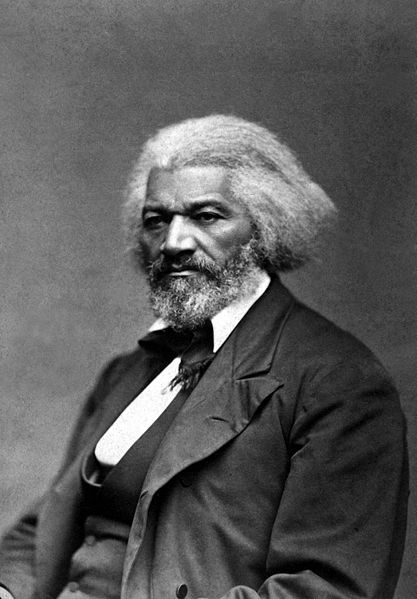
Frederick Douglass: The Democrats are the Party of Slavery
Via The Refounders:
On December 3, 1863, Frederick Douglass delivered a speech to the Anti-Slavery Society in Philadelphia entitled “Our Work is Not Done.” Douglass talked about the purpose of the Civil War, his meeting with Abraham Lincoln, and the future black Americans.
During his speech Douglass said, “The Democrat Party is for war to keep slavery; it is for peace for slavery; it is FOR habeas corpus for slavery; it is AGAINST habeas corpus for slavery; it was for the Mexican War for slavery; it FOR jury trial for supporters of slavery; it is AGAINST jury trial for fugitive slaves. And it was for the Florida war for slavery.
The Democrat Party has but one principle and one master. And it is guided, governed and directed by it–slavery! “
The First Black Members of Congress
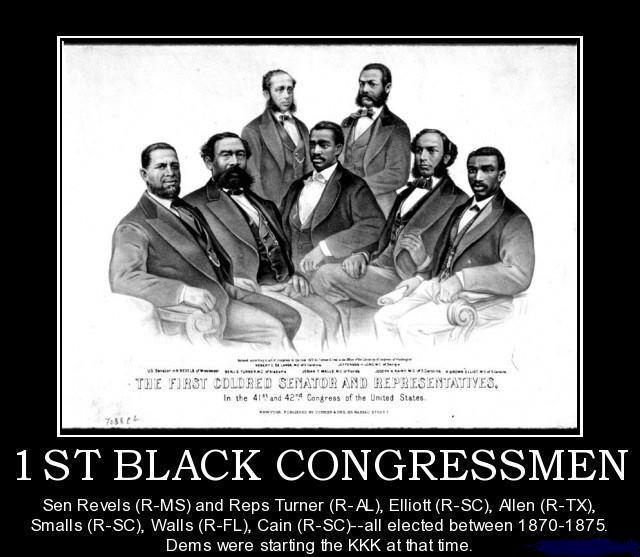
Never forget…
Inside the Beltway ‘Wisdom’ Isn’t So Wise
[Note, this story is stickied to the top of the page as it is our feature of the week. Please scroll down to see new posts and updates!]
by PoliticalArena.org Editor Chuck Norton
Sometimes beltway wisdom can reflect certain truths not apparent to many nice folks in “fly over country”, but often the beltway wisdom caters to government largess and the message can be sold to large donors and bundlers.
Inside the beltway, insiders from both parties treat small government conservatives as “extreme” because all of them make their money from government largess either directly or indirectly. There are also factors that swing the public that those inside the beltway never get exposed to. The greatest example of this was in 1976 and in 1980 when “insiders” believed that Ronald Reagan was a joke, a stupid B-movie actor whose eloquent speeches about the dangers of communism, socialism and collectivism should have went out with the 1950’s. Now those same pundits claim to be the very fathers of his success. While some of the names of the insiders and pundits have changed, the beltway mentality has not.
Please examine these comments from the insiders poll at National Journal and enjoy my comments which will appear in red.
National Journal:
The Gingrich Moment has yet to catch on with National Journal‘s Political Insiders. Despite former House Speaker Newt Gingrich‘s surge in the Republican presidential nomination contest, overwhelming majorities of both Democratic and Republican Insiders still say former Massachusetts Governor Mitt Romney has the better shot at beating President Obama in 2012.
[This is what the left and the elite media say. They said the same thing about McCain and Dole. The elite media is essentially the Democrat media complex, so if Mitt Romney is so much of a threat why are they avoiding piling on and trashing Romney like they have the other candidates? In each case where the most “moderate” candidate was considered the most electable the Democrat campaigned to the right of the GOP nominee and won. When there is a bold difference between the two candidates the conservative Republican wins.
Some insiders know this and are simply rooting for the two candidates who are most likely to guarantee continued government largess. Other insiders start out with the best of intentions, but end up adopting the very mentality that they came to DC to change in the first place. Having been to DC events I can tell you that the temptation to meld in to that mentality is highly seductive. Make no mistake, the media and the White House want to run against Romney and several White House staffers have let that leak out. They believe that the same strategy the GOP used against John Kerry in 2004 can be used against Mitt Romney. They also believe that Obama can fool voters by campaigning to the right of Romney’s record. They will say that Romney talks like Reagan, but governed like Dukakis. Obama will also run against what he will describe as a namby-pamby do nothing Congress that talks about grandiose reforms but ends up with a schizophrenic big government record like Romney’s. ]
For some of the Insiders, Romney’s well-oiled campaign and potential for moderate appeal gave him the edge.
[The well oiled campaign with huge state machines is not as overwhelmingly effective as it used to be for two reasons.
The first reason is that with the power of the internet and multiple 24 hours news channels voters have more unfiltered access to information and the candidates. Herman Cain had almost no ground machine to speak of, and the truth is that if it weren’t for his repeated stumbling when it comes to basic foreign policy questions and messaging, he would still be the front-runner. The allegations of sexual harassment by women, all of whom have direct ties to David Axelrod and the Chicago Democrat machine were so transparent, that most people were not swayed by them. The fact that the Cain allegations didn’t stick in spite of a massive elite media campaign to try to make them otherwise is yet another indicator of just how powerful new media really is (note, remember when Cain was asked if he would take a lie detector test about the allegations and he said yes? Only local media shared the results). A wealthy massive machine is no longer necessary to get a message out.]
“He [Romney] almost beat a liberal icon in a blue state and went on to win the governor’s race,” said one Democratic Insider. “He is a very strong general-election candidate.”
[And Newt nationalized a mid-term election, brought in a GOP majority in the House for the first time in 40 years, cut taxes, balanced the federal budget, created a surplus, and passed welfare reform with a Democrat President, yet our Democratic insider knows that. Also, since when has Massachusetts ever been a political gauge for the rest of the country? ]
“Mitt Romney is better positioned to speak to independent voters,” said another Democrat, “including key voting blocs like swing unmarried women.” A Republican strategist agreed. “Romney is more acceptable to moderate voters, especially female voters.”
[Nonsense. And this brings us to the second reason why massive state machines on the ground are not as effective as they used to be. Those machines were needed to get the attention of ordinarily more apathetic independent voters (and conservatives could not be more motivated already). Independent voters have been anything but apathetic since 2009. Independents are engaged and informed in a way I thought I would never see again in my lifetime. They are also far from what beltway insiders would consider moderate.
In questionnaires about civics and current events independents score almost as high as Republican voters, before 2009 they scored below Democrat voters.
In the 2009 state and local elections voters swung towards GOP/TEA candidates by 18 points in the key swing states of Florida and Pennsylvania. The independent voters in those key swing states were not energized by a “moderate message”. They were energized by the bold TEA Party message of Rick Santelli and Sarah Palin. In New Jersey the firebrand fiscal hawk Chris Christie was elected governor.
In 2010 GOP/TEA Party candidates swept the elections in nine of the top ten swing states. For the first time since 1984 when Ronald Reagan won 49 states, traditionally independent and slightly left leaning voters such as women and Catholics voted Republican by big numbers. There is no way that anyone could say that they were energized by Mitt Romney or anyone like him. Florida, which Obama won, tossed out their own Republican Governor Charlie Crist who was a wishy-washy Mitt Romney like moderate, and replaced him with reaganesque Marco Rubio. Governor Crist tried to take the independent vote away from Rubio by running as an independent and guarantee the Democrats a win, but independent voters such as women and Catholics voted for Rubio by significant margins.]
Other Republican Insiders named Romney as the stronger candidate, but couldn’t muster much enthusiasm about the prospect.
“Romney’s shape-shifting might not be appealing for conservatives in the primary, but he’s far more disciplined than Gingrich and is the only candidate that can win in November,” said one Republican.
[Romney is more disciplined, but not as disciplined as one might think, already since the debates started Romney has changed his messaging and positions. What is the bold Romney vision for America other than “I’m not Barack Obama and don’t I look sweet on TV? Also Newt has come back from the early missteps in his campaign with a new discipline and has avoided his previous academics ways of getting himself off message with excessive nuance.]
“Mitt Romney will be hard to hate in the general for the same reason he is hard to love in a primary,” said another Republican. “There isn’t much ‘there’ there, so the spotlight will gravitate to Obama. Romney makes it a referendum on Obama; Gingrich makes it a choice.”
[Indeed, 1980 could have been a referendum about Carter, but Ronald Reagan went out of his way to make it a choice. Gingrich gives you something to vote for.]
Concerns about Romney’s charisma led a small number of Insiders on both sides of the spectrum made the case for Gingrich as the stronger Obama opponent. “Romney seems like he is the most formidable on paper and in debates,” said one Democrat, “but the American people will struggle to take to him, just as the Republicans are struggling to take to him.” “The president’s money will dwarf ours,” warned a Republican strategist. “So our candidate must frame his message more clearly and forcefully. That’s Newt’s strength and that’s Romney’s weakness.”
[Hey someone in DC is thinking! Obama and his team led by David Axelrod will try to mottle everything, change history, and make the facts into a soup until people don’t know what to think. Newt has the boldness and razor like clarity in his presentation that can cut through the nonsense.]
Ann Coulter and Laura Ingraham are for Mitt Romney. Why?
Ann & Laura are singularly focused on Romney’s ability to speak and have been quite up front about this when discussing it.
I understand their point of view, but I do not totally agree with it. During the Bush administration while I was getting my latest degree at IU, I had to constantly defend what the administration was doing right because the administration made almost no attempt to articulate it themselves (with the exception of hiring Tony Snow).
This became very tiresome and was a reason why the GOP got pasted in 2006 and 2008. Since communication is the life of Ann and Laura (and it is my life too) I see how their point of view can be so unbalanced.
When George W. Bush was debating John Kerry can anyone honestly say that Bush dominated Kerry in any of those debates? Yet Bush still won convincingly.
The want to have Romney for the reasons stated is defensive in nature. Just as the Democrats picking Dukakis was defensive, picking Mondale was defensive, and picking Kerry was defensive. They were all picked because the Democrats “settled” on who they thought was “electable”. The GOP did this with Dole and McCain and today many “insiders” want to follow that line of thinking for 2012. Don’t be fooled.
Ann and Laura had a conversation on The Laura Ingraham Show and agreed that Mitt Romney will never be as conservative after the primary as he is now, and he will not be as conservative in the White House as he would be in the General Election. They both laughed and said how it will work out great for them because they will have yet another [liberal] Republican that they can make fun of for four years.
The state of the country is so dire that we no longer can afford the luxury of having a president talk radio can make fun of.
Obama at lowest approval at this stage in his presidency in history. Below Carter.

Gallup Polling firm’s daily presidential job approval index put the current president‘s job approval rating at 43 percent compared to President Jimmy Carter’s 51 percent:
The job approval numbers for other presidents at this stage of their terms, a year before the re-election campaign:
— Harry S. Truman: 54 percent.
— Dwight Eisenhower: 78 percent.
— Lyndon B. Johnson: 44 percent.
— Richard M. Nixon: 50 percent.
— Ronald Reagan: 54 percent.
— George H.W. Bush: 52 percent.
— Bill Clinton: 51 percent.
— George W. Bush: 55 percent.
What’s more, Gallup finds that Obama’s overall job approval rating so far has averaged 49 percent. Only three former presidents have had a worse average rating at this stage: Carter, Ford, and Harry S. Truman. Only Truman won re-election in an anti-Congress campaign that Obama’s team is using as a model.
To counter this the GOP should run against the Senate and the Democratic leadership. The Senate will not even do it’s constitutional duty and pass a budget. The GOP has passed job bills that actually are not government power grabs, balanced budget proposals, regulatory reforms etc and Democrats in the Senate will not even allow them to come to the floor.
DHF Center: Obama – The Anti-Israel President
Please examine this video from the David Horowitz Freedom Center
Glenn Beck dismantles Colin Powell’s “political analysis”…
It should bother good citizens when those who are put up as our brightest leaders don’t “get” the lessons of history. Glenn Beck dismantles Colin Powell’s made up on the fly political analysis in the following video. I served under General Powell so I have followed his career since 1989. Unfortunately he has had too many moments like the following.
Rush Limbaugh: The true story of Thanksgiving
Rush at his very best telling the true historical account of the first Thanksgiving:
[youtube-http://www.youtube.com/watch?v=xnaWhQe1Iac]
George Washington’s Thanksgiving Proclamation
Whereas it is the duty of all nations to acknowledge the providence of Almighty God, to obey His will, to be grateful for His benefits, and humbly to implore His protection and favor; and Whereas both Houses of Congress have, by their joint committee, requested me to:
“recommend to the people of the United States a day of public thanksgiving and prayer, to be observed by acknowledging with grateful hearts the many and signal favors of Almighty God, especially by affording them an opportunity peaceably to establish a form of government for their safety and happiness”
Now, therefore, I do recommend and assign Thursday, the 26th day of November next, to be devoted by the people of these States to the service of that great and glorious Being who is the beneficent author of all the good that was, that is, or that will be; that we may then all unite in rendering unto Him our sincere and humble thanks for His kind care and protection of the people of this country previous to their becoming a nation; for the signal and manifold mercies and the favorable interpositions of His providence in the course and conclusion of the late war; for the great degree of tranquility, union, and plenty which we have since enjoyed; for the peaceable and rational manner in which we have been enable to establish constitutions of government for our safety and happiness, and particularly the national one now lately instituted for the civil and religious liberty with which we are blessed, and the means we have of acquiring and diffusing useful knowledge; and, in general, for all the great and various favors which He has been pleased to confer upon us.
And also that we may then unite in most humbly offering our prayers and supplications to the great Lord and Ruler of Nations and beseech Him to pardon our national and other transgressions; to enable us all, whether in public or private stations, to perform our several and relative duties properly and punctually; to render our National Government a blessing to all the people by constantly being a Government of wise, just, and constitutional laws, discreetly and faithfully executed and obeyed; to protect and guide all sovereigns and nations (especially such as have shown kindness to us), and to bless them with good governments, peace, and concord; to promote the knowledge and practice of true religion and virtue, and the increase of science among them and us; and, generally to grant unto all mankind such a degree of temporal prosperity as He alone knows to be best.
Given under my hand, at the city of New York, the 3d day of October, A.D. 1789.
Must See Video – Newt Gingrich: Orwellian Government from 1979-2010
The good stuff starts near the end of video one when he starts talking about Poland at 7:35
From CPAC 2010.
“The Forgotten Depression” and How Presidents Coolidge & Harding Turned America Around.
With Glenn Beck, Reagan Budget Advisor Art Laffer, and Chris Edwards from the CATO Institute.
This is very interesting. Why is it that the second biggest domestic economic depression on record is scrubbed from our history books, including many economic texts? What made the Roaring 20’s Roar? And what President’s enacted policy saw an even faster economic turn around than Reagan’s?
UPDATE – HERE
Amity Shlaes: FDR, The Great Depression and the Record
You think you know what happened? Odds are you don’t. Amity Schleas is likely the greatest living economic historian. She is brilliant, funny, and also happens to be just darn adorable. I had a short conversion with her once and she is very pleasant.
You will not regret watching this interview as you will come away far better informed.
More Schleas –
Book TV: After Words with Amity Shlaes:
Niall Ferguson: Civilization – Is the West History?
This is the complete documentary of the six “killer apps” or ideals that made Western Civilization great by Prof. Niall Ferguson.
This six part series that explains the rise of the West, why it rose and why other civilizations did not. After looking into why our civilization became great, you will realize we are now struggling because we are abandoning those things that made us great. Get ready to learn and understand history better in a few hours than years of college would bring you. This series is entertaining and mega-informative. Every person alive should watch them as they are invaluable.
Competition
Science
Property
Medicine
Consumerism
The Protestant Work Ethic
Prof. Niall Ferguson: school history lessons ‘lack all cohesion’
Niall Ferguson is one of my very favorite academics. He creates narratives based on verifiable evidence and will not hesitate to rhetorically unravel anyone who skews history or what is obvious due to ideology or partisanship. Niall Ferguson is a site to see in a debate. Former professors of mine who thought I was too rough on people for displaying inexcusable ignorance, wait till you get a load of Niall.
Here is an example:
Interesting that Niall takes the same position that several on talk radio have (Limbaugh, Beck), as well as this web site has, that the Muslim Brotherhood is not a pro-democracy movement at all as the “establishment” insists and that is merely the organizations smiley front face. This video was from early last February. The Muslim Brotherhood is taking power, this is tantamount to 1979 in Iran and they want to break the peace treaty with Israel and impose Sharia, which will devastate their economy even more and create more instability. Notice what he says at the end, “This is a high probability scenario and the President is not even considering it.” He called it.
Historian says too few pupils are spending too little time studying history, particularly in state schools.
The Harvard academic Niall Ferguson has warned that too few pupils are spending too little time studying history – and what they do study lacks a sweeping narrative.
He offers his own lesson plan to remedy what he says is a lack of cohesion, in which pupils place six “building block” events, including the Reformation and the French revolution, into the right order.
His plan aims to give pupils an overview of the years 1400 to 1914, and encourage them “to understand and offer answers to the most important question of that period: why did the west dominate the rest?”
Ferguson, who has been invited by the education secretary, Michael Gove, to play a role in overhauling the history curriculum, directs the teacher to show their class a map of the world circa 1913 “showing the extent of the western empires”.
The class then divides into groups to defend the merits of six ingredients of western success, ranging from “competition” to – perhaps more controversially — “the work ethic”.
Ferguson, who works as a consultant for a software developer that creates history-based games, encourages the class to play five rounds of the multi-player game Commerce, Conquest and Colonisation, as a supplementary activity. The plan is aimed at a mixed-ability class in year 10, the first year of a history GCSE course.
In an article for the Guardian’s education supplement, Ferguson disagrees with a recent Ofsted survey that praised history teaching in secondary schools. While Ofsted criticised “disconnected topics” in the primary history curriculum, it said that provision was good or outstanding in most secondaries they visited.
Ferguson says: “Clearly, all last year’s talk by Michael Gove, Simon Schama, myself and others about the urgent need for reform was mere alarmism, doubtless actuated by some sinister political motive.”
Ofsted’s report said it was a “popular and inaccurate myth” that students at GCSE and A-level only studied Hitler. Students were required to study a range of topics, including a substantial amount of British history, the school inspectors said.
Ferguson’s fellow celebrity historian Simon Schama has agreed to advise ministers on an overhaul of the national curriculum intended to restore a narrative “island story” of Britain.
Ferguson writes: “History is emphatically not being made available to all in English schools. Too few pupils, especially in the state sector, spend too little time doing it. And what they study lacks all cohesion.”
The academic criticises “an unholy alliance between well-meaning politicians and educationalists” for reshaping history teaching to focus more on skills such as analysing sources while neglecting facts.
“The challenge for the education secretary, Michael Gove, is to make sure that he is not the latest in a succession of politicians to see his plans for reform subverted by an educational establishment – here exemplified by Ofsted – that is still in deep denial about the damage its beloved new history has done.”
Ferguson laments the fact that England is the only country in Europe where history is not compulsory after the age of 14, and expresses concern that design and technology is a more popular subject at GCSE.
He quotes a survey of first-year undergraduates that found that around two-thirds did not know who was monarch at the time of the Armada, while 69% did not know the location of the Boer war. The survey was a quiz set by an economics lecturer at Cardiff University, which tested first years’ historical knowledge over a three-year intake.
Ferguson writes: “Such evidence should make us very skeptical indeed about Ofsted’s claim that history is ‘a successful subject in schools'”.
The historian approves of a passage in Ofsted’s report, which highlights a lack of narrative in primary school history teaching.
“The only thing wrong with this observation is that Ofsted seems to think it applies only to primary school pupils, whereas it could equally well be applied to those in secondary school – and students at a good few universities, too.”
The “long arc of time” has been replaced by “odds and sods”, Ferguson says.
Niall Ferguson’s history lesson plan is available to download from the Guardian Teacher Network.
Andrew Klavan: Western Culture vs …..
The History of Western Culture in 2 1/2 Minutes –
Multiculturalism Explained –
Anti-Semitism –
Ground Zero Mosque –
Daily Caller: Dems at radicalization hearings recite Muslim Brotherhood-affiliated group’s talking points
I am not surprised I am sorry to say.
Ted Kennedy reached out to Russia to undermine Reagan.
Democrats opposed Reagan’s efforts to end the Cold War.
Democrats favored Daniel Ortega when he aligned with the Soviets in the 80’s
NPR was just caught expressing a willingness to funnel illegal terrorist funds from the Muslim Brotherhood to itself.
On college campus around the country the progressive secular left and the MSA, which is a part of the Muslim Brotherhood, collude to harass Christians and Jews and to stifle free speech.
The Daily Caller:
The Daily Caller has acquired the talking points that the Muslim Public Affairs Council (MPAC), a group with deep ties to the Muslim Brotherhood, supplied to its supporters as an aid in attacking the Muslim radicalization hearing New York Republican Rep. Peter King held Thursday. Save for Texas Democratic Rep. Sheila Jackson Lee’s incoherent ramblings on Thursday, Democrats’ statements and testimony against King’s hearing, whether intentionally or unintentionally, largely mirrored MPAC’s talking points.
MPAC recommended that its supporters accuse King of “pure political posturing,” and told them to say, “these hearings appear little more than a political circus with Rep. King as the ringleader.” MPAC also recommended supporters say that the “hearings hurt our national security” because of their “narrow scope.” Finally, it said supporters should say that the hearings were unnecessary because “active” partnerships between law enforcement and the American Muslim community already exist.
California Democratic Rep. Laura Richardson hit on the “pure political posturing” point in the MPAC memo. She compared King’s hearings to those of the McCarthy era.
Rep. Al Green, Texas Democrat, asked why King wasn’t investigating the Ku Klux Klan, something that plays right into the MPAC “suggested message” that the “hearings hurt our national security” because of a “narrow scope.”
“I think that all criminals should be prosecuted. I think that all terrorists should be investigated which is why I said we ought to investigate all of them and that would include the KKK,” Green said. “Over a hundred years of terrorism why not investigate them too. They are rooted in a religion as well. Check their website out. You’ll see.”
Minnesota Democratic Rep. Keith Ellison regurgitated all the MPAC talking points in his testimony at the beginning of the hearing.
“Ascribing the evil acts of a few individuals to an entire community is wrong; it is ineffective; and it risks making our country less secure,” Ellison said. “Targeting the Muslim American community for the actions of a few is unjust. Actually all of us–all communities–are responsible for combating violent extremism. Singling out one community focuses our analysis in the wrong direction.”
A spokesman for Ellison told TheDC that the congressman didn’t receive the MPAC talking points and “wrote his testimony himself.” Spokespeople for Green and Richardson did not immediately respond to TheDC’s request for comment.
The MPAC’s talking points aren’t something that surprise Ben Lerner of the Center for Security Policy. He said they are just another example of a self-described “rights” group shifting the debate away from the issues at hand and onto whatever they want to talk about.
“Serious people are trying to raise serious questions about the issue of homegrown terrorism and radicalization in the Muslim community,” Lerner said in a phone interview. “A lot of what these ‘so-called mainstream’ Muslim organizations are doing is throwing out insults and labels to anyone who has tried to delve into this. They’re not offering any serious, substantive responses to the concerns that are being raised by Congress.”
Must See Video – Newt Gingrich: Orwellian Government from 1979-2010
The good stuff starts near the end of video one when he starts talking about Poland.
Milton Friedman – The Great Depression Myth
The crash that initiated the Great depression was not a failure of freedom or private enterprise. The great depression was initiated largely by the actions of the Federal Reserve (with some outside forces) who acted in such a way that was contrary to the ideas in which it was created.
Notice how Dr. Friedman says that government can deliberately cause inflation because it acts as a tax. Inflation brings more money to government and also makes the dollars that the government pays back to debt holders and bond holders worth less and less. This is why the Obama Administration and his lackey at the Federal Reserve, Ben Bernanke, have been deliberately driving up prices with inflation. This also makes every dollar in savings that the elderly have weaker and able to buy less, thus making them even more dependent on government, which falls in line with the current Democrat Leadership’s political strategy.
Flashback: Obama vs Obama on ObamaCare
Obama on the transition process to nationalized health care. He says that he opposes national health care , but when in front of a safe audience he says that is what he supports and where he is headed.
Obama saying how he would do health care different form the Clinton’s; notice the transparency and process he is describing was never seriously attempted and the process the Democrats used was so secretive that ‘Easter Eggs” in the bill are still being discovered such as the three multi-billion dollar political slush funds hidden in the bill.
So six months ago we were “nuts” and now some on the left admit that we are right. Of course if one were still in denial over this and believes the video’s and information links above are totally innocent coincidences, at the very least you must admit that Obama gives very different messages when he is in front of different groups, showing that he is just a typical politician willing to tell you anything you want to hear at the time.
This one is just a bonus, definitely worth five minutes of your time. This video is from a union supporting Obama voter who came to the realization that his president just doesn’t tell the truth. The shame is that this guy who is just waking up, doesn’t realize that this ObamaCare bill regulates the insurance industry in such a way that it is designed to blow them up and make health care costs skyrocket. Using the Alinsky model they will blame capitalism and freedom for the problems they created and offer a government take over as the solution. –
Bill Whittle: How the “Progressive Movement” became corrupt
A history lesson you may never forget.
Donald Rumsfeld’s “Parade of Horribles”

I now have a better understanding of why the services of Donald Rumsfeld have always been in great demand.
It is well known that during the the early days of the Iraq War mistakes were made, what is less known is that Donald Rumsfeld predicted most of them. Other elements of the Bush Administration either did not take those warnings as seriously as they could have, or plan as effectively as possible in light of his warnings.
Rumsfeld’s “Parade of Horribles”
Parade of Horribles 10-15-2002 – LINK
Arrest Al Sadr or not 1-7-2004 – LINK
re: Security Update Situation in al-Anbar 2006-10-26 – LINK
re: National Security Council Meeting 10-27-2006 – LINK
Winston Churchill’s Warning About the American Left
This is a great read especially for students. This is an example of what you are deliberately not taught in school.
Via Julia Shaw at the Heritage Foundation:
One hundred and thirty six years ago this week, Winston Churchill—arguably the leading statesman of the twentieth century—was born. The son of a British father and an American mother, Churchill is often remembered for his formidable oratory skills and his love of fine cigars. Yet Churchill was also a great friend to America whose warnings about the empty promises of the nascent welfare state have come to fruition.
A great admirer of America, Churchill especially praised our founding document: “The Declaration is not only an American document. It follows on the Magna Carta and the Bill of Rights as the third great title deed on which the liberties of the English-speaking peoples are founded.” Though Britain and America were two separate nations with different forms of governments, they were united in principle: “I believe that our differences are more apparent than real, and are the result of geographical and other physical conditions rather than any true division of principle.” As Justin Lyons explains in “Winston Churchill’s Constitutionalism: A Critique of Socialism in America,” Churchill’s ideas about individual liberty, constitutionalism, and limited government “stemmed from his explicit agreement with the crucial statements of these principles by the American Founders.”
When Churchill saw America’s principles of liberty, constitutionalism, and limited government, threatened with the rise of the welfare state, he admonished America to resist this soft despotism. In “Roosevelt from Afar,” Churchill admits that the American economy was suffering when FDR took office, but FDR used this crisis as an opportunity to centralize his political authority [Sound familiar? LINK – IUSB Vision Editor] rather than to bolster the free market through decentralized alternatives. Churchill commends Roosevelt’s desire to improve the economic well-being for poorer Americans [FDR’s New Deal never got non-farm unemployment below 20%. What it accomplished was a great expansion of government power, prolonged misery for the American people, and a supreme court that abandoned the idea of limited government after the court stacking threat. – IUSB Vision Editor], but he critiques Roosevelt’s policies toward trade unionism and attacks on wealthy Americans as harmful to the free enterprise system. Drawing on Britain’s experience with trade unions, Churchill understood that unions can cripple an economy: “when one sees an attempt made within the space of a few months to lift American trade unionism by great heaves and bounds [to equal that of Great Britain],” one worries that result could be “a general crippling of that enterprise and flexibility upon which not only the wealth, but the happiness of modern communities depends.” Similarly, redistribution of wealth through penalties on the rich harms the economy: “far from depriving ordinary people of their earnings, [the millionaire] launches enterprise and carries it through, raises values, and he expands that credit without which on a vast scale no fuller economic life can be opened to the millions. To hunt wealth is not to capture commonwealth.” Ultimately, attacks on the wealthy only serve as a distraction from other economic issues.
We can readily recall Churchill’s foresight in foreign affairs—his warnings about appeasing Hitler and the rise of the Soviet Union—but we forget his warnings about America’s welfare state. Unlike the progressives in America and abroad, Churchill recognized that tyranny is still possible—even with a well-intentioned welfare state. Political change does not necessarily mean change for the better. Throughout the nineteenth century, political progress was assumed to be boundless and perpetual. After “terrible wars shattering great empires, laying nations low, sweeping away old institutions and ideas with a scourge of molten steel,” it became evident that the twentieth century would not live up to the nineteenth century’s promise of progress. Democratic regimes—even in America—would not be immune from destruction and degradation.
Years later, Churchill’s warnings about trade unionism and redistribution have proven accurate. Though our current economic situation seems bleak, we must also remember (as Churchill reminds us) that politics is not a mere victim of history. Just as progress is not inevitable in politics, neither is decline. Isn’t it time we looked to our old friend Winston Churchill?
Do you have New Common Sense? Sign up today!

Black Heroes of the Great American Revolution.
By The Founders:
 For many years the actions of black men, women, and children in our nation’s founding has been largely ignored. The enslavement of black Americans was prominent, not their contributions. We read about those slaves who joined the British Army to gain their freedom. But what of the thousands of blacks who served this country in her hour of need? Their deeds were no less important than those of their white neighbors. They fought and died on the battlefields. They road the countryside as couriers. They held office. The wrote in support of independence. The led their communities.
Below are some short biographies of some of these Black Founders and Patriots. This list is by no means exhaustive, and quotes and pictures are not always available. However, these people and the service they rendered this country do not deserve to be forgotten.
Continental Army
Many black men served as soldiers in the American Revolution. The number is between 12,000 and 15,000. Some were slaves fighting for the promise of freedom. Others were free blacks fighting for their country’s liberty. They served in an integrated army, the last one until the Korean War. By 1779, 15% of the Continental Army was black. These men fought in the very first Battles of Lexington and Concord all the way to the final major battle at Yorktown. They saw action in every major engagement including Ticonderoga, Monmouth, and Princeton. They suffered at Valley Forge and crossed the Delaware with Washington. Every colony except South Carolina and Georgia sent black men with the white men to fight.
In addition to the integrated units, there were also three all black units that served: the Rhode Island First regiment, who fought with distinction at Newport, Monmouth and Yorktown; the Black Bucks of America, a Massachusetts regiment whose banner is still on display at the Massachusetts Historical Society; and the Volunteer Chasseurs, a regiment from Haiti brought over by our French allies. The latter unit took the ideas of liberty back to Haiti with them. Those ideas were used to overthrow their French masters and create the second republic in the Americas.
Phillip Abbot
Abbot was a servant to the family of Nathaniel Abbot of Andover, Massachusetts. When Nathaniel Abbot’s men were called to the Battle of Bunker Hill, Phillip Abbot fought and died along side them.
Jack Arabus
Jack Arabus was a slave of a wealthy Connecticut merchant. As was common in those days, a person could pay someone to take their place in the military. Arabus’ owner offered him his freedom if he would fight in the place of the merchant’s son. Arabus accepted the offer and found in the American Revolution. Sadly, upon his return from war, his master changed his mind.
Arabus decided to take matters into his own hand and ran away. He was not free for long. He was captured the next day and put in jail in New Haven. His master sued for his return, but Arabus had a defender. The Yale educated lawyer, Chauncey Goodrich, took on his case. He won. The judge ruled that Arabus was free the moment he went to fight. The agreement did not matter. This case enabled hundred of enslaved black patriots to win their own freedom as they had won their country’s
Caesar Augustus
Augustus was the last colonist wounded in the Battle of Lexington. He was from Dorchester, Massachusetts.
Charles Bowles
Bowles was born in Boston in 1761. He was mixed race, his father was an African and his mother was the daughter of Colonel Morgan. At the age of 14, Bowles enlisted in the Continental Army. Her served during the entire length of the war. His first two years he spent in the service of an officer, but then reenlisted to fight. After the war, he moved to New Hampshire and became a farmer. There is a story that he had been a slave to a Tory family, but that would not be correct if his mother was white. He might have been a servant.

Seymour Burr
Seymour Burr, also spelled Seymore, was the slave of the brother of Colonel Aaron Burr, also named Seymour. Burr was from the colony of Connecticut. During the American Revolution, Burr ran away to join the British Army who was promising freedom to slaves who enlisted. Burr was found by his master before he could enlist. His master offered him his freedom if he would enlist in the Continental Army instead. Burr enlisted in the Massachusetts Seventh Regiment, led by Colonel John Brooks. He served at the siege of Fort Catskill, suffering cold and starvation.

Cyrus Bustill
Cyrus Bustill was born in Burlington in 1732. His father was an English lawyer and his mother a slave. Because the status of the child follows the status of the mother, this meant that Bustill was a slave. He was trained to be a baker by a Thomas Prior, who was a Quaker. At the age of 36, Bustill got his freedom. During the American Revolutiion he helped the army with something it had a great need for, bread. He was commended for this service and received a silver piece for General George Washington.
After the war, Bustill and his wife, who also mixed race – the daughter of an Englishman and a Delaware Indian, moved to Philadelphia. There they and their eight children attended Quaker meetings. Bustill was also an early member of the Free African Society which began in 1787. This is the society established by black Founders Richard Allen and Absalom Jones. When Bustill retired as a baker, he opened a school. He dies in 1806.
Oliver Cromwell
Oliver Cromwell was born in the colony of New Jersey, near Burlington. There seems to be some confusion on his birth date. One source has it as May 24, 1753, while another puts it in 1752. He was light skinned, a farmer, and was raised by the family of John Hutchin. It is possible that he was born a free black.
He served in the second New Jersey regiment under Captain Lowery and and Colonel Israel Shreve. He served in the battles of Trenton, Princeton, Brandywine, Monmouth, and Yorktown. He made the famous crossing of the Delaware on December 25, 1776.
George Washington personally signed Cromwell’s discharge papers at the end of the war. Washington also designed a medal which was presented to Cromwell. He later applied for a pension as a veteran. He could not read or write, but he was very well liked in the community of Burlington. Local lawyers, judges, and politicians helped him to get the pension of $96 a year. Cromwell purchased a 100 acre farm, fathered 14 children, and moved into Burlington in his later years. He outlived 8 of his children, and died when he was 100 years old. He is buried in the Methodist churchyard in Burlington, where some of his descendants still live.
Prince Easterbrooks
Prince Easterbrooks was also known as Estabrook. In the very first battle of the American Revolution, the Battle of Lexington, there were no fewer than ten black patriots. Easterbrooks was one of them. He served under Captain John Parker, the first to engage in the war. He was wounded when the British forces fired upon the citizens of the town. He was mentioned in the Salem Gazette or Newberry and Marblehead Advertiser for April 21, 1775, as a “Negro man” who was “wounded (Lexington) .”

Fraunces Tavern
Samuel and Elizabeth “Phoebe” Fraunces
Samuel Fraunces was a mulatto, a person with one whie and one black parent, from Jamaica. His was most likely born in 1734, though it could have been as early at 1722. At some point in his life he immigrated to the colonies and settled in New York City, eventually becoming the owner of a tavern. It was rumored that during the Revolutionary War, his tavern was used as a meeting place for Patriots. On December 4, 1783, George Washington delivered his farewell to his officers at Fraunce’s Tavern. Apparently Washington and Fraunces had a personal and business relationship. The two dined together at the Old 76 House in Tappan, New York, and Fraunces cooked for Washington at the DeWint House, which is also in Tappan. Fraunces also served a steward to President Washington in New York City, and in Philadelphia from 1791 to 1794. George Washington Parke Custis, Martha’s grandson, remarked on Fraunces at a state dinner, “Fraunces in snow-white apron, silk shorts and stockings, and hair in full powder, placed the first dish on the table, the clock being on the stroke of four, ‘the labors of Hercules’ ceased.”
Fraunces is also known to have helped feed the 13,000 American prisoners of war kept around New York City, including those kept on the notorious prison ships.
Fraunces and his wife, Elizabeth Dailey, had seven children, one by the name of Elizabeth, but called Phoebe. During the Revolution, Washington came to stay at a place called Mortier House in New York Cith. He wrote to ask Fraunces to find for him a housekeeper. Fraunces sent his daughter Phoebe. It is possible that he sent her because he had heard a rumor that an attempt was to be made on Washington’s life, or it may be that Phoebe discovered this plot while working at Mortier House. Either way, one of Washington’s body guards, Thomas Hickey, was executed for attempting to poison the general. Phoebe and her father are credited with discovering the plot, and Fraunces is credited with removing the poisoned peas intended for Washington’s dinner. Phoebe was ten years old at the time of Hickey’s execution in June of 1776.

The plaque showing Freeman stabbing the British officer
Jordan Freeman and Lambert Latham
In 1781, at the Battle of Groton Heights near New London, Connecticut, 185 Patriots, black and white, tried to hold off the 1,700 British led by that turncoat, Benedict Arnold. So heavily outnumbered, the Americans had no chance for victory, but refused to just surrender. They retreated to nearby Fort Griswold. The British stormed the fort. The Patriots ran out of ammunition and began fighting with bayonets, the butts of their muskets, and pikes. During this last stand, Jordan Freeman speared Major Montgomery who was leading the bayonet charge on the fort. About the same time, Lambert Latham picked up the American flag which had been shot off of its poll, and held it above his head.
Finally, the British were able to capture the fort. A British captain asked who was in charge of the fort. Colonel William Ledyard answered, “I did once. You do now.” As he stepped forward he offered his sword to the British officer, a sign of surrender. The officer took Ledyard’s sword and thrust it into his body to the hilt. “Lambert . . . retaliated upon the [British] officer by thrusting his bayonet through his body. Lambert, in return, received from the enemy thirty-three bayonet wounds, and thus fell, nobly avenging the death of his commander.”
The British response to the death of their captain and other officers was to slaughter every man, including Freeman. A plaque at the fort honors these men for their bravery.
Freeman had been the slave of Ledyard, but had been freed. Freeman stayed living near his former master, married, and enlisted when the fighting began, serving side-by-side with his former master.

Primus Hall
Hall was the son of Prince Hall, the founder of the Masonic lodge that bares his name. He was born in 1756. Primus Hall served as the servant of Colonel Pickering. Pickering and Washington were friends and this brought Hall and Washington together. A story goes that after one visit, Washington decided it was too late for him to return to his own camp. He asked Hall if there was enough straw and blankets to make him up a bed for the night. Hall answered that there was. When the officers retired for the night, Hall busied himself until they were asleep. Then he sat himself down upon a stool and slept. During the night, Washington awoke and realized that Hall had given up his own bed. Washington then assisted that Hall join him for the rest of the night. Hall resisted, but Washington won out. Note, it was not unusual during this period for men to share a bed while traveling.

Prince Hall
Prince Hall was born in 1735 in Boston, Massachusetts. He was the slave of William Hall. He father his son Primus by Delia, who was the servant of another Boston family. In 1762, when he was 27, he joined the Congregationalist Church. He also married a slave by the name of Sarah Ritchie. When Sarah died eight years later, Hall married again, this time to Flora Gibbs of Gloucester.
A month after the Boston Massacre, Hall was freed by his master, his certificate of manumission stating he was “no longer Reckoned a slave, but [had] always accounted as a free man.” Hall then worked as a peddler, caterer and leather dresser. He was even listed as a voter and a taxpayer. He owned a small house and leather workshop in Boston.
Did he fight? There were six men in Massachusetts named Prince Hall, but it is believed that he was the Prince Hall that served in the Battle of Bunker Hill. He also supplied leather drum heads to the Continental Army, as a bill he sent to Colonel Crafts in April of 1777 shows.
Before the war began, Hall and 14 other free black men had joined the British Army Lodge of Masons. When the British retreated from Boston, these men formed their own lodge, the African Lodge #1, which was later renamed in Hall’s honor. it took 12 years to get the official charter. Hall was the first Grand Master. This lodge was the first ever black lodge.
Hall became one of Boston’s most prominent citizens and a leader in the black community. He spoke out against slavery and the denial of the rights of blacks. After years of complaining of the lack of schools for black children, he set one up in his own home. In his last published speech, at the lodge in 1797, he spoke out against violence.
“Patience, I say; for were we not possessed of a great measure of it, we could not bear up under the daily insults we meet with in the streets of Boston, much more on public days of recreation. How, at such times, are we shamefully abused, and that to such a degree, that we may truly be said to carry our lives in our hands, and the arrows of death are flying about our heads….tis not for want of courage in you, for they know that they dare not face you man for man, but in a mob, which we despise…”
He died in 1807. It was a year after his death that the lodge he founded decided to honor him by renaming itself The Prince Hall Grand Lodge.

Lemuel Haynes
Haynes was born a free black in 1753 in West Hartford Connecticut. He was abandoned by his parents who were “a white woman of respectable ancestry” and a black man. At the age of five months, he was indentured to a David Rose of Middle Granville, Massachussets. His indenture was until the age of 21. According to Haynes, “He [David Rose] was a man of singular piety. I was taught the principles of religion. His wife . . . treated me as though I was her own child.” Part of the agreement for his indenture was that he would receive an education, which he did. “I had the advantage of attending a common school equal with the other children. I was early taught to read.” He developed a passion for reading, especially theology and the Bible. While just a teenager, he began giving sermons in the town parrish.
When his indenture ended in 1774, Haynes enlisted as a “Minuteman” in his local militia. Though he did not fight in the Battle of Lexington, he did write a ballad-sermon about it. The poem dicussed the conflict between slavery and freedom but did not address black slavery. He took part in the Siege of Boston and the expedition to Fort Ticonderoga led by Ethan Allen and the Green Mountain Boys.
After the war, Haynes had an opportunity to study at Dartmouth College. He turned it down. Instead he took up the study of Latin and Greek with a Connecticut clergyman. By 1780, he was able to receive his license to preach. His first congregation was a white one in Middle Granville. He eventually presided over white and mixed congregations in four different states, including New York and Massachusetts. Later he married a white school teacher by the name of Elizabeth Babbitt. He was ordained in the Congregationalist Church in 1785, the first black to be so by a mainstream protestant church.
For more than 30 years, Haynes presided over a mostly white church in Rutland, Vermont. During his time there, he developed an international reputation as a preacher and a writer. In 1801, he published a track called “The Nature and Importance of True Republicanism.” This contained his only published statement on race and slavery. He did argue for the abolition of slavery by arguing that it denied black men their rights to “life, liberty, and the pursuit of happiness.” He also said, “Liberty is equally as precious to a black man, as it is to a white one, and bondage as equally as intolerable to the one as it is to the other”. In 1804, he became the first black man in America to receive a masters degree, earning it from Middlebury College. He was also a friend and counselor to the presidents of Harvard and Yale universities.
Haynes left Rutland in 1818 due to conflicts over politics, Haynes was a fervent Federalist, and style. Sadly, after living and working with the people of Rutland for 30 years, there was speculation that the departure was due to his race.
Haynes final appointment to a church was in Manchester, Vermont. There he counseled two men who were condemned to death for murder. Their convictions were overturned when their victim reappeared quite alive. Haynes wrote a best seller about the seven year ordeal. The book stayed a best seller for a decade.
During the last decade of his life, Haynes ministered to a church in New York. He died in 1833, at the age of 80. His tombstone read,
“Here lies the dust of a poor hell deserving sinner, who ventured into eternity trusting wholly on the merits of Christ for salvation. In the full belief of the great doctrines he preached while on earth, he invites his children, and all who read this, to trust their eternal interest on the same foundation.”
Haynes was a great admirer of George Washington. He was a member of the Washington Benevolent Society, and every year he would preach a special sermon on Washington’s birthday.
Benjamin Scott Mayes
Benjamin Mayes, nicknamed Daddy Ben, was a royal prince in Africa. He was brought to America and sold to a Colonel Scott. During the Revolution, the British wanted to find Colonel Scott. They could not find him, but they did capture Mayes. In an attempt to get him to reveal the whereabouts of Scott, the British hung Mayes and cut him down before he was dead. They did this not once, not twice, but three times. Despite this torture, Mayes refused to divulge his master’s hiding place. For his bravery and loyalty, Mayes was awarded a gold medal and the admiration of the people of what is now Maury County, Tennessee. He died in 1829.

The flag presented to the Black Bucks by John Hancock
George Middleton and the Bucks of America
George Middleton was a Colonel in the Continental Army. He lead one of only three all black units in the Continental Army. His unit, the Bucks of America, was based out of Boston. The dates that the Bucks were formed and disbanded and their record of service have been lost. However, their actions during the war earned them recognition from one of the leading citizens of Boston, John Hancock, who presented the unit with a special silk flag. The flag resides at the Massachusetts Historical Society. He was also a member of the Prince Hall Freemasonry Lodge, as it is believed were many members of the Bucks. He was appointed Grand Master in 18809. After the war he founded African Benevolent Society in 1796. He was also instrumental in quelling a riot in Boston. He was also a master at breaking horses, worked as a coachmen, and played the violin.
“Freedom is desirable, if not, would men sacrifice their time, their property and finally their lives in the pursuit of this?” ~ 1808
Jordan B. Noble
Jordan Noble was born in Georgia around 1800, so he did not serve in the American Revolution, at least not the first one. He moved to Louisiana, whether on his own or not is unknown. At the age of just 13 he served as a drummer boy during the War of 1812, sometimes called our second revolution. He served under General Andrew Jackson with the Seventh Louisiana Regiment. During this time, musicians were a vital part of the military. They would communicate commands with their instruments. Noble beat his drums in many famous battles and events.
Noble also served in the Seminole War in Florida in 1836. He also was one of the few blacks to serve in the Mexican American War.

The stamp created in Poor’s honor
Salem Poor
Salem Poor was born in the 1740s. He had purchased his freedom in 1769 for 27 pounds, which was a year’s salary for a working man. He married a free black woman by the name of Nancy. Before the war began, they had a son. When the war began, he left behind his family to serve the Patriot cause.
Poor fought in the Battle of Bunker Hill in Colonel Frye’s Regiment and is credited with shooting British Lt. Col. James Abercrombie. He conducted himself so well during the battle, that no less that 14 officers, including Colonel William Prescott himself, petitioned the legislature of Massachusetts declaring that Poor had behaved like an experienced officer and brave soldier and “a reward was due to so great and distinguished a character.” Of all the men who served in the battle, Poor was the only one singled out for such an honor. What he did specifically to earn such praise is unknown, as the petition states, “to set forth the particulars of his conduct would be tedious.” Some historians think this indicates that Poor’s acts of bravery were too numerous to lay out.
Poor also fought in the Battle of Saratoga, which was the turning point of the war, and at the Battle of Monmouth.
He was honored with a U.S. postage stamp.
John Redman
John Redman served in the First Virginia Regiment of Light Dragoons. A dragoon is a mounted soldier who fights with sabers, pistols, and carbines. Not much else is known about Redman, except that on June 11, 1823, he applied for a veteran’s pension as a veteran of the American Revolution. He was awarded his pension one week later. He was one of the few black men to be a member of a cavalry unit.

Rhode Island First Regiment
During the harsh winter at Valley Forge, a new regiment was created, the Rhode Island First. They were an all black regiment of 125 men, some free and some enslaved. There first engagement was at the Battle of Newport in 1778. At that battle, the Continental Army was forced to retreat. The Rhode Island First put itself between the retreating Americans and the British. They were able to hold the line against no less thant three British attacks. In these, the British suffered heavy casualties. There bravery saved lives and led to the transfer of a Hessian officer. After the battle the officer requested this transfer because he feared for his life. He thought his own men would kill him because of the heavy losses they took.
Again in 1781, the Rhode Island First came to the rescue. At the Battle of Croton River, their commander, Colonel Greene was mortally injured. William Nell, who published a book in 1855 about the black Patriots, wrote,
“Colonel Greene, the commander of the regiment, was cut down and mortally wounded: but the sabres of the enemy only reached him through the bodies of his faithful guard of blacks, who hovered over him, and every one of whom was killed.”
Even though there the wound was fatal, some of the men of the Rhode Island First formed a barrier around him, choosing to die with their commander rather than abandon him to the enemy. The rest of the unit continued the fight and the war. A remnant of the original regiment was present with Washington at the Surrender at Yorktown.

“The Death of General Warren at the Battle of Bunker Hill.”
Salem is at the far right
Salem is at the far right
Peter Salem
Salem was a slave and a celebrated marksman. After the Battles of Lexington and Concord soldiers from all over Massachusetts, Connecticut, and Rhode Island assembled outside of Boston to confront the 5,000 British troops stationed there. That confrontation, the Battle of Bunker Hill, began well for the Americans until they began to run out of ammunition. At that point, Major John Pitcairn, who had lead troops at the Battle of Lexington, mounted the hill and called “The day is ours!” The day may have been a victory for the British, but it came at a dear price. Salem raised his musket and shot Pitcairn, throwing the British into confusion.
Salem did not serve alone in this battle. Salem Poor, Prince Hall, and Philip Abbott also distinguished themselves in this battle. Salem is considered one of the heroes of Bunker Hill. He had 14 accommodations that day for his acts of bravery and was acknowledge as a great leader of men. He received his honors before Washington himself.
“A negro man belonging to Groton, took aim at Major Pitcairn, as he was rallying the dispersed British Troops, and shot him through the head, he was brought over to Boston and died as he was landing on the ferry ways. It has long been known that Pitcairn was killed by a negro, but this is the first time perhaps that he has ever been connected to Groton.”
~ Groton Historical Series by Dr. Samuel A. Green, Vol IV, 1899, p. 259
Salem joined the Fifth Massachusetts Regiment and served in the battles of Concord and Saratoga. He served for seven years, a length of time few other soldiers could match. Though a slave at the beginning of his service, he was a free man by the end. At the end of the war, in 1783, he married.
In honor of his service, Salem was given a wool bounty coat.
Prince Sisson and the Commandos
In December of 1776, Washington’s second in command, General Charles Lee was captured by the British. The only hope of getting him back was a prisoner exchange. But the Americans did not have a British prioner that was equal to Lee. Lt. Colonel William Barton formed a plan. He would take some men, slip past the British pickets at Newport, Rhode Island and capture General Richard Prescott.
Barton selected 40 of his best men, black and white, for the mission. He warned them of the danger and asked for volunteers. Every man stepped forward.
The group waited until the middle of the night before climbing into rowboats. They wrapped fabric around the oars to muffle the sound and rowed right past the British gunboats anchored in the harbor. When they reached the shore near the generals’ head quarters, they quickly over powered his guards and entered his house. His door was locked.
At that moment, one of Barton’s men, Prince Sisson, threw himself at the door, hitting it with his head. Sisson was a large and powerful man. The door gave and Sisson entered the room and grabbed the general. Barton’s men quickly made their escape with their prisoner. Prescott was subsequently exchanged for General Lee.

Prince Whipple
Prince Whipple may have been a member of a royal family in his native Africa. He was from a rich family. When he was ten years old, his family sent him to America to get an education. But rather than arriving in America to attend school. he was sold by the captain of the ship into slavery in Baltimore. He was then bought by the Founder William Whipple of New Hampshire, who was also happened to be a ship’s captain.
William Nell, in the 1852 book The Colored Patriots of the American Revolution said,
“As was customary, Prince took the surname of his owner, William Whipple, who would later represent New Hampshire by signing the Declaration of Independence. . . . When William Whipple joined the revolution as a captain, Prince accompanied him and was in attendance to General Washington on Christmas night 1776 for the legendary and arduous crossing of the Delaware. The surprise attack following the crossing was a badly needed victory for America and for Washington’s sagging military reputation. In 1777, [William Whipple was] promoted to Brigadier General and [was] ordered to drive British General Burgoyne out of Vermont.”
An 1824 work provides details of what occurred after General Whipple’s promotion:
“On [his] way to the army, he told his servant [Prince] that if they should be called into action, he expected that he would behave like a man of courage and fight bravely for his country. Prince replied, “Sir, I have no inducement to fight, but if I had my liberty, I would endeavor to defend it to the last drop of my blood.” The general manumitted [freed] him on the spot.”
True to his word, Whipple enlisted as a soldier in the Continental Army. Besides serving during the famous crossing of the Delaware on Christmas in 1776, where he has been depicted as an oarsman for Washington’s boat, he also fought in the Battle of Saratoga in 1777 and the Battle of Rhode Island in 1778. He also served as a high ranking aide on Washington’s general staff.
Peter Williams
Peter Williams was a clergyman living in New York City. When the British invaded New York, Williams moved to the town of New Brunswick in New Jersey. After the war, his son wrote of Williams actions against the British,
“In the Revolutionary War, my father was decidedly an advocate of American Independence, and his life was repeatedly jeopardized in its cause…He was living in the State of [New] Jersey, and Parson Chapman, a champion of American liberty of great influence throughout that part of the country, was sought after by the British troops. My father immediately mounted a horse and rode round his parishioners to notify them of his danger, and to call on them to help in removing him and his goods to a place of safety.”

A statue in honor of the black soldiers of the American Revolution
Black Rights and the Constitution
”When the Constitution of the United States was framed, colored men voted in a majority of these States; they voted in the State of New York, in Pennsylvania, in Massachusetts, in Connecticut, Rhode Island, New Jersey, Delaware and North Carolina; and long after the adoption of the Constitution, they continued to vote in North Carolina and Tennessee also. The Constitution of the United States makes no distinction of color.”
~ The Colored Patriots of the American Revolution by Wm Cooper Neil & Harriet Beecher Stowe 1855
In fact, a number of state constitutions protected voting rights for blacks. The state constitutions of Delaware, Maryland, Pennsylvania (all 1776), New York (1777), Massachusetts (1780), and New Hampshire (1784) included black suffrage. In 1874, Robert Brown Elliot, a member of the House of Representatives from South Carolina and a black man, stated “When did Massachusetts sully her proud record by placing on her statute-book any law which admitted to the ballot the white man and shut out the black man? She has never done it; she will not do it.”
However, no state allowed slaves to vote and in South Carolina no free blacks could vote. When it was brought to the state for ratification, our Constitution was voted on by white and black citizens. In Baltimore, Maryland, more blacks voted than whites. Besides the right to vote, blacks in many of the states could hold office as did Wentworth Cheswell. The blacks used their votes well, working along side white abolitionists to end slavery in several states. These included Pennsylvania, Massachusetts, Connecticut, Rhode Island, Vermont, New Hampshire, and New York.
It has also been suggested that the Constitution was a proslavery document. Is it? There are only three references to the institution of slavery in the Constitution. The first is in Enumeration Clause in Article 1, Section 3. This is the famous 3/5 clause which some have pointed to as proof that the Founders viewed blacks as less than white. That may be true of some individuals, but not of the clause or the ideas behind the Constitution. Some delegates to the Constitution, especially those that were against slavery, argued that since slaves were considered property, they should not counted at all. The southern states wished them to be counted as a full person since their large slave populations would give those states greater representation and more power in Congress. A compromise was reached, the 3/5 clause. The effect of that clause was to reduce the number of representatives in the House for states with large slave populations and thereby reduce their power. This makes the clause antislavery.
The second mention is in Article 1, Section 9. In this section a date was set to end the importation of slaves. This was another compromise. It allowed the slave trade to continue for a period of twenty years, but then end it. It would be difficult to consider the ending of the slave trade as a proslavery clause.
The final mention of slavery is in Article 4, Section 2. This is the Fugitive Slave clause. That section of the Constitution deals with the states, their citizens, and extradition from one state to another. It holds that people who are bound in service in one state, cannot be excused from it because of the laws of another state. This is the most proslavery section of the Constitution since it allows owners to retrieve runaway slaves from other states, even those that outlawed slavery, but it alone does not make the Constitution proslavery.
Federal efforts against slavery did not end with the Constitution. In 1789, Congress passed a law which banned slavery in all federal territories. Five years later, in 1784, another antislavery law was passed. This one forbade exporting slaves from any state.
Sadly, this progress did not continue. As many of the generation of the Revolution passed away, so did many of their ideals. Beginning in the early 1800s, new laws were passed that limited the rights of blacks and women. This was in part, a political move by one party to limit the influence of the other, but it also reflected a loss of the revolutionary ideals. In 1809, Maryland disenfranchised black voters. Other states followed suit, such as North Carolina in 1835. Even before they were formally denied the vote, many blacks and women were prevented from voting by their white neighbors. This foreshadowed the treatment blacks would receive following the end of Reconstruction.
In 1820, with the passage of the Missouri Compromise, the few remaining Founders began to fear that slavery would destroy the country. Elias Boudinot said it would be “an end to the happiness of the United States.” John Adams went further by saying that removing the prohibition against slavery in the territories would bring an end to the United States. Thomas Jefferson lamented,
“I had for a long time ceased to read newspapers, or pay any attention to public affairs, confident they were in good hands, and content to be a passenger in our bark to the shore from which I am not distant. But this momentous question, like a firebell in the night, awakened and filled me with terror. I considered it at once as the knell of the Union.”
At this time, Congress also enacted the Fugitive Slave Law which allowed slave owners to enter free states to find their runaways. It also enabled the kidnapping and enslavement of many free blacks by claiming they were runaways. The Kansas-Nebraska Act pushed the country farther along the road that would take us to war, where finally, the slavery question would be settled.
 Political Arena