Bill Clinton Admitting Paul Ryan’s Budget is a Good Plan…
UPDATE – Erskine Bowles: Ryan budget is “sensible…honest, serious” (video) – LINK
Bill Clinton Admitting Paul Ryan’s Budget is a Good Plan…
UPDATE – Erskine Bowles: Ryan budget is “sensible…honest, serious” (video) – LINK
Paul Ryan spanks Austin Goolsbee: Bain vs Solyndra
This is from June 2011. Palin speaks about the Ryan plan and what she says about Paul Revere is also true and is in several books. Revere was briefly detained by the British and he told them that if they proceeded to try and confiscate arms they would be shot by the colonists.
Cloward-Piven Strategy in motion.
Federal and state welfare assistance has grown almost 19 percent under President Barack Obama, according to the conservative Heritage Foundation.
All in all, there are 79 means-tested federal welfare programs, at a cost approaching $1 trillion annually, said Heritage Senior Research Fellow Robert Rector.
Rector conducted a comprehensive analysis of spending for government assistance programs, ranging from food, education and childcare programs to housing and medical care.
Since Fiscal Year 2009, federal and state welfare spending has risen from $779.9 billion to $927.2 billion, an increase of 18.8 percent. That fiscal year includes spending from Oct. 1, 2008 to Sept. 30, 2009.
In his report, Rector said the increase in federal means-tested welfare spending during Obama’s first two years in office was two-and-a-half times greater than any previous increase in federal welfare spending in U.S. history, after adjusting for inflation.
Rachel Sheffield, a research associate at The Heritage Foundation’s DeVos Center for Religion and Civil Society, told CNSNews.com that this kind of pay out can not be maintained.
“It’s a huge amount of money we’re spending on these programs and our debt is growing,” she said. “It’s not sustainable.”
According to the report, titled “Examining the Means-tested Welfare State,” in FY 2011 the federal government dolled out $717.1 billion on welfare programs, while states spent $210.1 billion.
The 79 federal programs include:
— 12 programs providing food aid;
— 12 programs funding social services;
— 12 educational assistance programs;
— 11 housing assistance programs;
— 10 programs providing cash assistance;
— 9 vocational training programs;
— 7 medical assistance programs;
— 3 energy and utility assistance programs; and,
— 3 child care and child development programs.
Left-leaning economists often argue that the $800 billion American Recovery and Reinvestment Act was too small and that more stimulus is needed to get the economy going again. The real amount of fiscal stimulus pumped into the economy, however, may be much higher.
Tom Firey of the libertarian Cato Institute estimates that the U.S. has dumped at least $2.5 trillion of fiscal stimulus into the economy since 2008.
“If you sum it all up, we’ve pumped an awful lot of fiscal stimulus into the economy since this recession started. Far more than anyone wants to acknowledge,” Firey told The Daily Caller News Foundation in an interview.
“I’ve been watching the debate over stimulus measure since ARRA, since early 2009 … and it seems like each time a measure was passed, it was like nothing had preceded it and nothing would come after it,” he continued. “And so I started tracking them.”
Firey tracked fifteen pieces of legislation that were passed since 2008, including the 2009 stimulus bill, unemployment insurance extensions and the payroll tax cuts.
Some of the bills tracked by Firey were measures explicitly aimed at stimulating the economy, like the 2009 stimulus bill, by borrowing money to spend now, while paying it back down the road.
Other bills, like the bills extending unemployment insurance, were not explicitly intended to be stimulus measures, but Firey argues that they were in effect stimulus measures because they borrowed and spent money now, rather than redirecting money the government already has.
New Paul Ryan Ad. Enjoy!
Paul Ryan takes President Obama to school on ObamaCare and budgeting
Paul Ryan Takes Chris Matthews “To School” On Deficits and Taxes
RELATED:
Candidate Joe Kennedy III Calls for End To “Cheap Oil” – LINK
Gas Prices Under President Obama – LINK
EPA Official on Video: We Are “Crucifying” Oil And Gas Companies – LINK
Under Obama, Price of Gas Has Jumped 83 Percent, Ground Beef 24 Percent, Bacon 22 Percent – LINK
Obama Green Energy Program Cost $9.8 million Per Job – LINK
15th Green Energy Company Funded by Obama Goes Under – LINK
On Oil Obama Says One Thing & Does Another – LINK
GAO: Recoverable American oil in a single location equal to the entire world oil reserves – LINK
With the country focused on this week’s high drama at the Supreme Court, President Obama’s EPA quietly released long-delayed regulations to apply global warming rules never authorized by Congress to new coal-fired power plants.
That Obama’s EPA would release a rule to destroy coal-fired electricity while the president gives stump speeches about an “all of the above” energy policy is an insult to the American people.
This rule will effectively block any new coal-fired power plants from being built in America, and a second round of related rules – expected after the election, of course – will shut down existing coal-fired power plants.
The result will be steeply higher electricity prices, lost jobs, and lower standards of living. Remarkably, this is all done in the name of global warming, but even EPA Administrator Lisa Jackson admits it will have no discernible impact on global temperatures. Obama’s EPA is crippling the U.S. economy not to accomplish anything, but just to enjoy a nice, warm, green feeling of self-satisfaction.
Four years ago, then-candidate Barack Obama explained his anti-coal energy policy in an editorial board meeting with the San Francisco Chronicle. Obama said: “Under my plan of a cap-and-trade system, electricity rates would necessarily skyrocket. Even regardless of what I say about whether coal is good or bad.” He went on to explain: “So, if somebody wants to build a coal plant, they can — it’s just that it will bankrupt them.”
Indeed Obama attempted to make good on his campaign promise to bankrupt the coal industry and make electricity prices skyrocket the legitimate way – by proposing cap-and-trade legislation in Congress. It was jammed through the House but crashed and burned in the Senate, where many Democrats understood such an energy rationing plan to be political suicide.
They were right.
The American people decisively rejected energy taxes and rationing in the 2010 election, with dozens of Democrats losing because of their support for cap-and-trade. West Virginia Democrat Joe Manchin survived and won his Senate seat by literally shooting a bullet through in the bill in a television ad.
But the day after the 2010 election President Obama said
: “Cap-and-trade was just one way of skinning the cat; it was not the only way. It was a means, not an end. And I’m going to be looking for other means to address this problem.”
With Tuesday’s EPA action to bankrupt coal, he found his “other means” to address the “problem” of affordable electricity.
As I demonstrated in my book “Democracy Denied”, under Article I, Section 1 of the U.S. Constitution, the power to make these decisions resides in Congress, not the EPA.
The House has already acted to fix the structural problem that allows bureaucrats to implement economy-changing rules without congressional approval when they passed the REINS Act last year, a bill that would require prior-approval from Congress for major new regulations.
The Senate has refused to act on the legislation.
Fortunately, Senator Jim Inhofe (R-Okla.) has already promised to introduce a resolution of disapproval that will put every senator on the record on this global warming power grab. Because the resolution is privileged under the Congressional Review Act, Harry Reid cannot prevent it from coming to the floor and it cannot be filibustered.
Whatever the result of that Senate vote is, it will ultimately be up to the American people to hold Congress and the president accountable for the actions taken by rogue EPA bureaucrats this week.
Nothing less than America’s economic future is at stake.
Phil Kerpen is vice president for policy at Americans for Prosperity and the author of “Democracy Denied: How Obama is Ignoring You and Bypassing Congress to Radically Transform America – and How to Stop Him.”
Related: Sweden turns to Reagan’s economic reforms and it’s working – LINK
Matt Kibbe at Forbes:
With Most Of Europe Still On Its Back, Sweden Tries Policies That Actually Work.
While the rest of Europe and the United States have gone on massive spending sprees fueled by government borrowing and tax hikes, Sweden took a different approach. In the Spring 2012 Economic and Budget Policy Guidelines, the Swedish Government and its Finance Minister, Anders Borg, have laid out a plan that is focused on lowering taxes. Their rationale? “When individuals and families get to keep more their income, their independence and their opportunities to shape their own lives also increase.”
Borg also wants to lower the corporate tax rate as a way of meeting the government’s goal of “full employment”. The government has already cut property taxes and other luxury taxes on the rich to lure investors and entrepreneurs back to Sweden. The government has also slashed spending across the board, including on the welfare programs that used to be Sweden’s claim to fame. They’ve also installed caps on annual government expenditures: real and enforceable limits that the Swedes believe are pivotal to economic stability. They explain in their Policy Guidelines that “the expenditure ceiling is the Government’s most important tool for meeting the surplus.” Imagine that, a government that stays within its limits. So why didn’t Sweden hop on the stimulus bandwagon like the U.S. and much of Europe?
Anders Borg explains, “Look at Spain, Portugal or the UK, whose governments were arguing for large temporary stimulus… Well, we can see that very little of the stimulus went to the economy. But they are stuck with the debt.” We have now seen that attempts at austerity within the Eurozone have met a similar fate: none of it was serious. As spending increases have been squandered, spending cuts have been a charade, failing to target the big government programs at the core of the debt crisis. So Anders Borg and the Swedish Government have undertaken an economic and budget plan that slashes taxes and (actually) caps government spending. If you told Paul Krugman and the rest of the Keynesians back at the onset of the financial crisis that Sweden’s finance minister was planning such action, they would have surely laughed in your face and cynically predicted doom and gloom for the Scandinavian nation. However, in reality, a place Keynesians seem to be unfamiliar with, it’s become clear that what Sweden is doing is working. And it’s working better than even Minister Borg expected.
Despite slow projected growth for 2012, Sweden is expecting annual GDP growth of over 3 percent starting next year, projected out through 2016 by which time their unemployment is expected to slide down to just about 5 percent. During this time the Swedish gross debt is expected to drop from 37.7 percent/GDP to 22.5 percent/GDP as a result of government surpluses. For comparison, US gross debt to GDP is well over 100 percent and climbing. All this success must be on the backs of the working class right? Wrong. Wages are slated to rise in Sweden by nearly 4 percent annually through 2016.
Why California is going out of business.
Paul Ryan doing what he does best!
The GOP needs to get the message out that the tax the Democrats wish to raise does not have much impact on millionaires and billionaires, because most of their income is defined as “unearned”; rather it will impact the small businesses who actually employ people the most.
Remember that new taxes that are designed to soak the rich for some reason just don’t. Instead they impact the productive middle class and risk takers which benefits large, well connected mega-corps.
President Barack Obama blamed Republicans on Saturday for a stalemate that could increase taxes on Americans next year while a leading Senate Republican cast Obama and his Democratic Party as obstructionists who want to place the tax burden on businesses during an economic slowdown.
In his weekly radio and online address, Obama pressed the Republican-controlled House to extend Bush-era tax cuts for households making $250,000 or less while letting lower rates on wealthier taxpayers expire and go up. The Democratic-controlled Senate narrowly passed such a measure earlier in the week, but the House is not expected to follow suit.
“Instead of doing what’s right for middle-class families and small-business owners, Republicans in Congress are holding these tax cuts hostage until we extend tax cuts for the wealthiest Americans,” Obama said.
Responding on behalf of the congressional GOP, Sen. Orrin Hatch of Utah, the top Republican on the Senate Finance Committee, said Obama’s plan would do more harm to the economy and criticized him with almost identical language. He called for extending current tax rates for all taxpayers and spending 2013 overhauling and simplifying the tax code.
“Raising taxes as our economy continues to struggle is not a solution, and the majority of Americans and businesses understand that,” Hatch said. “The president and his Washington allies need to stop holding America’s economy hostage in order to raise taxes on those trying to lead our economic recovery.”
Read more on Newsmax.com: Hatch: Obama Holding Country Hostage With Tax Plan
The constant blurring of distinctions and the rewriting of history in political communications get really old.
The economy suffered after the Clinton tax increases and that is one reason why the Republican Revolution hit him in 1994 (along with gays in the military and HillaryCare which featured federal health care police with guns). Bill Clinton had campaigned on a tax cut to help get the economy growing again. He delivered just the opposite.
It is important to keep in mind that President Bush 41 went along with Democrats in increasing taxes in violation of his “read my lips no new taxes” promise. At the time Democrats praised President Bush saying “he had grown”, but when the tax increase resulted in a short 1-2 quarter recession the Democrats blasted him for reneging on his no new taxes pledge. Clinton ran against that tax increase and promised to lower them again.
But what about the Clinton economy and the surplus? Well that was in Clinton’s second term when Newt and the House Republicans balanced the budget, passed welfare reform over Clinton’s initial VETO threats and of course, the new GOP majority in Congress cut taxes.
The Dangerous Myth About the Clinton Tax Increase
One of the most dangerous myths that has infected the current debate over the direction of tax policy is the oft repeated claim that the tax increases under President Bill Clinton led to the boom of the 1990s. In their Wall Street Journal Op-Ed last Friday, for example, Clinton campaign manager James Carville and Democratic pollster and Clinton advisor Stanley Greenberg write the increase in the top tax rate to 39.6% “produced the one period of shared prosperity in this past era (since 1980).”
While this myth is now a central part of liberal Democratic folklore, it is contradicted by the political disaster and poor economic results that followed the tax increase. The real lesson of the Clinton Presidency is the way back to prosperity lies not through increased taxes on “the rich,” but through tax and regulatory reform and a return to a rules based monetary policy that produces a strong and stable dollar.
The 1993 Clinton tax increase raised the top two income tax rates to 36% and 39.6%, with the top rate hitting joint returns with incomes above $250,000 ($400,000 in 2012 dollars). In addition, it removed the cap on the 2.9% Medicare payroll tax, raised the corporate tax rate to 35% from 34%, increased the taxable portion of Social Security benefits, and imposed a 4.3 cent per gallon increase in transportation fuel taxes.
If these tax increases were good for the middle class, then they should have been popular. Yet, in the 1994 elections, the Democratic Party suffered historic losses. Even though Senate Majority Leader George Mitchell had declared the unpopular HillaryCare dead in September of that year, the Republican Party gained 54 seats in the House and 8 seats in the Senate to win control of both the House and the Senate for the first time since 1952.
Second, Messrs. Carville and Greenberg are contradicted by their former boss. Speaking at a fund raiser in 1995, President Clinton said: ”Probably there are people in this room still mad at me at that budget because you think I raised your taxes too much. It might surprise you to know that I think I raised them too much, too.”
During the first four years of his Presidency, real GDP growth average 3.2%, respectable relative to today’s economy, but disappointing coming as it did following just one year of recovery from the 1991 recession, the end of the Cold War and the reduction in consumer price inflation below 3% for the first time (with the single exception of 1986) since 1965.
For example, it was a half a percentage point slower than under Reagan during the four years following the first year of the recovery from the 1982 recession.
Employment growth was a respectable 2 million a year. But real hourly wages continued to stagnate, rising only 2 cents to 7.43 an hour in 1996 from $7.41 in 1992. No real gains for the middle class there.
However, with his masterful 1995 flip-flop on taxes, President Clinton took the first step toward a successful campaign for re-election and a shift in policy that produced the economic boom that occurred during his second term.
- Welfare reform, which he signed in the summer of 1996, led to a massive reduction in the effective tax rates on the poor by ameliorating the rapid phase out of benefits associated with going to work.
- The phased reduction in tariff and non-tariff barriers between the U.S., Mexico and Canada under the North American Free Trade Agreement continued, leading to increased trade.
- In 1997, Clinton signed a reduction in the (audible liberal gasp) capital gains tax rate to 20% from 28%.
- The 1997 tax cuts also included a phased in increase in the death tax exemption to $1 million from $600,000, and established Roth IRAs and increased the limits for deductible IRAs.
- Annual growth in federal spending was kept to below 3%, or $57 billion.
- The Clinton Administration also maintained its policy of a strong and stable dollar. Over his entire second term, consumer price inflation averaged only 2.4% a year.
The boom was on. Between the end of 1996 and the end of 2000:
- Economic growth accelerated a full percentage point to 4.2% a year.
- Employment growth nudged higher, to 2.1 million jobs per year as the unemployment rate fell to 4.0% from 5.4%.
- As the tax rate on capital gains came down, real wages made their biggest advance since the implementation of the Reagan tax rate reductions in the mid 1980s. Real average hourly earnings were (in 1982 dollars) $7.43 in 1996, $7.55 in 1997, $7.75 in 1998, $7.86 in 1999, and $7.89 in 2000.
- Millions of Americans shared in the prosperity as the value of their 401(k)s climbed along with the stock market, which saw the price of the S&P 500 index rise 78%.
- Revenue growth accelerated an astounding 59%, increasing on average $143 billion a year. Combined with continued restraint on government spending, that produced a $198 billion budget surplus in 2000.
Shared prosperity indeed! But one created not by raising tax rates on high income but not yet rich middle class families, and certainly not by raising the capital gains tax rate or by imposing the equivalent of the Buffett rule, a new alternative minimum tax of 30% on incomes over $1 million, nor by massively increasing federal spending.
Rather, it was a prosperity produced by freeing America’s poor from a punitive welfare system, lowering tariffs, reducing tax rates on the creators of wealth, limiting the growth of federal government expenditures, and providing a strong and stable dollar to businesses and families in America and throughout the world.
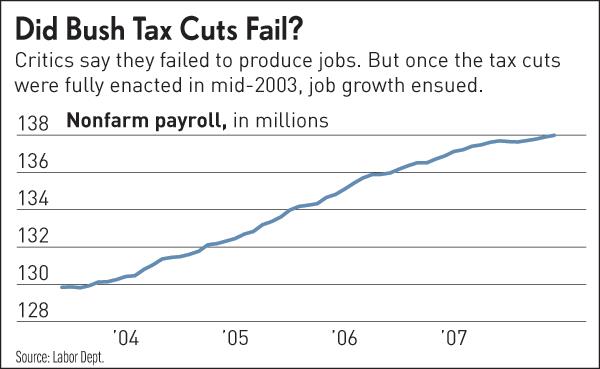
Via the RSC:
Why weren’t even more jobs created during the Bush years? Because we were at full employment for 5.5 years. John Merline says “A key attack line in President Obama’s campaign stump speech these days is to claim that the country has tried Mitt Romney’s economic policies already, and they were a dismal failure. ‘The truth is,’ Obama says, ‘we tried (that) for almost a decade, and it didn’t work.’ . . .
“The month after Bush signed that 2003 law, jobs and the economy finally started growing again. From June 2003 to December 2007, the economy added 8.1 million jobs, according to the Bureau of Labor Statistics.
“The unemployment rate fell to 5% from 6.3%. Real GDP growth averaged close to 3% in the four-plus years after that, and the budget deficit fell steadily from 2004 to 2007.
“What’s more, the rich ended up paying a larger chunk of the federal income tax burden after Bush’s tax cuts went into effect [This is true, I wrote about this in 2006 HERE – PoliticalArena Editor]. Obama is correct that the country has tried a combination of deregulation and tax cuts before; that took place under President Reagan.
“Reagan aggressively deregulated entire industries, while putting the brakes on new federal rules. As a result, regulatory compliance costs fell 8% during his time in office, and staffing dropped almost 7%. At the same time, Reagan’s tax cuts knocked taxes as a share of GDP down by 6%.
“The result was an almost eight-year economic boom in which real quarterly GDP growth averaged 4.3%. That’s nearly double the average growth rate Obama’s economic policies produced during the 3-year-old recovery.”
Some recovery… Obama and the Democrats have been running two trillion dollar deficits and economically we have so little to show for it.
WASHINGTON (AP) — The ranks of America’s poor are on track to climb to levels unseen in nearly half a century, erasing gains from the war on poverty in the 1960s amid a weak economy and fraying government safety net.
Census figures for 2011 will be released this fall in the critical weeks ahead of the November elections.
The Associated Press surveyed more than a dozen economists, think tanks and academics, both nonpartisan and those with known liberal or conservative leanings, and found a broad consensus: The official poverty rate will rise from 15.1 percent in 2010, climbing as high as 15.7 percent. Several predicted a more modest gain, but even a 0.1 percentage point increase would put poverty at the highest level since 1965.
Poverty is spreading at record levels across many groups, from underemployed workers and suburban families to the poorest poor. More discouraged workers are giving up on the job market, leaving them vulnerable as unemployment aid begins to run out. Suburbs are seeing increases in poverty, including in such political battlegrounds as Colorado, Florida and Nevada, where voters are coping with a new norm of living hand to mouth.
Is this the change you voted for?
The Mexican government has been working with the United States Department of Agriculture to increase participation in the Supplemental Nutrition Assistance Program (SNAP), or food stamps.
USDA has an agreement with Mexico to promote American food assistance programs, including food stamps, among Mexican Americans, Mexican nationals and migrant communities in America.
“USDA and the government of Mexico have entered into a partnership to help educate eligible Mexican nationals living in the United States about available nutrition assistance,” the USDA explains in a brief paragraph on their “Reaching Low-Income Hispanics With Nutrition Assistance” web page. “Mexico will help disseminate this information through its embassy and network of approximately 50 consular offices.”
The partnership — which was signed by former USDA Secretary Ann M. Veneman and Mexican Secretary of Foreign Affairs Luis Ernesto Derbez Bautista in 2004 — sees to it that the Mexican Embassy and Mexican consulates in America provide USDA nutrition assistance program information to Mexican Americans, Mexican nationals working in America and migrant communities in America. The information is specifically focused on eligibility criteria and access.
The goal, for USDA, is to get rid of what they see as enrollment obstacles and increase access among potentially eligible populations by working with arms of the Mexican government in America. Benefits are not guaranteed or provided under the program — the purpose is outreach and education.
Some of the materials the USDA encourages the Mexican government to use to educate and promote the benefit programs are available free online for order and download. A partial list of materials include English and Spanish brochures titled “Five Easy Steps To Snap Benefits,” “How To Get Food Help — A Consumer’s Guide to FNCS Programs,” “Ending Hunger Improving Nutrition Combating Obesity,” and posters with slogans like “Food Stamps Make America Stronger.”
When asked for details and to elaborate on the program, USDA stressed it was established in 2004 and not meant for illegal immigrants.
[Political Arena Editor Responds – That is what the Obama Administration said about Fast & Furious; the documentation revision for this program is dated Feb, 16, 2012.]
Union Bosses: “Green Jobs” – a lot of it is “Bullshit” like digging ditches and just refilling them…
James O’Keefe strikes again! This is how your public funds all too often get spent….
“Don’t use shovels, use spoons. It takes longer.” – Liberal economist Paul Krugman
Lets see there are about 20 million illegal aliens…..
Center for Immigration Studies:
Among the findings:
In 2009 (based on data collected in 2010), 57 percent of households headed by an immigrant (legal and illegal) with children (under 18) used at least one welfare program, compared to 39 percent for native households with children.
Immigrant households’ use of welfare tends to be much higher than natives for food assistance programs and Medicaid. Their use of cash and housing programs tends to be similar to native households.
A large share of the welfare used by immigrant households with children is received on behalf of their U.S.-born children, who are American citizens. But even households with children comprised entirely of immigrants (no U.S.-born children) still had a welfare use rate of 56 percent in 2009.
Immigrant households with children used welfare programs at consistently higher rates than natives, even before the current recession. In 2001, 50 percent of all immigrant households with children used at least one welfare program, compared to 32 percent for natives.
Households with children with the highest welfare use rates are those headed by immigrants from the Dominican Republic (82 percent), Mexico and Guatemala (75 percent), and Ecuador (70 percent). Those with the lowest use rates are from the United Kingdom (7 percent), India (19 percent), Canada (23 percent), and Korea (25 percent).
The states where immigrant households with children have the highest welfare use rates are Arizona (62 percent); Texas, California, and New York (61 percent); Pennsylvania (59 percent); Minnesota and Oregon (56 percent); and Colorado (55 percent).
We estimate that 52 percent of households with children headed by legal immigrants used at least one welfare program in 2009, compared to 71 percent for illegal immigrant households with children. Illegal immigrants generally receive benefits on behalf of their U.S.-born children.
Illegal immigrant households with children primarily use food assistance and Medicaid, making almost no use of cash or housing assistance. In contrast, legal immigrant households tend to have relatively high use rates for every type of program.
High welfare use by immigrant-headed households with children is partly explained by the low education level of many immigrants. Of households headed by an immigrant who has not graduated high school, 80 percent access the welfare system, compared to 25 percent for those headed by an immigrant who has at least a bachelor’s degree.
An unwillingness to work is not the reason immigrant welfare use is high. The vast majority (95 percent) of immigrant households with children had at least one worker in 2009. But their low education levels mean that more than half of these working immigrant households with children still accessed the welfare system during 2009.
If we exclude the primary refugee-sending countries, the share of immigrant households with children using at least one welfare program is still 57 percent.
Welfare use tends to be high for both new arrivals and established residents. In 2009, 60 percent of households with children headed by an immigrant who arrived in 2000 or later used at least one welfare program; for households headed by immigrants who arrived before 2000 it was 55 percent.
For all households (those with and without children), the use rates were 37 percent for households headed by immigrants and 22 percent for those headed by natives.
Although most new legal immigrants are barred from using some welfare for the first five years, this provision has only a modest impact on household use rates because most immigrants have been in the United States for longer than five years; the ban only applies to some programs; some states provide welfare to new immigrants with their own money; by becoming citizens immigrants become eligible for all welfare programs; and perhaps most importantly, the U.S.-born children of immigrants (including those born to illegal immigrants) are automatically awarded American citizenship and are therefore eligible for all welfare programs at birth.
The eight major welfare programs examined in this report are SSI (Supplemental Security Income for low income elderly and disabled), TANF (Temporary Assistance to Needy Families), WIC (Women, Infants, and Children food program), free/reduced school lunch, food stamps (Supplemental Nutrition Assistance Program), Medicaid (health insurance for those with low incomes), public housing, and rent subsidies.
Judicial Watch is also reporting this.
Spain now has a 21% national sales tax. This is what happens when socialist governments spend like crazy.
It is worse, in Spain their sales tax is in the form of a value added tax. This means that the tax is applied at every stage of production – The sugar, the flour, the water, the making of the dough, the baking, the packaging and finally the selling. That adds up to one expensive loaf of bread. This is who elite Democrats and academics say we should emulate.
CNBC:
Prime Minister Mariano Rajoy announced a swathe of new taxes and spending cuts on Wednesday designed to slash 65 billion euros from the budget deficit by 2014 as recession-plagued Spain struggles to meet tough targets agreed with Europe.
Rajoy, of the center-right People’s Party, proposed a 3-point hike in the main rate of Value Added Tax on goods and services to 21 percent, and outlined cuts in unemployment benefit and civil service pay and perks in a parliamentary speech interrupted by jeers and boos from the opposition.
“These measures are not pleasant, but they are necessary. Our public spending exceeds our income by tens of billions of euros,” Rajoy told parliament.
He also announced new indirect taxes on energy, plans to privatize ports, airports and rail assets, and a reversal of property tax breaks that his party had restored last December.
We all knew that NBC was in the tank, but wow this is a sight to see. This interview was so factually lopsided he just ends laughing at her.
At the end, what Sununu says about small business is true. Most small businesses exist as labors of love that don’t make profits and/or just exist on paper. The small percentage of small businesses that actually have employees do 70% of the hiring in this country.
As far as outsourcing, Bain was able to help almost 80% of the companies it invested in and only a small number of them engaged in heavy outsourcing. NBC and the Democrat media complex thinks that the American people will be more interested in what Mitt Romney does with his own money, than what Barack Obama does with yours. Some estimates show that $29 BILLION of your “Obama” stimulus dollars went overseas almost directly. That dwarfs anything that Mitt Romney did with his money or Bain’s.
The RNC has a website called Obamanamics Outsourced that lists how many jobs Obama outsourced to other countries using your tax dollars.
This is incredible.
“I don’t care about my critics, I understand that my country is at a very perilous situation and I’m going to use the type of words that are necessary to get the attention of the American people.”
“I want to make sure that the United States of America, that has been around for 236 years as the beacon of liberty, freedom and democracy, continues on for our subsequent generations. Our children and grandchildren. And I really don’t care about critics. I really don’t care about the liberal media”.
President Obama’s former Communications Director Anita Dunn said that Mao (the largest communist mass murderer in world history) was the philosopher she looked to most. Former Green jobs Czar Van Jones is a self admitted communist revolutionary and the list goes on…
China’s attempt at a high-speed rail network is fraught with corrupt officials, impossible costs, and deadly safety failures. But U.S. Transportation Secretary Ray LaHood wishes America would follow it as a model.
LaHood told The Cable last week:
The Chinese are more successful [in building infrastructure] because in their country, only three people make the decision. In our country, 3,000 people do, 3 million. In a country where only three people make the decision, they can decide where to put their rail line, get the money, and do it. We don’t do it that way in America.
His comments are stunning. Yes, that’s how Communists do it: A few people make decisions for the country and control the money, land, resources, and workers. And how has that worked out?
“Rather than demonstrating the advantages of centrally planned long-term investment, as its foreign admirers sometimes suggested, China’s bullet-train experience shows what can go wrong when an unelected elite, influenced by corrupt opportunists, gives orders that all must follow — without the robust public discussion we would have in the states.” That sounds like a direct rebuttal to LaHood, but Washington Post editorial writer Charles Lane wrote that back in April 2011.
The Telegraph (U.K.) reported in February that 70 percent of China’s railway projects had been suspended, as its railways ministry attempted to continue deficit financing while facing slow ticket sales. Last year, a deadly train crash brought safety concerns and corruption at the highest levels of the railway to light.
The bottom line is that high-speed rail is like pouring money down a hole. China’s official institutions aren’t known for transparency, but according to the Voice of America, “Even the [Chinese] national research institution, the Academy of Science, reported last year that at current investment and estimated passenger numbers, the trains will never collect enough in fares to repay construction loans.”
LaHood—and President Obama—advocate high-speed rail in America by evoking the image of thousands of workers on the project. It’s part of their stimulus-funded plan to get America back to work. But once again, China’s experience demonstrates that government spending on infrastructure has not helped the Chinese economy.
Obama and the Democrat Party leadership after saying it was not a tax, directed their lawyers in court to argue that it is a legal tax and now the Obama campaign is saying that they never said it was a tax and that the SDupreme Court got it wrong when they agreed wih the argument form Obama’s own lawyer.
[Actually there are 21 new taxes in ObamaCare several of which target the chronically ill and disabled – LINK – LINK – LINK – Editor]
I mean, we cant have incentives that are deigned to help people make smart health care choices and actually save money, not when we are trying to bankrupt the country…
I first reported on this story on my old college blog when our friend Amity Shleas wrote an article about Obama moving to kill the popular and budget saving program called HIP. Why? Well Mitch Daniels is our governor and the Obama Administration did not want such a successful program written by a popular Republican governor to get any publicity.
Indiana once again tried to save HIP by asking for a waiver and Obama once again is determined to kill the program.
Obama Administration Denies Waiver for Indiana’s Popular Medicaid Program
In 2007, under Gov. Mitch Daniels (R.), Indiana enacted the Healthy Indiana Plan, an expansion of Medicaid that used consumer-driven health plans to encourage low-income beneficiaries to take a more active role in their own care. Today, Healthy Indiana is the most innovative and successful reform of Medicaid in the history of the program. Today, we learn that the Obama Administration has rejected the state’s request to extend its federal waiver, which means that over 45,000 Indianans who get their insurance through the program are out of luck.
Medicaid, of course, is the nation’s government-run health insurance program for the poor. In theory, it’s jointly run by the federal government and the states, but in reality, any time a state wants to make the tiniest changes in its Medicaid program, it has to go hat-in-hand to the U.S. Department of Health and Human Services with a formal request for a waiver, and these waivers are usually denied.
Indiana succeeded in gaining a waiver in 2007 because it was seeking to expand Medicaid to a group of people who weren’t then eligible for the program, and because the state’s effort required no additional outlays from the federal government (the Medicaid expansion was paid for with a 44-cent increase in the state’s cigarette tax.)
Structure of Indiana’s consumer-driven Medicaid plan
Beneficiaries get a high-deductible health plan and a health savings account, called a POWER account, to which individuals must make a mandatory monthly contribution between 2 to 5 percent of income, up to $92 per month. Participants lose their coverage if they don’t make their contributions within 60 days of their due date. After making this contribution, beneficiaries have no other cost-sharing requirements (co-pays, deductibles, etc.) except for non-urgent use of emergency rooms. The state chips in $1,100, which corresponds to the size of the would-be deductible.
Those who have money remaining in their POWER accounts at the end of the year can apply the balance to the following year’s contribution requirements, if they have obtained a specified amount of preventive care: annual physical exams, pap smears and mammograms for women, cholesterol tests, flu shots, blood glucose screens, and tetanus-diphtheria screens.
“We did a lot of reading on criticism of health savings accounts,” says Seema Verma, who was the architect of the Indiana program. “One of the criticisms was that people didn’t have enough money to pay for preventive care. So we took preventive care out, made that first-dollar coverage. Also, people said that people didn’t have enough for the deductible, so we fully funded it. Then, you have to make your contribution every month, with a 60-day grace period. If you don’t make the contribution, you’re out of the program for 12 months. It’s a strong personal responsibility mechanism.”
Indiana’s Medicaid successes
The program has been, by many measures, a smashing success. “What we’re finding out is that, first of all, low-income people are just as capable as anybody else of making wise decisions when it’s their own money that they’re spending,” Mitch Daniels explains in a Heritage Foundation video. “And they’re also acting more like good consumers. They’re visiting emergency rooms less, they’re using more generic drugs, they’re asking for second opinions. And some real money is starting to accumulate in their [health savings] accounts.”
The program has been overwhelmingly popular in Indiana. There’s a large waiting list—in the tens of thousands—to enroll in Healthy Indiana; enrollment was capped in order to ensure that the program’s costs remain predictable. 90 percent of enrollees are making their required monthly contributions. “The program’s level of satisfaction is at an unheard-of 98 percent approval rating,” Verma told Kenneth Artz. Employers didn’t dump their workers onto the program, crowding others out, because you needed to be uninsured for six months in order to be eligible for it.
A 2010 study by Mathematica Policy Research found that the program dramatically increased the percentage of beneficiaries who obtained preventive care, from 39 percent in the first six months of enrollment to 59 percent after one year. Of the members who had money left in the POWER accounts at the end of the year, 71 percent met the preventive care requirement and were able to roll the balances over to the following year. (The remaining 29 percent could roll over their personal contributions, but not the state contributions to their POWER accounts.)
This is an astounding achievement, given that the biggest problem with Medicaid is the way that it ghettoizes its participants, preventing them from gaining access to routine medical and dental care. This lack of physician access is the biggest reason why health outcomes for Medicaid patients lag far behind those of individuals with private insurance, and even behind those with no insurance at all. Healthy Indiana has completely reversed this trend, achieving preventive care participation rates that are higher than the privately-insured population.
Niall Ferguson is an award winning historian and economic historian who’s work is recognized around the world. This very web site contains several pieces of his work.
The economic historian, who is affiliated to Oxford and Harvard Universities, says wise young voters should insist politicians pay off debts as soon as possible for the benefit and security of their own financial interests.
Speaking at the Reith Lectures on Tuesday, Professor Ferguson will argue the “young should welcome austerity,” adding they “find it quite hard to compute their own long-term economic interests.”
In his first lecture, which will be broadcast on BBC Radio 4 on Tuesday, Prof Ferguson will insist the current public debt “allows the current generation of voters to live at the expense of those as yet too young to vote or as yet unborn.”
“It is surprisingly easy to win the support of young voters for policies that would ultimately make matters even worse for them, like maintaining defined benefit pensions for public employees,” he says in an article ahead of the lecture.
He adds: “If young Americans knew what was good for them, they would all be in the Tea Party.”
Professor Ferguson argues the true size of government debt in Western democracies is many times larger than “deeply misleading” figures issued in the form of bonds because they do not record unfunded liabilities of social security and health care schemes.
“The last corporation to publish financial statements this misleading was Enron,” he wrote.
“These mind-boggling numbers represent nothing less than a vast claim by the generation currently retired or about to retire on their children and grandchildren, who are obligated by current law to find the money in the future, by submitting either to substantial increases in taxation or to drastic cuts in other forms of public expenditure,” he said.
He argues one of the ways out of the current economic “mess” would be for “a heroic effort of leadership” to persuade all generations to “vote for a more responsible fiscal policy.”
Read the rest HERE.
The elite media will often report news like this on their web site so they can say they reported it, but don’t expect it to be highlighted in the evening broadcast…
CBS:
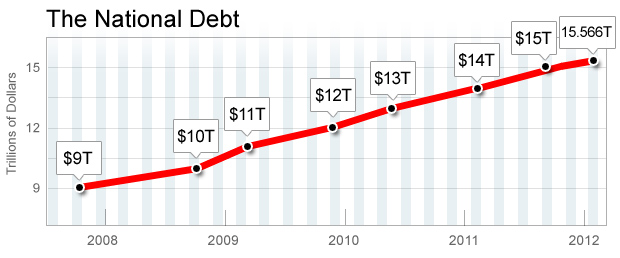
(CBS News) The National Debt has now increased more during President Obama’s three years and two months in office than it did during 8 years of the George W. Bush presidency.The Debt rose $4.899 trillion during the two terms of the Bush presidency. It has now gone up $4.939 trillion since President Obama took office.
The latest posting from the Bureau of Public Debt at the Treasury Department shows the National Debt now stands at $15.566 trillion. It was $10.626 trillion on President Bush’s last day in office, which coincided with President Obama’s first day.
The National Debt also now exceeds 100% of the nation’s Gross Domestic Product, the total value of goods and services.
Mr. Obama has been quick to blame his predecessor for the soaring Debt, saying Mr. Bush paid for two wars and a Medicare prescription drug program with borrowed funds.
The federal budget sent to Congress last month by Mr. Obama, projects the National Debt will continue to rise as far as the eye can see. The budget shows the Debt hitting $16.3 trillion in 2012, $17.5 trillion in 2013 and $25.9 trillion in 2022.
Federal budget records show the National Debt once topped 121% of GDP at the end of World War II. The Debt that year, 1946, was, by today’s standards, a mere $270 billion dollars.
Mr. Obama doesn’t mention the National Debt much, though he does want to be seen trying to reduce the annual budget deficit, though it’s topped a trillion dollars for four years now.
As part of his “Win the Future” program, Mr. Obama called for “taking responsibility for our deficits, by cutting wasteful, excessive spending wherever we find it.”
His latest budget projects a $1.3 trillion deficit this year declining to $901 billion in 2012, and then annual deficits in the range of $500 billion to $700 billion in the 10 years to come.
[Political Arena Editor Chuck Norton Comments: The FY2007 Budget which was the last one mostly controlled by the Republicans had a yearly deficit of less than $200 billion.]
If Mr. Obama wins re-election, and his budget projections prove accurate, the National Debt will top $20 trillion in 2016, the final year of his second term. That would mean the Debt increased by 87 percent, or $9.34 trillion, during his two terms.
Currently, as the chart shows, debt per American is at (or around) $50,000. Just four years ago, in 2008, the year President Obama was first elected, debt per person was at $35,000.
In 2037, if things stay relatively the same, debt per American will be at $147,000.
In that year, according to Republican side of the Senate Budget Committee, “the federal government will spend $2.7 trillion per year in interest payments alone, representing more than a quarter of our entire budget that year and greater than the total federal budget in 2003.”
Per American family, on average, debt will stand at $382,000 in 2037, only 25 years from now. That figure constitutes an increase of $287,000 per family.
The CBO’s numbers were released yesterday as part of its “long-term outlook.” The non-partisan governmental organization warns, “waiting to address the long-term budgetary imbalance and allowing debt to mount in the meantime would be detrimental to future generations.”
And this is just debt and obligations that are on the books. With of budget trickery and the fact that the CBO uses static models with assumptions that are handed to it by politicians the actual figure is worse.
President Obama has shelled out more in federal spending than the five presidents that came before him.
A new chart by the Comeback America Initiative (CAI), a non-partisan group dedicated to promoting fiscal responsibility by policymakers, shows federal spending by president as a percentage of GDP, and it doesn’t reflect well on Obama.
“There has been a dramatic increase in spending under the Obama administration,” David Walker, Founder and CEO of CAI, told Whispers. “Most of it is attributable to year one of his presidency and the stimulus… but President Obama has continued to take spending to a new level.”
Federal spending was close to 20 percent under the Carter administration, dropped to 18 percent under Clinton, and is currently at an incredible 24 percent of GDP. According to the Congressional Budget Office, federal spending may hover around 22 percent for the next decade.
Federal spending is also higher this year than any year since 1949. The last time spending was higher—in 1946, it was 24.8—the country was just coming down from the exorbitant rates of spending during World War II.
GOP presidential candidate Mitt Romney has said he would cut federal spending down to just 17 percent of GDP.
President Obama is facing some heat over the economy Friday after a depressing job report showed the jobless rate climbed to 8.2 percent in May.
$870,000 in debt the day he graduates from high school…..
By Charlie Kirk
In two weeks I will graduate from Wheeling High School. It is going to be a day to remember for the rest of my life. My principal will hand me a diploma, but that diploma is also an invoice for $870,000 – my share of America’s 2012 debt burden. The average American earns $1.3 million during their working career. When we factor in future deficit spending and interest, every single high school student owes the federal government more than they will ever earn in their lifetime. Since the day I was born, the United States has accrued eleven trillion dollars worth of new debt; and for those eighteen years of my existence, I haven’t even had a say in it.
Last August, as I watched our divided government tear our democracy apart, my friend Mike Diamond and I decided to take action against Washington’s disregard for the future of this country.
It all began as an idea, to speak for our generation, the one who will be paying for Washington’s massive debts and deficits.
Mike and I spoke at political organizations all across Illinois, working our way up the local political ladder. As we progressed we noticed individuals were very sympathetic to our cause; not only because we are students, but because it’s difficult to argue with common sense.
Growing up I was taught the basic principle of not spending money I don’t have. However, this traditional American value seems to have sunk in a sea of debt.
Over the past two months Mike and I began organizing a network of concerned students from all across the country. Through Facebook and Twitter we reached over four million people. Our message of fiscal responsibility and living within your means was resonating all across the country.
We decided, in collaboration with close friends and family, to name our organization SOS Liberty. SOS is the international distress call for help, which is appropriate since my generation is drowning in an ocean on debt. Without real solutions and reforms we will never be able turn this ship around. But first, the distress call has to be heard.
I noticed that politics was the last thing on my friends’ minds. “I’ll start caring about politics when I turn eighteen,” they would say. Unfortunately, most teenagers do not have an “on” and “off” switch that flips the day they turn eighteen, making them care about politics. Most teenagers don’t realize that they will be stuck with a tab that’s been running for generations. They don’t realize that every cent will have to be paid back — plus interest.
That’s where SOS Liberty comes in. Our goal is to change the conversation. Change the conversation of teenagers, so they realize the negative implications of such a large debt.
Read more: http://www.foxnews.com/opinion/2012/06/01/high-school-student-message-for-washington

 Political Arena