This situation makes the U3 unemployment number look better than the actual unemployment problem is. Using the U3 number those who get part time jobs and those who give up on looking for gainful employment are not counted among the unemployed.
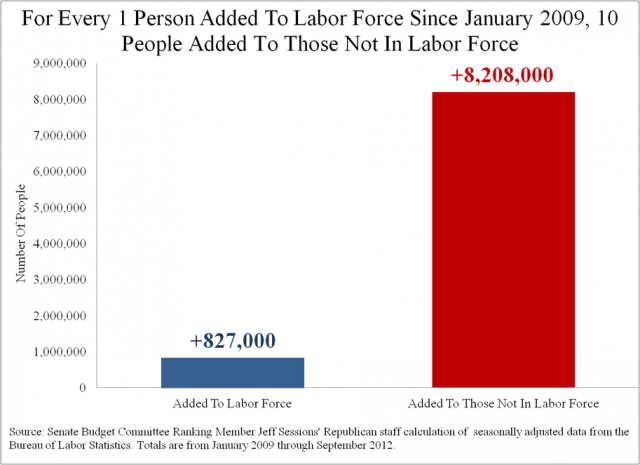
“For Every 1 Person Added To Labor Force Since January 2009,” the chart reads, “10 People Added To Those Not In Labor Force.”
That is, in nearly the four years, since President Obama took office in January 2009, only 827,000 people have been added to the labor force, while during that same time period, 8,208,000 have been added to those not in the labor force.
The chart relies on data available from the federal Bureau of Labor Statistics.
“The numbers represented in the chart are a measure of growth from January 2009 through September 2012,” the Republican side of the Senate Budget Committee explains. “The data is sourced from the Bureau of Labor Statistics’ Current Population Survey, a sample of 60,000 households conducted by personal and telephone interviews. Basic labor force data are gathered monthly. The labor force consists of all people aged 16 and over either employed or actively seeking work. It does not include discouraged workers, people who have retired, or those on welfare or disability who are no longer looking for work. The ‘not in the labor force’ group is defined as the total civilian non-institutional population minus the labor force.”
Since January 2009, the labor force has grown by 0.54 percent, or 827,000 people (from 154,236,000 to 155,063,000). Those not in the labor force grew by 10.2 percent during the same period (8,208,000 people), from 80,502,000 to 88,710,000. In other words, for every one person added to the labor force of the United States since January 2009, the size of the U.S. population not in the labor force grew by 10 people.

 Political Arena