A looming increase in the capital-gains tax rate next year is fueling sales of some privately-held businesses.
Many business owners—mostly founders who could gain a lot from a sale—are looking to close deals before next year, when the maximum tax on investment income is scheduled to rise from 15% currently to at least 23.8% on most capital gains, at least for higher-income households. Many sellers intend to convert their equity into retirement funds or just start anew.
“It just made more sense for me to take my chips off the table and go do something else,” said Bert Wolf, 60 years old, who has an agreement to sell his compressed-gas business, Acetylene Oxygen Co. of Harlingen, Tex., before year-end.
Mr. Wolf added that if he waited until after the tax increase to sell, he would have to expand the business at the current rate “for at least 3 or 4 more years to achieve the same after-tax sales dollar.” He is profiting on the sale of his business to PraxairInc., a public company.
“There’s a kind of a panic on to get things done,” said Beatrice Mitchell, co-founder of Sperry, Mitchell & Co. Inc., a New York investment bank that is advising Mr. Wolf on the sale.
The top tax rate will go up at year-end by at least 3.8 percentage points because of a provision in President Barack Obama’s health-care overhaul law. But that will be added onto a top rate that will depend on negotiations between Mr. Obama and Congress after the November election, when they are expected to seek a deal on numerous tax and spending measures.
Mr. Obama and Congress agreed in late 2010 to extend the current 15% capital-gains tax rate through this year. Absent further action, the top capital gains tax rate will rise to 20% on Jan. 1. After adding the extra charge from the health-care law for higher-income households, the maximum tax on investment income would be 23.8%. When combined with the scheduled expiration of some other tax breaks for high earners, the maximum tax on investment income would be as high as 25%.
Many Republican lawmakers want to extend the 15% rate. If they prevail, the maximum tax likely would rise to at least 18.8% because of the health-care charge.
Mr. Obama proposes to let the top capital gains tax rate rise to 20% on income above $250,000 for couples, but hold it to 15% on income below that threshold.
But here is the rub, most “couples” that make 250k aren’t the one’s who pay these taxes, small businesses and investors do. It directly chases jobs and investment out of the country.
Singer and liberal activist Bruce Springsteen is well … a man of the people.
“He stands up for the little guy. A regular blue-collar Joe. A union man. A bona fide working-class hero.
And, when he’s not busy being all that… he’s a tax-dodging liberal hypocrite worth over $200 million who pretends to be a farmer to save hundreds of thousands of dollars on his property taxes that would have otherwise funded the welfare programs he pretends to care about.”
Recall that Springsteen actively campaigned for Obama in 2008, hosting free concerts that attracted tens of thousands of people in key battleground states. Springsteen’s song, “The Rising,” became a campaign staple for Obama’s speech venues and culminated in him playing for Obama’s Inauguration. And this time around, the White House plans on using the aging rocker’s new politically-motivated track, “We Take Care of Our Own,” to warm up crowds as the re-election bid kicks into high gear.
~snip
Bruce Springsteen pays over $138,000 a year in taxes for his three-acre home in Colts Neck, New Jersey. He owns another 200 adjoining acres. But because he has a part-time farmer come and grow a few tomatoes (organic, of course) and has horses, his tax bill on the remaining 200 acres is just $4,639 bucks. Do the math. By being a fake farmer, the working-class zero Springsteen is making a mint by robbing New Jersey of the antipoverty program funds he says they desperately need.
“I think it is unfair to our other property taxpayers that if you are a fake farmer, and that you don’t legitimately farm, that you are getting a property tax break and forcing your neighbor to pick up your tab,” said state senator Jennifer Beck. “That was not the intent of the law. It’s a violation of the public trust.” When Fox 5 New York reporter Barbara Nevins Taylor asked a lawyer for the trust that owns Springsteen’s land to comment on the Boss’s lucrative fake-farming tax breaks, predictably, the lawyer had no comment.
The tax loophole comes from the New Jersey’s Farmland Assessment Act of 1964. Originally the provision was created to help preserve agriculture in New Jersey. To qualify for the tax break, landowners must own at least five acres of land and produce just $500 a year in goods in order to qualify. Anyone who can meet those minimum standards can reduce their farmland tax bills by an astounding 98 percent.
Wealth goes where it is treated well. It should be the first rule of economics. When a bunch of radicalized leftists in Illinois demonize you for daring to start a good business and create jobs why stay?
CHAMPAIGN – The founder of Jimmy John’s said he has applied for Florida residency and may recommend that his corporate headquarters move out-of-state as a result of the Illinois tax increases enacted last week.
Jimmy John Liautaud told The News-Gazette on Tuesday that he is angry about the moves, which boosted the individual income tax from 3 percent to 5 percent and the corporate income tax from 7.3 percent to 9.5 percent.
“All they do is stick it to us,” he said, adding that the Legislature and governor showed “a clear lack of understanding.”
“I could absorb this and adapt, but it doesn’t feel good in my soul to make it happen,” Liautaud said.
Jimmy John’s, which has its corporate headquarters on Fox Drive in Champaign, has more than 1,000 sandwich shops nationwide, many of them franchise operations.
Champaign has been its corporate base, but Liautaud said it will not necessarily continue that way.
Liautaud said he has been contacted by “multiple pro-business states” that made him feel “wanted and important.”
“I enjoy being courted and the process,” he said.
Once he collects information on alternative sites, he will present it to the company’s board of directors and ask the board to decide.
As for himself, “my family and I are out of here,” he said.
Lets hope he keeps this promise, but even so, his plan, even if it becomes law, might not be bold enough to help solve the economic, fiscal and finance problems we are facing today.
Joe Donnelly is a member of the House of Representatives in Indiana’s 2nd Congressional District (South Bend) and is running for Senate in Indiana against Republican Dick Mourdock.
In the interests of full disclosure, Joe is my Congressman and I have talked with him a few times.
Joe Donnelly is one of “those” swing district politicians. What do I mean by that? Donnelly plays a very dishonest balancing act of keeping his right foot in Indiana and his far left foot in DC. Joe Donnelly is a reliable vote for the far left on any close vote, but on some big votes where the party leadership knows it has enough to pass what they like, Donnelly will vote ‘No’ so he can come home and tell the South Bend Tribune what an independent conservative Democrat he is; all while ensuring that Pelosi and the Democrat leadership get what they want. The most famous player of this game in Indiana politics is former Congressman Tim Roemer, who of course is also from South Bend.
One of the most famous examples of Roemer’s play of this style of politics was on the 1993 Clinton tax increase and budget. Roemer voted to preserve Clinton’s new taxes and spending increases in the new budget 44 times in votes as the Bill was being amended and debated, but on the final vote, knowing it had enough voted to pass the House, he voted ‘No’ so he could come home and tell the people that the Clinton Budget spent and taxed too much.
MSNBC’s Lawrence O’Donnell once said that we need ‘Blue Dogs’ like Donnelly because they help cover what the real socialists are doing.
Indiana has a great deal of medical device manufacturing, Bayer, Miles Labs, and countless others have a long history here. While the 2.3% tax that Donnelly voted for on medical devices might not seem like a lot if you are talking about a device such as a personal blood sugar meter from Bayer, which is made in Donnelly’s home district, on a top of the line MRI Machine that tax translates into a $11,500 tax on every machine. In order to stay competitive with overseas competition cuts will have to be made and often that means outsourcing. While not every medical device costs as much as an MRI, X-Ray machines and defibrillator’s etc still cost tens of thousands of dollars so the 2.3% tax makes the difference between being competitive and non-competitive. While Democrats are still struggling to explain how ObamaCare will make health care cheaper by slapping over 20 new taxes on it, the medical device tax is already costing Indiana much needed jobs:
An Indiana company’s decision to scrap expansion plans due to a looming tax on medical devices has renewed pressure on the Senate to consider a House-passed bill repealing the tax.
House Speaker John Boehner, in a written statement, urged the Senate to take up the bill “as soon as possible.”
Companies in the medical device industry for months have been calling on Congress to strip the provision. Amid the complaints, though, several firms have already taken steps to cut back U.S. investment out of concern for the tax’s impact.
Cook Medical, an Indiana-based medical equipment manufacturer, last week said it’s nixing plans to open five new plants in the next five years — claiming the tax will cost between $15 million and $30 million a year, cutting into money that would otherwise go toward expanding into new facilities in the Midwest.
“Unfortunately, we have had to shelve these expansion plans and look overseas for that,” Allison Giles, vice president for federal affairs with the company, told FoxNews.com. “It’s a huge amount for us.”
An Indiana company’s decision to scrap expansion plans due to a looming tax on medical devices has renewed pressure on the Senate to consider a House-passed bill repealing the tax.
House Speaker John Boehner, in a written statement, urged the Senate to take up the bill “as soon as possible.”
Companies in the medical device industry for months have been calling on Congress to strip the provision. Amid the complaints, though, several firms have already taken steps to cut back U.S. investment out of concern for the tax’s impact.
Cook Medical, an Indiana-based medical equipment manufacturer, last week said it’s nixing plans to open five new plants in the next five years — claiming the tax will cost between $15 million and $30 million a year, cutting into money that would otherwise go toward expanding into new facilities in the Midwest.
“Unfortunately, we have had to shelve these expansion plans and look overseas for that,” Allison Giles, vice president for federal affairs with the company, told FoxNews.com. “It’s a huge amount for us.”
She urged the Senate to take up the repeal bill, even if it has to wait for the post-election lame-duck session.
“We’re hoping that members will look at this, not so much as a health care provision, but as a jobs provision,” she said.
The Affordable Care Act imposed the 2.3 percent tax on medical devices beginning in 2013. It is projected to raise nearly $30 billion over the next decade — the House voted to repeal it last month.
The Obama administration argues that claims the tax will shift jobs overseas are overblown.
Since the Bush tax cuts “the rich” have been paying a larger share of the federal tax pie, but that pie has been shrinking as more wealth flees the country, more of the wealthy expatriate, more jobs leave the country, and more people drop out of the workforce.
[Editor’s Note – The raw CBO report can be found HERE]
President Barack Obama says someone has to pay more taxes if the U.S. is to tame its budget deficit and provide the government he thinks the nation needs. He proposes that the best-off Americans pay more. It’s only fair, he says.
“There are a lot of wealthy, successful Americans who agree with me because they want to give something back,” he said in a speech in Roanoke, Va., that set off dueling campaign ads. “Look, if you’ve been successful, you didn’t get there on your own.”
His Republican opponent, Mitt Romney, counters that the deficit can be reduced without raising taxes if Washington is tough on spending. He thinks raising taxes on the best-off would be unwise and unfair. “President Obama attacks success, and therefore under President Obama we have less success,” he said.
The contrasting comments underscore philosophical differences over the roles of the individual and society. But the most tangible disagreement is on taxing the rich.
“Who’s right: Obama or Romney? Both. Or neither,” says Joseph Thorndike, a tax historian. “When it comes to taxing the rich, there is no single, objectively correct answer. You can talk all you want about asking rich people to pay ‘their fair’ share,’ but don’t kid yourself. You’re just trying to turn private opinions into public policy.”
“I’m struck” he adds, “how the facts can be used selectively by either side.”
Academic tomes have been written about revamping the tax code so it finances the government while doing less damage to economic growth. But, countless congressional hearings later, the U.S. is no closer to a consensus on “fair share” than when the income tax was born 100 years ago.
The top marginal income-tax rate, the most visible metric, has gone from 7% in 1913 to 92% in the 1950s to 28% with the Tax Reform Act of 1986 to 39.6% in the Clinton years to today’s 35%. Mr. Obama wants to raise that; Mr. Romney wants to cut it while eliminating loopholes and deductions to make up the lost revenue.
Over the past three decades, Americans—including most of the rich—have paid less of their incomes to Washington. Top earners have received more of the income and paid more of the taxes; a growing number at the bottom have paid less or, in some cases, nothing.
Whether that is fair is a question of politics and values. Facts can inform the debate. Here are a few salient ones:
The top 5%, top 1% and top 0.1% of Americans have been getting a bigger slice of all the income and paying a growing share of federal taxes.
To measure the tax burden over time, Congressional Budget Office economists look beyond income-tax returns. They add federal income, payroll, excise and corporate taxes and calculate them as a percentage of income, broadly defined to include wages plus the value of government- and employer-provided benefits.
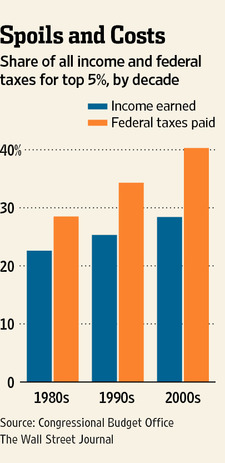
From Ronald Reagan to Barack Obama, the tax code has been tweaked and the economy has had its ups and downs, and the share of federal taxes paid by the top 5% and the top 1% has risen faster than their share of income:
In the 1980s, the top 5% averaged 22.6% of income and paid 28.5% of taxes.
In the 1990s, the top 5% averaged 25.3% of income and paid 34.3% of taxes
In the 2000s, the top 5% averaged 28.4% of the income and paid 40.3% of the taxes.
That doesn’t mean that the best-off are living on less. The top 1% averaged income of $1,530,773 this year (up $174,083 from 2004, when the data series begins) and paid federal taxes of all sorts of $422,915 (up $20,704 from 2004), according to estimates by the Tax Policy Center, a number-crunching joint venture of the Brookings Institution and Urban Institute.
Average tax rates have come down for everyone. On average, the tax bite on the rich is bigger—except for those whose income mainly comes from capital gains and dividends.
Across the earnings spectrum, Americans’ share of income that went to taxes fell in the 1980s, rose in the 1990s and fell again in the 2000s. This year, taxes and other receipts will cover only two-thirds of federal spending; the government will borrow the rest.
For those in the top 1%, whose incomes are more volatile than others, the average tax bite in 2007 was 28.9%, below the 1995 Clinton-era peak (35.3%) but higher than the 1986 Reagan-era trough (24.6%.)
Most Americans, though, have seen the share of their income that goes to taxes fall steadily. For earners in the middle, the tax bite eased from 18.9% in 1979 to 16.6% in 1999 to 14% in 2007 even before the recession and recession-fighting tax cuts.
The rich do, on average, pay more of their income in taxes than the middle class. So do the super-rich—on average.
The annual Internal Revenue Service scorecard of the top 400 taxpayers—who reported average incomes of $200 million—showed they paid 19.9% of their adjusted gross income in federal income taxes in 2009, well above the rate paid by the middle class. Those with incomes between $100,000 and $200,000, for instance, paid about 12%. (The IRS tally for the top 400 counts only income reported on tax returns, and only income taxes. Neither the IRS nor CBO calculates figures for the 1% using the broader definitions of income and taxes.)
The fortunate 400, though, paid a lower rate than the not-quite-so-rich, those with incomes over $1.5 million. The main reason: More than 60% of the top 400’s income was from dividends or capital gains in 2009, and those are taxed at a top rate of 15%, lower than many pay on wages.
The share of taxes paid by the bottom 40% of the population has been shrinking along with their share of income.
In 2007, the bottom 40% received 14.9% of the income (including the value of government benefits) and paid 5.9% of all federal taxes. In 1979, they had a bigger share (17.4%) of the income and paid more (9.5%) of the taxes.
When President Obama was campaigning in 2008, he spoke often of his desire to limit the influence of lobbyists in Washington. There’s only one problem: the more government involves itself in the private sector, the more private businesses needs to hire lobbyists to make sure that new laws and regulations don’t put them out of business. Inevitably, the next step involves campaign contributions to key lawmakers, protection money that ensures that the law favors those with the right political connections.
In the case of Obamacare, this phenomenon shows up in manifold ways. Roy Poses highlights the story of how Dr. Elias Zerhouni, former head of the National Institutes of Health, had leveraged his position into lucrative corporate packages. Timothy Carney of the Washington Examiner has been tracking a long list of Washington officials and staffers who are taking advantage of “The Great Health-Care Cashout.”
Then came the news last week the Department of Health and Human Services has granted over 700 waivers[Note – this number is up to 1,200 last we checked – Political Arena Editor] to Obamacare’s obtuse rule that businesses drop “mini-med” plans in favor of more expensive, comprehensive coverage. Many businesses, such as McDonald’s, were faced with dropping their health coverage entirely, rather than face the prohibitive expense of complying with the new law. So rather than repealing the regulation, HHS has taken it upon itself to grant waivers arbitrarily to those whom it deems fit.
The Casablanca-style shocker is that, of the more than 2 million workers who will benefit from the HHS waivers, 40 percent belong to labor unions[as of 2011] “Waivers for Favors,” as Michelle Malkin memorably put it:
The Teamsters Union, which hailed Obama last March for “enacting historic health care reform, providing health insurance to millions of Americans who don’t have it and controlling costs for millions more who do,” obtained waivers for 17 different locals.
The United Food and Commercial Workers International Union (UFCW), which celebrated the passage of Obamacare as “an achievement that will rank among the highest in our national experience,” secured waivers for 28 different affiliates.
The International Brotherhood of Electrical Workers — which exulted after the health-care law’s passage that “finally, affordable and comprehensive health care coverage will be available for millions of working Americans” — saw eight of its affiliates win shelter from the Obamacare wrecking ball.
The Communications Workers of America, which sent its workers to lobby for Obamacare on Capitol Hill as part of the Health Care for America Now front group funded by left-wing billionaire George Soros, snagged a waiver that will spare a hefty 19,000 of its members from the onerous federal mandate.
And the Service Employees International Union, which poured $60 million into Democratic/Obama coffers in 2008 and millions more into the campaign for the federal health-care takeover, added four new affiliates to the waiver list: SEIU Local 2000 Health and Welfare Fund, representing 161 enrollees; SEIU 32BJ North Health Benefit Fund, representing 7,020 enrollees; SEIU Local 300, Civil Service Forum Employees Welfare Fund, representing 2,000 enrollees; and SEIU Health & Welfare Fund, representing 1,620 enrollees.
That’s in addition to three other previous SEIU waiver winners: Local 25 SEIU in Chicago with 31,000 enrollees; Local 1199 SEIU Greater New York Benefit Fund with 4,544 enrollees; and SEIU Local 1 Cleveland Welfare Fund with 520 enrollees. This brings the total number of Obamacare-promoting SEIU Obamacare refugees to an estimated 45,000 workers represented by seven SEIU locals.
According to the Bureau of Labor Statistics, labor unions represent less than 7 percent of the private sector workforce, compared to 40 percent of HHS’ waivers. Does anyone seriously believe that HHS is handing these waivers out based on merit and need, rather than political self-interest?
With Most Of Europe Still On Its Back, Sweden Tries Policies That Actually Work.
While the rest of Europe and the United States have gone on massive spending sprees fueled by government borrowing and tax hikes, Sweden took a different approach. In the Spring 2012 Economic and Budget Policy Guidelines, the Swedish Government and its Finance Minister, Anders Borg, have laid out a plan that is focused on lowering taxes. Their rationale? “When individuals and families get to keep more their income, their independence and their opportunities to shape their own lives also increase.”
Borg also wants to lower the corporate tax rate as a way of meeting the government’s goal of “full employment”. The government has already cut property taxes and other luxury taxes on the rich to lure investors and entrepreneurs back to Sweden. The government has also slashed spending across the board, including on the welfare programs that used to be Sweden’s claim to fame. They’ve also installed caps on annual government expenditures: real and enforceable limits that the Swedes believe are pivotal to economic stability. They explain in their Policy Guidelines that “the expenditure ceiling is the Government’s most important tool for meeting the surplus.” Imagine that, a government that stays within its limits. So why didn’t Sweden hop on the stimulus bandwagon like the U.S. and much of Europe?
Anders Borg explains, “Look at Spain, Portugal or the UK, whose governments were arguing for large temporary stimulus… Well, we can see that very little of the stimulus went to the economy. But they are stuck with the debt.” We have now seen that attempts at austerity within the Eurozone have met a similar fate: none of it was serious. As spending increases have been squandered, spending cuts have been a charade, failing to target the big government programs at the core of the debt crisis. So Anders Borg and the Swedish Government have undertaken an economic and budget plan that slashes taxes and (actually) caps government spending. If you told Paul Krugman and the rest of the Keynesians back at the onset of the financial crisis that Sweden’s finance minister was planning such action, they would have surely laughed in your face and cynically predicted doom and gloom for the Scandinavian nation. However, in reality, a place Keynesians seem to be unfamiliar with, it’s become clear that what Sweden is doing is working. And it’s working better than even Minister Borg expected.
Despite slow projected growth for 2012, Sweden is expecting annual GDP growth of over 3 percent starting next year, projected out through 2016 by which time their unemployment is expected to slide down to just about 5 percent. During this time the Swedish gross debt is expected to drop from 37.7 percent/GDP to 22.5 percent/GDP as a result of government surpluses. For comparison, US gross debt to GDP is well over 100 percent and climbing. All this success must be on the backs of the working class right? Wrong. Wages are slated to rise in Sweden by nearly 4 percent annually through 2016.
Business owners will pay $4 billion more in taxes under President Obama’s Affordable Care Act (ACA) than the Congressional Budget Office had previously expected.
“According to the updated estimates, the amount of deficit reduction from penalty payments and other effects on tax revenues under the ACA will be $5 billion more than previously estimated,” the CBO reported today. “That change primarily effects a $4 billion increase in collections from such payments by employers, a $1 billion increase in such payments by individuals, and an increase of less than $500 million in tax revenues stemming from a small reduction in employment-based coverage, which will lead to a larger share of total compensation taking the form of taxable wages and salaries and a smaller share taking the form of nontaxable health benefits.”
In short, CBO revised the Obamacare tax burden upward by $4 billion for businesses and $1 billion to $1.5 billion for individual workers.
CBO couldn’t help but bump into Chief Justice John Roberts controversial decision uphold the individual mandate as a constitutional exercise of Congress’s taxing power. The report dubs the individual mandate a “penalty tax” — that is, “a penalty paid to the Treasury by taxpayers when they file their tax returns and enforced by the Internal Revenue Service.”
Of course, if your health insurance plan is “too good” you run into the “Cadillac Health Plan Tax”. The tax is not indexed for inflation so eventually you are taxed to hell if you do and taxed to hell if you don’t.
Beginning January 1, 2014 the P.P.A.C.A. (a.k.a. ‘Obamacare’) legislation levies a brand new tax – the “Roberts Tax”. A tax aptly named after U.S. Supreme Court Chief Justice John Roberts who created this new tax all by himself. It is neither an excise tax, nor a capital gains tax or any other kind of defined tax. It is instead a new tax, a tax for doing nothing and it will be levied on nearly all Americans including small and large business owners whether they do offer health insurance to their employees or they do not.
The best way to describe this new tax is to imagine walking into a grocery store and the clerk asks if you would like to purchase a pack of gum. You politely decline the offer and are then forced by a new tax law – as defined by John Roberts – to give that clerk a tax for refusing to purchase that pack of gum. This, my fellow Americans, is how unmoored from our Constitution that our Federal Government has become.
Why weren’t even more jobs created during the Bush years? Because we were at full employment for 5.5 years. John Merline says “A key attack line in President Obama’s campaign stump speech these days is to claim that the country has tried Mitt Romney’s economic policies already, and they were a dismal failure. ‘The truth is,’ Obama says, ‘we tried (that) for almost a decade, and it didn’t work.’ . . .
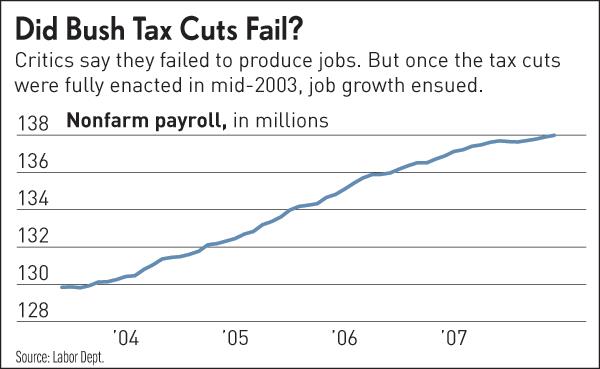
“The month after Bush signed that 2003 law, jobs and the economy finally started growing again. From June 2003 to December 2007, the economy added 8.1 million jobs, according to the Bureau of Labor Statistics.
“The unemployment rate fell to 5% from 6.3%. Real GDP growth averaged close to 3% in the four-plus years after that, and the budget deficit fell steadily from 2004 to 2007.
“What’s more, the rich ended up paying a larger chunk of the federal income tax burden after Bush’s tax cuts went into effect [This is true, I wrote about this in 2006 HERE – PoliticalArena Editor]. Obama is correct that the country has tried a combination of deregulation and tax cuts before; that took place under President Reagan.
“Reagan aggressively deregulated entire industries, while putting the brakes on new federal rules. As a result, regulatory compliance costs fell 8% during his time in office, and staffing dropped almost 7%. At the same time, Reagan’s tax cuts knocked taxes as a share of GDP down by 6%.
“The result was an almost eight-year economic boom in which real quarterly GDP growth averaged 4.3%. That’s nearly double the average growth rate Obama’s economic policies produced during the 3-year-old recovery.”
I have been waiting for this for a long time. When I was in college finishing my latest degree I was making many of these very same claims about global warming alarmist nonsense as the IAC report below. Leftist students and faculty pretty much told me that I was nuts, and I wasn’t a climate scientist so how would I know? Well it looks like I knew. It was easy. First of all it doesn’t take a genius to see when the scientific method is being ignored and second of all, what I am an expert on is politics and I know a political movement when I see one.
At the bottom of the article I posted a list of links that I wrote starting in 2007 saying many of the same things the IAC has pointed out below. Why am I so often using the word “I” when that is not an attitude that as editor I often take here at Political Arena? To be honest, I am going to take the low road and revel in rubbing it in my critic’s noses. I reactivated my old college blog just for the purpose of posting this story. We should ask ourselves what has happened to our education system when the doctoral academics who doubted me and called me names behind my back were all wrong, while the mere undergrad like me was spot on? – Chuck Norton
On June 27, the Intergovernmental Panel on Climate Change (IPCC) issued a statement saying it had “complete[d] the process of implementation of a set of recommendations issued in August 2010 by the Inter Academy Council (IAC), the group created by the world’s science academies to provide advice to international bodies.”
Hidden behind this seemingly routine update on bureaucratic processes is an astonishing and entirely unreported story. The IPCC is the world’s most prominent source of alarmist predictions and claims about man-made global warming. Its four reports (a fifth report is scheduled for release in various parts in 2013 and 2014) are cited by the Environmental Protection Agency (EPA) in the U.S. and by national academies of science around the world as “proof” that the global warming of the past five or so decades was both man-made and evidence of a mounting crisis.
If the IPCC’s reports were flawed, as a many global warming “skeptics” have long claimed, then the scientific footing of the man-made global warming movement — the environmental movement’s “mother of all environmental scares” — is undermined. The Obama administration’s war on coal may be unnecessary. Billions of dollars in subsidies to solar and wind may have been wasted. Trillions of dollars of personal income may have been squandered worldwide in campaigns to “fix” a problem that didn’t really exist.
The “recommendations” issued by the IAC were not minor adjustments to a fundamentally sound scientific procedure. Here are some of the findings of the IAC’s 2010 report.
Alternative views not considered, claims not properly peer reviewed
The IAC reported that IPCC lead authors fail to give “due consideration … to properly documented alternative views” (p. 20), fail to “provide detailed written responses to the most significant review issues identified by the Review Editors” (p. 21), and are not “consider[ing] review comments carefully and document[ing] their responses” (p. 22). In plain English: the IPCC reports are not peer-reviewed.
No formal criteria for selecting IPCC authors
The IAC found that “the IPCC has no formal process or criteria for selecting authors” and “the selection criteria seemed arbitrary to many respondents” (p. 18). Government officials appoint scientists from their countries and “do not always nominate the best scientists from among those who volunteer, either because they do not know who these scientists are or because political considerations are given more weight than scientific qualifications” (p. 18). In other words: authors are selected from a “club” of scientists and nonscientists who agree with the alarmist perspective favored by politicians.
Too political…
The rewriting of the Summary for Policy Makers by politicians and environmental activists — a problem called out by global warming realists for many years, but with little apparent notice by the media or policymakers — was plainly admitted, perhaps for the first time by an organization in the “mainstream” of alarmist climate change thinking. “[M]any were concerned that reinterpretations of the assessment’s findings, suggested in the final Plenary, might be politically motivated,” the IAC auditors wrote. The scientists they interviewed commonly found the Synthesis Report “too political” (p. 25).
Really? Too political? We were told by everyone — environmentalists, reporters, politicians, even celebrities — that the IPCC reports were science, not politics. Now we are told that even the scientists involved in writing the reports — remember, they are all true believers in man-made global warming themselves — felt the summaries were “too political.”
Here is how the IAC described how the IPCC arrives at the “consensus of scientists”:
Plenary sessions to approve a Summary for Policy Makers last for several days and commonly end with an all-night meeting. Thus, the individuals with the most endurance or the countries that have large delegations can end up having the most influence on the report (p. 25).
How can such a process possibly be said to capture or represent the “true consensus of scientists”?
Phony estimates of certainty
Another problem documented by the IAC is the use of phony “confidence intervals” and estimates of “certainty” in the Summary for Policy Makers (pp. 27-34). Those of us who study the IPCC reports knew this was make-believe when we first saw it in 2007. Work by J. Scott Armstrong on the science of forecasting makes it clear that scientists cannot simply gather around a table and vote on how confident they are about some prediction, and then affix a number to it such as “80% confident.” Yet that is how the IPCC proceeds.
The IAC authors say it is “not an appropriate way to characterize uncertainty” (p. 34), a huge understatement. Unfortunately, the IAC authors recommend an equally fraudulent substitute, called “level of understanding scale,” which is more mush-mouth for “consensus.”
The IAC authors warn, also on page 34, that “conclusions will likely be stated so vaguely as to make them impossible to refute, and therefore statements of ‘very high confidence’ will have little substantive value.” Yes, but that doesn’t keep the media and environmental activists from citing them over and over again as “proof” that global warming is man-made and a crisis…even if that’s not really what the reports’ authors are saying.
IPCC participants had conflicts of interest
Finally, the IAC noted, “the lack of a conflict of interest and disclosure policy for IPCC leaders and Lead Authors was a concern raised by a number of individuals who were interviewed by the Committee or provided written input” as well as “the practice of scientists responsible for writing IPCC assessments reviewing their own work. The Committee did not investigate the basis of these claims, which is beyond the mandate of this review” (p. 46).
Too bad, because these are both big issues in light of recent revelations that a majority of the authors and contributors to some chapters of the IPCC reports are environmental activists, not scientists at all. That’s a structural problem with the IPCC that could dwarf the big problems already reported.
IPCC critics vindicated
So on June 27, nearly two years after these bombshells fell (without so much as a raised eyebrow by the mainstream media in the U.S. — go ahead and try Googling it), the IPCC admits that it was all true and promises to do better for its next report. Nothing to see here…keep on moving.
Well I say, hold on, there! The news release means that the IAC report was right. That, in turn, means that the first four IPCC reports were, in fact, unreliable. Not just “possibly flawed” or “could have been improved,” but likely to be wrong and even fraudulent.
It means that all of the “endorsements” of the climate consensus made by the world’s national academies of science — which invariably refer to the reports of the IPCC as their scientific basis — were based on false or unreliable data and therefore should be disregarded or revised. It means that the EPA’s “endangerment finding” — its claim that carbon dioxide is a pollutant and threat to human health — was wrong and should be overturned.
And what of the next IPCC report, due out in 2013 and 2014? The near-final drafts of that report have been circulating for months already. They were written by scientists chosen by politicians rather than on the basis of merit; many of them were reviewing their own work and were free to ignore the questions and comments of people with whom they disagree. Instead of “confidence,” we will get “level of understanding scales” that are just as meaningless.
And on this basis we should transform the world’s economy to run on breezes and sunbeams?
In 2010, we learned that much of what we thought we knew about global warming was compromised and probably false. On June 27, the culprits confessed and promised to do better. But where do we go to get our money back?
Related from my old college blog:
Inconvenient Questions Global Warming Alarmists Don’t Want You to Ask – February 18, 2007 – LINK
Top Scientists Say: You Are Not the Cause of Global Warming – October 22, 2007 – LINK
Global Cooling Continues; Global Warming Alarmists Still Issuing Death Threats – December 28, 2008 – LINK
UK Telegraph: 2008 was the year man-made global warming was disproved – December 28, 2008 – LINK
National Climatic Data Center: Cooling in Last 10 Years – January 10, 2009 – LINK
The Debate is Over. Global Warming Alarmism is About Achieving Central Control of the Economy and Now They Admit It Openly – March 27, 2009 – LINK
Al Gore: Climate change issue can lead to world government – July 11, 2009 – LINK
EPA Tried to Suppress Global Warming Report Admitting Skeptics Correct – October 23, 2009 – LINK
New AP Article on “Global Cooling Myth” Spins a Bad Study – UPDATED: Look where they put THIS ground station… – October 27, 2009 – LINK
Professors Paid to Plagiarize – UPDATE: Global warming scientists hacked emails show manipulation of data, hiding of other data and conspiring to attack/smear global warming skeptics! – November 19, 2009 – LINK
National Association of Scholars on the “ClimateGate” Scandal – November 28, 2009 – LINK
Examples of the “Climategate” Documents – UPDATE: BBC Had the emails and files for 6 weeks, sat on story. UPDATE II – They carried out their conspiracy threat; much of the raw data from CRU destroyed! – November 28, 2009 – LINK
Scientific American thinks you are stupid: The dissection of a blatant propaganda piece for global warming alarmism. – December 6, 2009 – LINK
The Roundup: IPCC Authors Now Admitting Fault – No Warming Since 1995 – Sea Levels Not Rising. Senator Inhofe: Possible criminal misuse of taxpayer research funds. – February 23, 2010 – LINK
OOPS AGAIN: IPCC scientists screeching about the cataclysmic effects of sea-level rises forgot to consider sedimentary deposits… – April 23, 2010 – LINK
UN IPCC Co-chair: climate policy is redistributing the world’s wealth – November 18, 2010 – LINK
More Hadley Center Global Warming Horror Claims Debunked by Real Science – December 6, 2010 – LINK
ClimateGate One Year Later. Elite Media Still Lying – December 6, 2010 – LINK
More ClimateGate One Year Later – December 7, 2010 – LINK
IPCC Lead Author Dr. Richard Lindzen of MIT: Most global warming models are exaggerated, many scientists in it for the grant money or treat it like a religion – December 7, 2010 – LINK
How Global Warming Propaganda Works – December 8, 2010 – LINK
NASA’s global warming evidence page filled with lies, half truths and suspect data – December 10, 2010 – LINK
Director of the Tyndall Centre for Climate Change Research: Halt economic growth, start government rationing. Global Warming Alarmists Party Fat in Cancun – December 21, 2010 – LINK
Global Warming Conference Delegates Sign Petitions to Ban Water and “Destabilize U.S. Economy” – February 15, 2011 – LINK
Global Warming Alarmist Quote of the Day – Former Canadian Environment Minister Christine Stewart: No matter if the science is all phony, there are collateral environmental benefits…climate change provides the greatest chance to bring about justice and equality in the world.
AAUP Seeks to Limit Transparency Over Climate Science – September 19, 2011 – LINK
This is what happens when you punish success in some vein attempt at “getevenwithemism” so that the far left feels like it got it’s pound of flesh. But now those wealthy and productive will not be spending money in France, they will not have new investment in France, they will not be buying local goods and paying local taxes in France, they will not start new business in France. They passed this tax rate and they will take in less money as a result.
By the way, the same thing is happening in America – LINK.
The previous top tax bracket of 41 per cent on earnings over 72,000 euros is also set to increase to 45 per cent.
Sotheby’s Realty, the estate agent arm of the British auction house, said its French offices sold more than 100 properties over 1.7 million euros between April and June this year – a marked increase on the same period in 2011.
Alexander Kraft, head of Sotheby’s Realty, France, said: “The result of the presidential election has had a real impact on our sales.
“Now a large number of wealthy French families are leaving the country as a direct result of the proposals of the new government.
In 2009 (based on data collected in 2010), 57 percent of households headed by an immigrant (legal and illegal) with children (under 18) used at least one welfare program, compared to 39 percent for native households with children.
Immigrant households’ use of welfare tends to be much higher than natives for food assistance programs and Medicaid. Their use of cash and housing programs tends to be similar to native households.
A large share of the welfare used by immigrant households with children is received on behalf of their U.S.-born children, who are American citizens. But even households with children comprised entirely of immigrants (no U.S.-born children) still had a welfare use rate of 56 percent in 2009.
Immigrant households with children used welfare programs at consistently higher rates than natives, even before the current recession. In 2001, 50 percent of all immigrant households with children used at least one welfare program, compared to 32 percent for natives.
Households with children with the highest welfare use rates are those headed by immigrants from the Dominican Republic (82 percent), Mexico and Guatemala (75 percent), and Ecuador (70 percent). Those with the lowest use rates are from the United Kingdom (7 percent), India (19 percent), Canada (23 percent), and Korea (25 percent).
The states where immigrant households with children have the highest welfare use rates are Arizona (62 percent); Texas, California, and New York (61 percent); Pennsylvania (59 percent); Minnesota and Oregon (56 percent); and Colorado (55 percent).
We estimate that 52 percent of households with children headed by legal immigrants used at least one welfare program in 2009, compared to 71 percent for illegal immigrant households with children. Illegal immigrants generally receive benefits on behalf of their U.S.-born children.
Illegal immigrant households with children primarily use food assistance and Medicaid, making almost no use of cash or housing assistance. In contrast, legal immigrant households tend to have relatively high use rates for every type of program.
High welfare use by immigrant-headed households with children is partly explained by the low education level of many immigrants. Of households headed by an immigrant who has not graduated high school, 80 percent access the welfare system, compared to 25 percent for those headed by an immigrant who has at least a bachelor’s degree.
An unwillingness to work is not the reason immigrant welfare use is high. The vast majority (95 percent) of immigrant households with children had at least one worker in 2009. But their low education levels mean that more than half of these working immigrant households with children still accessed the welfare system during 2009.
If we exclude the primary refugee-sending countries, the share of immigrant households with children using at least one welfare program is still 57 percent.
Welfare use tends to be high for both new arrivals and established residents. In 2009, 60 percent of households with children headed by an immigrant who arrived in 2000 or later used at least one welfare program; for households headed by immigrants who arrived before 2000 it was 55 percent.
For all households (those with and without children), the use rates were 37 percent for households headed by immigrants and 22 percent for those headed by natives.
Although most new legal immigrants are barred from using some welfare for the first five years, this provision has only a modest impact on household use rates because most immigrants have been in the United States for longer than five years; the ban only applies to some programs; some states provide welfare to new immigrants with their own money; by becoming citizens immigrants become eligible for all welfare programs; and perhaps most importantly, the U.S.-born children of immigrants (including those born to illegal immigrants) are automatically awarded American citizenship and are therefore eligible for all welfare programs at birth.
The eight major welfare programs examined in this report are SSI (Supplemental Security Income for low income elderly and disabled), TANF (Temporary Assistance to Needy Families), WIC (Women, Infants, and Children food program), free/reduced school lunch, food stamps (Supplemental Nutrition Assistance Program), Medicaid (health insurance for those with low incomes), public housing, and rent subsidies.
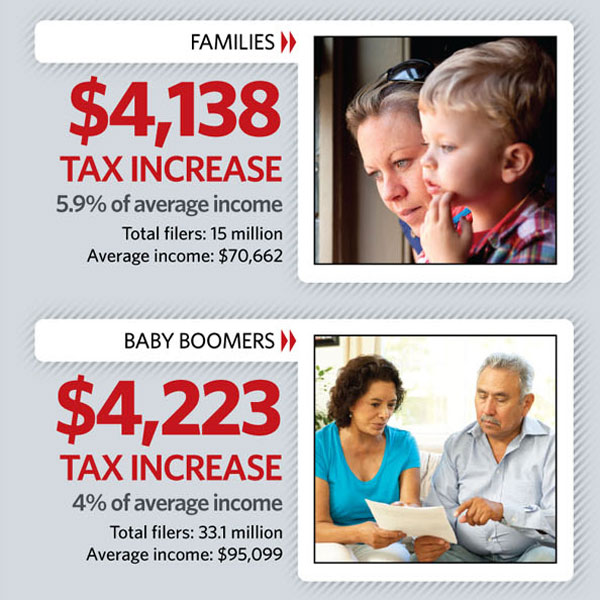
Starting January 1, 2013, Americans will face a $494 billion tax increase, the highest ever in one year. According to The Washington Post, congressional aides started calling it “Taxmageddon“—a chilling reference fit for an apocalyptic nightmare. Federal Reserve Chairman Ben Bernanke has warned that it will be a “massive fiscal cliff” for the economy.
This impending tax increase is mostly the result of the expiration of many long-standing policies that all expire at the end of 2012. President Obama and Congress should start working together now to prevent this massive tax increase rather than waiting until the end of the year. That would assure families, businesses, and investors that their taxes will not rise sharply as the economy is still staggering to its feet and show the voters that Washington really can get important things done—even in an election year.
Taxmageddon Is Huge
Taxmageddon is a $494 billion tax increase that strikes at the beginning of 2013. Under current law, tax policies in seven different categories will expire, and five of the 18 new tax hikes from Obamacare will begin.
These tax hikes will raise $494 billion in 2013 but will remain in place unless President Obama and Congress stop them. Taxpayers would see even bigger tax hikes in succeeding years as the tax increases raise more revenue as the economy grows. [And this is only a partial list folks. See the rest in the PDF link above – Political Arena Editor]
CNN has been at the bottom of the ratings heap for some time. Maybe their new angle is to actually do good journalism and that would be a welcome change. Will it last? I wouldn’t bet on it, but I hope I am wrong.
Of course the majority of the $250K+ who pay the top marginal tax rate are not “people” at all, they are small to medium sized S-Corps (small businesses).
The study, by the anti-tax group Change Maryland, says that a net 31,000 residents left the state between 2007 and 2010, the tenure of a “millionaire’s tax” pushed through by Gov. Martin O’Malley. The tax, which expired in 2010, in imposed a rate of 6.25 percent on incomes of more than $1 million a year.
The Change Maryland study found that the tax cost Maryland $1.7 billion in lost tax revenues. A county-by-county analysis by Change Maryland also found that the state’s wealthiest counties also had some of the largest population outflows.
In total, Maryland has added 24 new taxes or fees in recent years, Change Maryland says. Florida, which has no income-tax, has been a large recipient of Maryland’s exiled wealthy.
“Maryland has reached the point of diminishing returns. We’re taxing people too much and people are voting with their feet,” said Change Maryland Chairman Larry Hogan. “Until we change our focus from tax increases to increasing the tax base, more people are simply going to leave, leading to a downward spiral of raising revenues on fewer citizens.”
The finding adds to the renewed debate over raising taxes on the wealthy. In New Jersey, Gov. Chris Christie recently vetoed a millionaire’s tax passed by his legislature, while California and other state governments are also considering higher taxes on high earners to fix budget problems. President Obama on Monday asked Congress to extend tax cuts for those making $250,000 or less – effectively increasing taxes for the higher earners.
Many contend that higher taxes drive out the highly mobile rich, who can simply move to a lower-tax state or even lower-tax country. Recent data shows that a record 1,800 Americans renounces their citizenship last year.
Attacking the few companies that Bain Capital invested in that had to do some outsourcing to survive is the Obama Administration’s attack plan against Mitt Romney. But after setting up a jobs program for illegal aliens you would think that the hypocrisy from the Obama Campaign could not get much thicker; we thought that too and we were wrong.
Related – White House Connected GE Pays No Tax on $14 Billion ….Again! – LINK
Economic Collapse Blog has the details with multiple sources and links for your viewing pleasure:
Jeffery Immelt – General Electric CEO, Head of Obama’s “Jobs Council”.
Jeffrey Immelt, the head of Barack Obama’s highly touted “Jobs Council”, is moving even more GE infrastructure to China. GE makes more medical-imaging machines than anyone else in the world, and now GE has announced that it “is moving the headquarters of its 115-year-old X-ray business to Beijing“. Apparently, this is all part of a “plan to invest about $2 billion across China” over the next few years. But moving core pieces of its business overseas is nothing new for GE. Under Immelt, GE has shipped tens of thousands of good jobs out of the United States. Perhaps GE should change its slogan to “Imagination At Work (In China)”. If the very people that have been entrusted with solving the unemployment crisis are shipping jobs out of the country, what hope is there that things are going to turn around any time soon?
As the administration struggles to prod businesses to create jobs at home, GE has been busy sending them abroad. Since Immelt took over in 2001, GE has shed 34,000 jobs in the U.S., according to its most recent annual filing with the Securities and Exchange Commission. But it’s added 25,000 jobs overseas.
At the end of 2009, GE employed 36,000 more people abroad than it did in the U.S. In 2000, it was nearly the opposite.
GE is supposed to be creating the “jobs of tomorrow”, but it seems that most of the “jobs of tomorrow” will not be located inside the United States.
The last GE factory in the U.S. that made light bulbs closed last September. The transition to the new CFL light bulbs was supposed to create a whole bunch of those “green jobs” that Barack Obama keeps talking about, but as an article in the Washington Post noted, that simply is not happening….
Rather than setting off a boom in the U.S. manufacture of replacement lights, the leading replacement lights are compact fluorescents, or CFLs, which are made almost entirely overseas, mostly in China.
But GE is far from alone in shipping jobs and economic infrastructure out of the United States. For example, big automakers such as Ford are being very aggressive in China. Ford is currently “building three factories in Chongqing as part of $1.6 billion investment that also includes another plant in Nanchang”.
Today, China accounts for approximately one out of every four vehicles sold worldwide. The big automakers consider the future to be in China.
Just a few decades ago, China was an economic joke and the U.S. economy was absolutely unparalleled.
Always keep in mind the difference between the productive middle class, the rich and the super rich – LINK – LINK – LINK – LINK. The Democrat leadership makes like there is no difference for reasons you will discover in that list of links.
Americans making over $50,000 paid most of the federal taxes that were paid in the U.S. in 2010.
According to statistics compiled from the Internal Revenue Service (IRS) by the Tax Foundation, those people making above $50,000 had an effective tax rate of 14.1 percent, and carried 93.3 percent of the total tax burden.
In contrast, Americans making less than $50,000 had an effective tax rate of 3.5 percent and their total share of the tax burden was just 6.7 percent.
Americans making more than $250,000 had an effective tax rate of 23.4 percent and their total share of the tax burden was 45.7 percent.
Out of the 143 million tax returns that were filed with the IRS in 2010, 58 million – or 41 percent – of those filers were non-payers.
In other words, only 85 million actually paid taxes.
But Tax Foundation data also shows that people who didn’t pay any income tax received $105 billion in refundable tax credits from the IRS.
Additionally, statistics from the Tax Foundation shows that the federal tax code is 3.8 million words long – 3.5 times longer than all seven books of J.K. Rowling’s famous Harry Potter series combined.
According to Scholastic.com, the total word count of all seven Harry Potter books is 1,083,594 words with Harry Potter and the Sorcerer’s Stone being the shortest (76,944 words) and Harry Potter and the Order of the Phoenix the longest (257,045).
In contrast, the federal tax code is 3.8 million words, almost a tripling of its size since 2001 when the Joint Committee on Taxation estimated the tax code to be 1,395,000, and almost doubling its size since the Tax Foundation’s estimates in 2001.
The Supreme Court has long distinguished the regulatory from the taxing power.
In 1935, Secretary of Labor Frances Perkins was fretting about finding a constitutional basis for the Social Security Act. Supreme Court Justice Harlan Fiske Stone advised her, “The taxing power, my dear, the taxing power. You can do anything under the taxing power.”
Last week, in his ObamaCare opinion, NFIB v. Sebelius, Chief Justice John Roberts gave Congress the same advice—just enact regulatory legislation and tack on a financial penalty, as in failure to comply with the individual insurance mandate. So how did the power to tax under the Constitution become unbounded?
The first enumerated power that the Constitution grants to Congress is the “power to lay and collect taxes, duties, imposts, and excises, to pay the debts and provide for the common defense and general welfare of the United States.” The text indicates that the taxing power is not plenary, but can be used only for defined ends and objects—since a comma, not a semicolon, separated the clauses on means (taxes) and ends (debts, defense, welfare).
This punctuation was no small matter. In 1798, Pennsylvania Rep. Albert Gallatin said that fellow Pennsylvania Rep. Gouverneur Morris, chairman of the Committee on Style at the Constitutional Convention, had smuggled in the semicolon in order to make Congress’s taxing power limitless, but that the alert Roger Sherman had the comma restored. The altered punctuation, Gallatin said, would have turned “words [that] had originally been inserted in the Constitution as a limitation to the power of levying taxes” into “a distinct power.” Thirty years later, Virginia Rep. Mark Alexander accused Secretary of State John Quincy Adams of doing the same thing after Congress instructed the administration to print copies of the Constitution.
The punctuation debate simply reinforced James Madison’s point in Federalist No. 41 that Congress could tax and spend only for those objects enumerated, primarily in Article I, Section 8.
Congress enacted very few taxes up to the end of the Civil War, and none that was a pretext for regulating things that the Constitution gave it no power to regulate. True, the purpose of tariffs was to protect domestic industry from foreign competition, not raise revenue. But the Constitution grants Congress a plenary power to regulate commerce with other nations.
Congress also enacted a tax to destroy state bank notes in 1866, but this could be seen as a “necessary and proper” means to stop the states from usurping Congress’s monetary or currency power. It was upheld in Veazie Bank v. Fenno (1869).
The first unabashed use of the taxing power for regulatory purposes came when Congress enacted a tax on “oleomargarine” in 1886. Dairy farmers tried to drive this cheaper butter substitute from the market but could only get Congress to adopt a mild tax, based on the claim that margarine was often artificially colored and fraudulently sold as butter. President Grover Cleveland reluctantly signed the bill, saying that if he were convinced the revenue aspect was simply a pretext “to destroy . . . one industry of our people for the protection and benefit of another,” he would have vetoed it.
Congress imposed another tax on margarine in 1902, which the Supreme Court upheld (U.S. v. McCray, 1904). Three justices dissented, but without writing an opinion.
Then, in 1914, Congress imposed taxes on druggists’ sales of opiates as a way to regulate their use. Five years later, in U.S. v. Doremus, the Supreme Court upheld the levy under Congress’s express power to impose excise taxes.
Then, in 1922, the court rejected Congress’s attempt to prohibit child labor by imposing a tax on companies that employed children. An earlier attempt to accomplish this, by prohibiting the interstate shipment of goods made by child labor, was struck down as unconstitutional—since it was understood since the earliest days of the republic that Congress had the power to regulate commerce but not manufacturing. “A Court must be blind not to see that the so-called tax is imposed to stop the employment of children within the age limits prescribed,” Chief Justice William Howard Taft wrote in Bailey v. Drexel Furniture Co. “Its prohibitory and regulatory effect and purpose are palpable.” Even liberal justices Oliver Wendell Holmes and Louis D. Brandeis concurred in Taft’s opinion.
Things came to a head in the New Deal, when Congress imposed a tax on food and fiber processors and used those tax dollars to provide benefits to farmers. Though in U.S. v. Butler (1936) the court adopted a more expansive view of the taxing power—allowing Congress to tax and spend for the “general welfare” beyond the powers specifically enumerated in the Constitution—it still held the ends had to be “general” and not transfer payments from one group to another. After President Franklin D. Roosevelt threatened to “pack” the Supreme Court in 1937, it accepted such transfer payments in Mulford v. Smith (1939), so long as the taxes were paid into the general treasury and not earmarked for farmers.
And now, in 2012, Justice Roberts has confirmed that there are no limits to regulatory taxation as long as the revenue is deposited in the U.S. Treasury.
Are there any other limits? Article I, Section 2 says that “direct taxes shall be apportioned among the states” according to population. This is repeated in Article I, Section 9, which says that “no capitation, or other direct tax, shall be laid,” unless apportioned.
The Supreme Court struck down income taxes in 1895 (Pollock v. Farmers’ Loan & Trust Co.), on the ground that they were “direct” taxes but not apportioned by population. Apportioning an income tax would defeat the purpose of the relatively poorer Southern and Western states, who wanted the relatively richer states of the Northeast to pay the bulk of the tax. The 16th Amendment gave Congress the power to tax incomes without apportionment.
Other direct taxes should presumably have to be apportioned according to the Constitution. Justice Roberts quickly dismissed the notion that the individual mandate penalty-tax is not a direct tax “under this Court’s precedents.” To any sentient adult, it looks like a “capitation” or head tax, imposed upon individuals directly. Unfortunately, having plenty of other reasons to object to ObamaCare, the four dissenting justices in NFIB v. Sebelius did not explore this point.
Some conservatives have cheered that part of Justice Roberts’s decision that limits Congress’s Commerce Clause power. But an unlimited taxing power is equally dangerous to constitutional government.
Mr. Moreno is a professor of history at Hillsdale College and the author of “The American State from the Civil War to the New Deal,”
Six months from now, in January 2013, five major ObamaCare taxes will come into force:
1. The ObamaCare Medical Device Manufacturing Tax
This 2.3 percent tax on medical device makers will raise the price of (for example) every pacemaker, prosthetic limb, stent, and operating table. Can you remind us, Mr. President, how taxing medical devices will reduce the cost of health care? The tax is particularly destructive because it is levied on gross sales and even targets companies who haven’t turned a profit yet.
These are often small, scrappy companies with less than 20 employees who pioneer the next generation of life-prolonging devices. In addition to raising the cost of health care, this $20 billion tax over the next ten years will not help the country’s jobs outlook, as the industry employs nearly 400,000 Americans. Several companies have already responded to the looming tax by cutting research and development budgets and laying off workers.
2. The ObamaCare High Medical Bills Tax
This onerous tax provision will hit Americans facing the highest out-of-pocket medical bills. Currently, Americans are allowed to deduct medical expenses on their 1040 form to the extent the costs exceed 7.5 percent of one’s adjusted gross income.
The new ObamaCare provision will raise that threshold to 10 percent, subjecting patients to a higher tax bill. This tax will hit pre-retirement seniors the hardest. Over the next ten years, affected Americans will pony up a minimum total of $15 billion in taxes thanks to this provision.
3. The ObamaCare Flexible Spending Account Cap
The 24 million Americans who have Flexible Spending Accounts will face a new federally imposed $2,500 annual cap. These pre-tax accounts, which currently have no federal limit, are used to purchase everything from contact lenses to children’s braces. With the cost of braces being as high as $7,200, this tax provision will play an unwelcome role in everyday kitchen-table health care decisions.
The cap will also affect families with special-needs children, whose tuition can be covered using FSA funds. Special-needs tuition can cost up to $14,000 per child per year. This cruel tax provision will limit the options available to such families, all so that the federal government can squeeze an additional $13 billion out of taxpayer pockets over the next ten years.
The targeting of FSAs by President Obama and congressional Democrats is no accident. The progressive left has never been fond of the consumer-driven accounts, which serve as a small roadblock in their long-term drive for a one-size-fits-all government health care bureaucracy.
For further proof, note the ObamaCare “medicine cabinet tax” which since 2011 has barred the 13.5 million Americans with Health Savings Accounts from purchasing over-the-counter medicines with pre-tax funds.
4. The ObamaCare Surtax on Investment Income
Under current law, the capital gains tax rate for all Americans rises from 15 to 20 percent in 2013, while the top dividend rate rises from 15 to 39.6 percent. The new ObamaCare surtax takes the top capital gains rate to 23.8 percent and top dividend rate to 43.4 percent. The tax will take a minimum of $123 billion out of taxpayer pockets over the next ten years.
And, last but not least…
5. The ObamaCare Medicare Payroll Tax increase
This tax soaks employers to the tune of $86 billion over the next ten years.
As you can understand, there is a reason why the authors of ObamaCare wrote the law in such a way that the most brutal tax increases take effect conveniently after the 2012 election. It’s the same reason President Obama, congressional Democrats, and the mainstream media conveniently neglect to mention these taxes and prefer that you simply “move on” after the Supreme Court ruling.
The elite media will often report news like this on their web site so they can say they reported it, but don’t expect it to be highlighted in the evening broadcast…
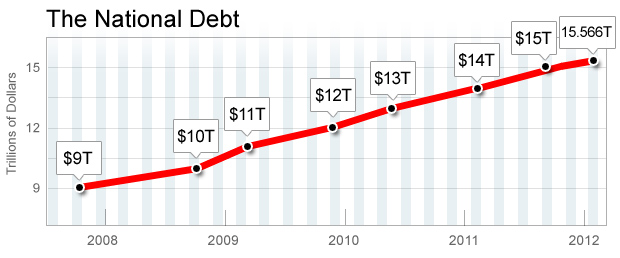
(CBS News) The National Debt has now increased more during President Obama’s three years and two months in office than it did during 8 years of the George W. Bush presidency.
The Debt rose $4.899 trillion during the two terms of the Bush presidency. It has now gone up $4.939 trillion since President Obama took office.
The latest posting from the Bureau of Public Debt at the Treasury Department shows the National Debt now stands at $15.566 trillion. It was $10.626 trillion on President Bush’s last day in office, which coincided with President Obama’s first day.
The National Debt also now exceeds 100% of the nation’s Gross Domestic Product, the total value of goods and services.
Mr. Obama has been quick to blame his predecessor for the soaring Debt, saying Mr. Bush paid for two wars and a Medicare prescription drug program with borrowed funds.
The federal budget sent to Congress last month by Mr. Obama, projects the National Debt will continue to rise as far as the eye can see. The budget shows the Debt hitting $16.3 trillion in 2012, $17.5 trillion in 2013 and $25.9 trillion in 2022.
Federal budget records show the National Debt once topped 121% of GDP at the end of World War II. The Debt that year, 1946, was, by today’s standards, a mere $270 billion dollars.
Mr. Obama doesn’t mention the National Debt much, though he does want to be seen trying to reduce the annual budget deficit, though it’s topped a trillion dollars for four years now.
As part of his “Win the Future” program, Mr. Obama called for “taking responsibility for our deficits, by cutting wasteful, excessive spending wherever we find it.”
His latest budget projects a $1.3 trillion deficit this year declining to $901 billion in 2012, and then annual deficits in the range of $500 billion to $700 billion in the 10 years to come.
[Political Arena Editor Chuck Norton Comments: The FY2007 Budget which was the last one mostly controlled by the Republicans had a yearly deficit of less than $200 billion.]
If Mr. Obama wins re-election, and his budget projections prove accurate, the National Debt will top $20 trillion in 2016, the final year of his second term. That would mean the Debt increased by 87 percent, or $9.34 trillion, during his two terms.
Currently, as the chart shows, debt per American is at (or around) $50,000. Just four years ago, in 2008, the year President Obama was first elected, debt per person was at $35,000.
In 2037, if things stay relatively the same, debt per American will be at $147,000.
In that year, according to Republican side of the Senate Budget Committee, “the federal government will spend $2.7 trillion per year in interest payments alone, representing more than a quarter of our entire budget that year and greater than the total federal budget in 2003.”
Per American family, on average, debt will stand at $382,000 in 2037, only 25 years from now. That figure constitutes an increase of $287,000 per family.
The CBO’s numbers were released yesterday as part of its “long-term outlook.” The non-partisan governmental organization warns, “waiting to address the long-term budgetary imbalance and allowing debt to mount in the meantime would be detrimental to future generations.”
And this is just debt and obligations that are on the books. With of budget trickery and the fact that the CBO uses static models with assumptions that are handed to it by politicians the actual figure is worse.
“If you are not careful, the newspapers will have you hating the people who are being oppressed and loving the people who are doing the oppressing.” – Malcolm X


To measure the tax burden over time, Congressional Budget Office economists look beyond income-tax returns. They add federal income, payroll, excise and corporate taxes and calculate them as a percentage of income, broadly defined to include wages plus the value of government- and employer-provided benefits.






 Political Arena