Category Archives: Paul Ryan

GE Filed 57,000-Page Tax Return, Paid No Taxes on $14 Billion in Profits (Again)

And indeed it is perfectly legal. This is what you get when you have a 60,000 page tax code filled with loopholes (some justified some not), favors, cronyism and every incentive there can be to make money overseas instead of at home because we have the highest corporate tax rate in the world. So how can we have the highest rate in the world and this still happens? You are about to find out and it involves putting Americans out of work to do it.

Weekly Standard:

General Electric, one of the largest corporations in America, filed a whopping 57,000-page federal tax return earlier this year but didn’t pay taxes on $14 billion in profits. The return, which was filed electronically, would have been 19 feet high if printed out and stacked.

The fact that GE paid no taxes in 2010 was widely reported earlier this year, but the size of its tax return first came to light when House budget committee chairman Paul Ryan (R, Wisc.) made the case for corporate tax reform at a recent townhall meeting. “GE was able to utilize all of these various loopholes, all of these various deductions–it’s legal,” Ryan said. Nine billion dollars of GE’s profits came overseas, outside the jurisdiction of U.S. tax law. GE wasn’t taxed on $5 billion in U.S. profits because it utilized numerous deductions and tax credits, including tax breaks for investments in low-income housing, green energy, research and development, as well as depreciation of property.

“I asked the GE tax officer, ‘How long was your tax form?'” Ryan said. “He said, ‘Well, we file electronically, we don’t measure in pages.'” Ryan asked for an estimate, which came back at a stunning 57,000 pages. When Ryan relayed the story at the townhall meeting in Janesville, there were audible gasps from the crowd.

Ken Kies, a tax lawyer who represents GE, confirmed to THE WEEKLY STANDARD the tax return would have been 57,000 pages had it been filed on paper. The size of GE’s tax return has more than doubled in the last five years.

Ryan used the data point to underscore the irrationality of the corporate income tax code. He also contrasted GE with UPS to make the point that the corporate income tax code doesn’t make sense. “UPS paid a 34 percent effective tax rate,” while its biggest foreign competitor, DHL, paid a 24 percent tax rate, Ryan said.

The problems with the corporate taxes occur because “Republicans and Democrats, both parties, sit in Congress and they’re picking winners and losers,” Ryan said. The solution, according to the Wisconsin congressman: “Get rid of those loopholes and lower tax rates by a corresponding amount. Don’t lose revenue, but for every loophole you pull out, and deny a company from being able to get this little carveout, you can lower the rates so we can be more competitive with our competitors overseas. We want to stem the bleeding of jobs going overseas, of foreign companies buying U.S. companies and taking headquarters overseas.”

Obama’s own Medicare Actuary more confident in Paul Ryan’s ‘Road Map’ cost controls than Obama’s health law

These facts have been coming out for a year yet they have fallen out of the dialogue. It is time to remind each other and our friends. With the demise of the CLASS Act it is now worse. We said that ObamaCare would cost a trillion dollars to implement and every day new evidence moves us closer and closer to that number.

Daily Caller:

The government’s chief actuary for Medicare spending on Wednesday said he had more confidence that Republican Paul Ryan’s plan to reform entitlements would drive down health-care costs than President Obama’s recently passed overhaul.

Richard S. Foster, the chief actuary of the Centers for Medicare and Medicaid Services, made the comment in response to questions from lawmakers during House Budget Committee hearing.

Rep. Chris Van Hollen, the ranking Democrat from Maryland, went on the attack against committee chairman Paul Ryan’s “Road Map” plan, which is a long-term proposal to make entitlement spending solvent.

Van Hollen pressed Foster on whether Ryan’s plan would work, prompting Foster to point out that one of the biggest problems in health care now is that most new technology that is developed increases costs rather than decreasing it.

“If there’s a way to turn around the mindset for the people who do the research and development … to get them to focus more on cost-reducing tech and less on cost increasing technology, if you can do that then one of biggest components of [increasing costs] turns to your side,” Foster said. “If you can put that pressure on the research and development community, you might have fighting chance of changing the nature of new medical technology in a way that makes lower cost levels possible.”

Foster said: “The Road Map has that potential. There is some potential for the Affordable Care Act price reductions, though I’m a little less confident about that.”

The thinking behind Foster’s comment is that a voucher system would reduce the amount of government money available for health care over time, causing consumers to shop around and creating an incentive in the health-care sector to compete for those dollars.

In a brief interview outside the House chamber later in the day, Ryan explained it this way: “There’s only going to be so much money for health care because the economy can only support so much … So is it better spent through the person in a competitive marketplace or through the government under increasing price controls and pressure?”

“If you go through the century, these entitlements consume all money. The GAO calculation assumes Congress is going to wise up and cut back on these programs because people will decide they don’t want 100 percent of their discretionary income going to health care. They want some for food and some for shelter and some for other things. So there will be a curtailment of health care spending in the future,” Ryan said. “The question is which curtailment gets you the better results at going after the cause of health inflation: consumer pressure or government price controls.”

Official US Debt Projections

Get it yet?

Related:

Obama’s Debt Commission Chair’s Speak Out! To Increase Govt Revenue We Must: Lower the tax rates to 8, 14 and 23%. Make a new lean tax code. Lower the corporate tax rate. Public sector unions over reach. Democrats not serious about budget. Republicans should push for larger cuts.

Sen. Durbin Tells FOX News Sunday: Dems Will Only Cut $10.5 Billion From Bloated Budget – UPDATED!

Via Business Insider:

GOA Report: Dozens of Govt. Agencies in Duplicate. Massive Waste.

52 programs funding entreprenurial efforts.

35 agencies for infrastructure.

26 agencies to fund telecommunications.

18 food assistance programs

47 job training programs

82 programs to improve teachers

…well you get the picture.

The Hill:

GAO report expected to show hundreds of duplicate programs

By Vicki Needham – 02/28/11 09:00 PM ET

The Government Accountability Office (GAO) found hundreds of possibly duplicate programs throughout the federal government’s agencies, according to a report scheduled for release on Tuesday.

The GAO, an independent, nonpartisan agency that works for Congress and investigates how the federal government spends taxpayer dollars, identified  programs across the agencies including Defense and Energy departments, the Wall Street Journal reported Monday night.

Congress and the White House have targeted many duplicate programs for elimination, including several that are included in the House Republicans’ two-week continuing resolution, also in President Obama’s fiscal 2012 budget, that cuts $4 billion in spending through March 18.

The Journal reported these duplications from the GAO study:

1. Food safety: 15 agencies that implement several federal laws.

2. Defense: Duplication in the purchasing of tactical wheeled vehicles, procurement and medical costs.

3. Economic development: 80 programs spread across several agencies that share goals.

4. Surface transportation: More than 100 programs run by five divisions within the Transportation Department.

5. Energy: Cutting ethanol production programs could save $5.7 billion each year.

6. Government information technology: 24 federal agencies handle IT.

7. Health: The Defense and Veterans Affairs departments are still working separately to update electronic health records.

8. Homelessness: There are more than 20 federal programs dealing with the issue.

9. Teachers: 82 programs and several agencies deal with teacher quality.

10. Job training: 44 employment and training programs.

Niall Ferguson speaks out on Paul Ryan, Paul Krugman, and America’s debt

Pardon the dopey 15 second introduction before the substance of the video begins (we didn’t edit this piece), but watch this video.

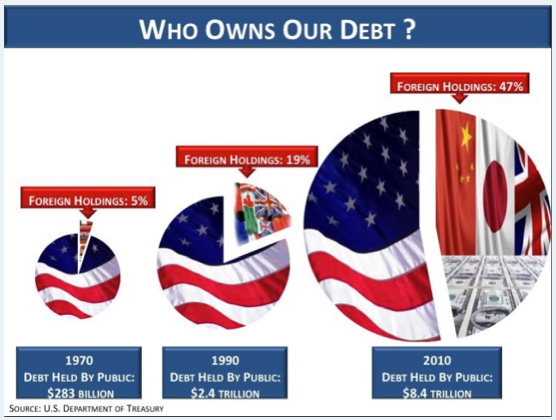
The Chinese have noticed what the rest of the worlds investors pretend not to see: The United States is on a completely unsustainable fiscal course with no apparent political means of self correction…

Andrew Klavan: The Ryan Plan vs the Obama Plan

Note – In this video Klavan tells us that the USA has the second highest corporate tax rate in the world. At the time this video was made that was true, however Japan, Canada and many other countries have since drastically lowered their rates leaving the United States to have the highest business taxes in the world, which explains why so many jobs have left the country.