Category Archives: Econ

Democrats Face Another Financial Scandal: MF Global client money feared gone

CEO of Thomas Capital Management and Political Arena contributor Thomas J. Zaleski comments:

WHERE are the Democrats blood curdling screams of corporate raiders, banksters, greed, etc? Oh, Democrats love [former New Jersey Governor] Corzine! And it’s Bush’s fault?

Imagine a CPA NOT being able to find ONE POINT TWO BILLION? Must be a drunk CPA. James R. Spear, CPA Diplomat Forensic Accounting could find the money in days.


Watch this video and keep in mind that New Jersey fired Gov. Corzine because he put the state on the brink of default, now Gov. Chris Christie is cleaning up the mess:

Wall Street Journal/NY Post:

MF Global client money feared gone

Nearly three months after MF Global Holdings collapsed, officials hunting for an estimated $1.2 billion in missing customer money increasingly believe that much of it might never be recovered, according to people familiar with the investigation.

As the sprawling probe that includes regulators, criminal and congressional investigators, and court-appointed trustees grinds on, the findings so far suggest that a “significant amount” of the money could have “vaporized” as a result of chaotic trading at MF Global during the week before the company’s Oct. 31 bankruptcy filing, a person close to the investigation was cited as saying Monday.

Many officials now believe certain employees at MF Global dipped into the “customer segregated account” that the New York company was supposed to keep separate from its own assets — and then used the money to meet demands for more collateral or to unfreeze assets at banks and other counterparties as they grew more concerned about their financial exposure to MF Global.

Lawmakers have pushed for answers from Jon S. Corzine, the former New Jersey governor and Goldman Sachs Group chairman who led MF Global into its big European bet and was CEO when the company failed.

[But I thought it was those rascally Republicans who owned Wall Street and Goldman Sachs…. – Editor]

Read more HERE.

Real GDP Tanked at 1.7%. Food Stamps and Welfare at Record Levels

Business Insider:

1.7%. That’s the final, pathetic growth number for 2011.

From the just-released GDP report:

Real GDP increased 1.7 percent in 2011 (that is, from the 2010 annual level to the 2011 annual level), compared with an increase of 3.0 percent in 2010.

The increase in real GDP in 2011 primarily reflected positive contributions from personal consumption expenditures (PCE), exports, and nonresidential fixed investment that were partly offset by negative contributions from state and local government spending, private inventory investment, and federal government spending.  Imports, which are a subtraction in the calculation of GDP, increased.


Business Insider:

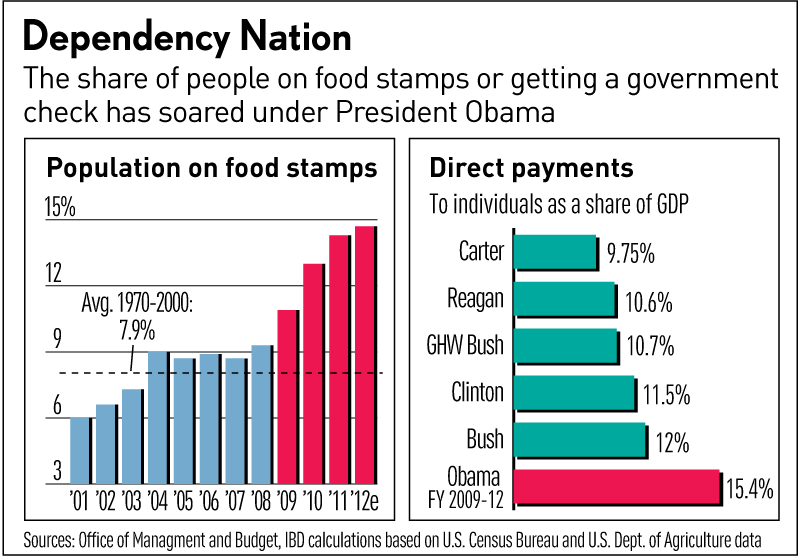
Direct payments. The amount of money the federal government hands out in direct payments to individuals steadily increased over the past four decades, but shot up under Obama, climbing by almost $600 billion — a 32% increase — in his first three years. And Obama’s last budget called for these payments to climb another $500 billion by 2016, at which point they would account for fully two-thirds of all federal spending.

People getting benefits. According to the Census Bureau 49% now live in homes where at least one person gets a federal benefit — Social Security, workers comp, unemployment, subsidized housing, and the like. That’s up from 44% the year before Obama took office, and way up from 1983, when fewer than a third were government beneficiaries.

Food stamps. This year, more than 46 million (15% of all Americans) will get food stamps. That’s 45% higher than when Obama took office, and twice as high as the average for the previous 40 years. This surge was driven in part by the recession, but also because Obama boosted the benefit amount as part of his stimulus plan.

Disability. The number of people on Social Security disability has steadily climbed since the 1970s, thanks mainly to easier eligibility rules. But their numbers jumped 10% in Obama’s first two years in office, according to the Social Security Administration. That sharp rise was due largely to meager job prospects since the recession ended in 2009. When employment opportunities are scarce, experts note, many who could otherwise work sign up for disability benefits instead.


Forbes: Worst Economic Recovery Since The Great Depression

Read carefully!

Forbes:

The National Bureau of Economic Research scored the recession as ending in June, 2009. Yet, today, in the 49th month since the recession started, there has still been no real recovery, like recoveries from previous recessions in America.

Unemployment actually rose after June, 2009, and did not fall back down below that level until 18 months later in December, 2010. Instead of a recovery, America has suffered the longest period of unemployment near 9% or above since the Great Depression, under President Obama’s public policy malpractice. Even today, 49 months after the recession started, the U6 unemployment rate counting the unemployed, underemployed and discouraged workers is still 15.2%. And that doesn’t include all the workers who have fled the workforce under Obama’s economic oppression. The unemployment rate with the full measure of discouraged workers is reported at www.shadowstats.com as about 23%, which is depression level unemployment.

Today, over 4 years since the recession started, there are still almost 25 million Americans unemployed or underemployed. That includes 5.6 million who are long-term unemployed for 27 weeks, or more than 6 months. Under President Obama, America has suffered the longest period with so many in such long-term unemployment since the Great Depression.

Notably, blacks have been suffering another depression under Obama, with unemployment today, 49 months after the recession started, still at 15.8%. Black unemployment has been over 15% for 2 ½ years under Obama.  Black teenage unemployment today is over 40%, where it has persisted for over 2 years as well.

Hispanics have also been suffering a depression under Obama, with unemployment today still in double digits at 11%.  Hispanic unemployment has been in double digits for three years under President Obama.  Over one fourth of Hispanic youths remain unemployed today, which also has persisted for years.

The Census Bureau reported in September that more Americans are in poverty today than at any time in the entire history of Census tracking poverty. Americans dependent on food stamps are at an all time high as well.

Real wages and incomes have been falling so steadily under Obama and his confused, throwback, Keynesian/neo-Marxist Obamanomics, that the Census Bureau also reported that real median family income in America has fallen all the way back to 1996 levels.

Compare Obama’s lack of a recovery 2 ½ years after the recession ended with the first 2 ½ years of the Reagan recovery.  In those years under Reagan, the American economy created 8 million new jobs, the unemployment rate fell by 3.6 percentage points, real wages and incomes were jumping, and poverty had reversed an upsurge started under Carter, beginning a long term decline.

While Obama crows about 200,000 jobs created last month, the most for a month during his entire Administration, in September, 1983 the Reagan recovery less than a year after it began created 1.1 million jobs in that one month alone.  Under Obama, we are still almost 6 million jobs below the peak before the recession started over 4 years ago! In the second year of the Reagan recovery, real economic growth boomed by 6.8%, the highest in 50 years.

The chief excuse of the Obama apologists is that what we have suffered was not just a recession, but a financial crisis, and, they argue, recovery from a financial crisis takes a lot longer than recovery from a recession.  But that is not the experience of the American, free market, capitalist economy.

The experience of the American economy is reported in full at the National Bureau of Economic Research, as cited above – recessions since the Great Depression previously have lasted an average of 10 months, with the longest previously 16 months, and the deeper the recession the stronger the recovery.  That is the standard by which the performance of Obamanomics is to be judged.  Which of those American recessions was a “financial crisis” that breaks the pattern?

Read more HERE.

K.L. South: Romney’s behavior at Bain is a question of character, not capitalism.

K.L. South writes in the famed Furthermore Blog that the issue with Mitt Romney’s behavior at Bain is a question of character, not capitalism:

There is a huge difference between capitalism and ‘predatory capitalism’ or ‘corporate raiding’. The latter is more of a chop-shop mentality of ‘creative destruction.’ It is still a form of capitalism, sure, even if not held in high regard. That is not the issue. And, I agree most capitalism is moral… the problem is that people defend ALL OF IT equally. You cannot. But, the court of public opinion doesn’t do nuance very well.

No rational person would defend ALL matters of transportation equally; drunk driving, car hijackings, exploits of TSA agents in airports; are abusive or exploitative practices. As is a car salesman who knowingly sells you a lemon where the car will predictably break down 6 months later. Hereto, it is a free market transaction, right? It is capitalism, too.

More…

Mitt Romney has been a rank opportunist throughout his political career. Mitt Romney was a clever money-making opportunist throughout his business career. The leveraged buyout business, which does not have to be an evil business, is a business that is ripe for heartless exploitation of vulnerable companies and individuals.

More…

What about Romney benefiting from a $10 million federal bailout and pocketing $4 million dollars directly? It’s not difficult to understand why Romney is not against federal bailouts, having been the beneficiary of them. Perhaps Romney should explain to us how TARP and federal bailouts are free-market capitalism? Romney’s main accomplishment in his one term as governor was RomneyCare, which openly funded abortions for a $50 co-pay. Do Romney supporters call that capitalism too?

Bain defunded pension funds and kept the money – when companies went bankrupt, the pensions had to be paid out of ERISA – government insurance – paid for by those of us who pay taxes. A federal government insurance agency ponied up $44 million to bailout one of Bain Company’s underfunded pension plan. Nevertheless, Bain profited on the deal, receiving $12 million on its $8 million initial investment and at least $4.5 million in consulting fees.

While at Bain, and as Governor, Romney showed an example of the government stepping into the marketplace, picking winners and losers, providing profits to business owners and leaving taxpayers stuck with the bill. Romney’s Bain made avid use of public-private partnerships, something that many conservatives consider being “corporate welfare.” It is a commitment that carried over into his term as governor. Bain Capital has been a corporate welfare hog under Romney’s tenure and beyond. If one can make millions of dollars whether a company succeeds or fails then where is the risk-taking Romney speaks of so fondly?

Bain, at times, pursued a practice of socializing their losses to banks and pension insurers while privatizing their gains in the same kind of Wall Street practice that led to the mortgage crisis. They leveraged government assistance to boost profits. Is it anti-capitalist to ask if an average worker is an expendable line on a spreadsheet as that worker’s tax dollars were needed to bailout Bain and financiers? And let’s note; as a supporter of the TARP Wall Street bailout, Romney’s “creative destruction” applied only to Main Street, not Wall Street.

And this just scratches the surface folks. Read on at Furthermore

Socialist Europe on a downward spiral…..

Wall Street Journal

The cascade of rating downgrades that hit France and eight other euro-zone nations last week casts fresh doubts over the monetary union’s ability to bail itself out of financial crisis and rescue its most vulnerable member, Greece.

Standard & Poor’s Ratings Services on Friday said it had stripped triple-A ratings from France and Austria and downgraded seven others, including Spain, Italy and Portugal. It retained the triple-A rating on Europe’s No. 1 economy, Germany.

The downgrade to France, the bloc’s second-largest economy, will make it harder—and potentially more expensive—for the euro zone’s bailout fund to help troubled states…….

US retail sales fail to hit forecasts. Unemployment claims up.

Financial Times:

US retail sales rose less than expected over the holidays while new jobless claims climbed to a six-week high, underlining the slow pace of recovery from recession.

Retail sales increased 0.1 per cent in December to $400.6bn, missing forecasts of a 0.3 per cent rise and logging the weakest growth since last May, according to a commerce department report.

High quality global journalism requires investment. Please share this article with others using the link below, do not cut & paste the article. See our Ts&Cs and Copyright Policy for more detail. Email ftsales.support@ft.com to buy additional rights. http://www.ft.com/cms/s/0/29bdb8a0-3d27-11e1-8129-00144feabdc0.html#ixzz1jUijEZz0

Separately, first-time claims for unemployment benefits rose to 399,000. Economists say claims need to stay below 400,000 to sustain job growth.

December sales of electronics and appliances fell 3.9 per cent and department store purchases slipped 0.2 per cent. Meanwhile, cheaper fuel prices brought down receipts at petrol stations 1.6 per cent last month, while food and beverage sales fell 0.2 per cent.

“December’s retail sales figures suggest it was not a happy holiday season for US retailers,” said Paul Dales, senior US economist at Capital Economics. “In other words, households have started to pare back their spending, most probably because their real incomes have continued to fall.”

Read the rest HERE.

The Atlantic: Is Private Equity Bad For the Economy?

For another valid view on private equity firms, Jordan Wiessmann has an excellent column where he asks:

Do private equity buyouts hurt workers? 
Yes, then no. More workers get fired in the aftermath. Then more get hired. 

Do private equity firms drive companies into bankruptcy?
The data isn’t complete, but some indicators say no. 

Does private equity make the whole economy more efficient? 
Possibly. Industries with lots of private equity activity actually see faster growth. 

The Truth About RomneyCare

Why is it that Mitt won’t talk about the whole story on RomneyCare. Keep in mind that this is the policy he refuses to walk away from… price controls and all…..

PJ Media Paul Hsieh, MD:

Now that Mitt Romney has shown himself politically vulnerable after Iowa, more people are taking a closer look at his claims about the “RomneyCare” health care plan he helped create as Massachusetts governor. In this interview from April 2010 which recently recirculated last month, Romney attempts to draw some distinctions (as well as acknowledge similarities) between his RomneyCare plan and the national ObamaCare plan. One of the alleged virtues of RomneyCare over ObamaCare is that Romney’s plan does not contain “price controls,” whereas ObamaCare does. But how does this stack up against reality?

Romney’s claim may have been technically true at the time the plan was enacted. But according to the New York Times, this was a deliberate choice on the part of Romney and the Massachusetts lawmakers when they passed the law in 2006. They aimed for “universal coverage” first, and decided to worry about controlling costs later. In other words, they knew that costs would be a problem but chose to kick the can down the road. It’s like borrowing money from a loan shark then saying, “At least I don’t owe him any money right now!”

But even before Romney’s 2010 claims, the state had already implemented some price controls. As Michael Tennant notes, “Requiring insurers to cover those with pre-existing conditions at the same rates as healthy individuals –  another feature of the Massachusetts law that Romney praises — surely qualifies as a price control.”

Similarly, requiring insurance companies to provide numerous mandatory benefits (including lay midwives, orthotics, and drug-abuse treatment) and then denying insurers’ requests for rate increases to cover their increased costs is another form of price control.

Yet another price control considered (but ultimately not implemented) was a proposal to compel doctors to accept patients covered by the state’s “Affordable Health Plans” at government-set payment rates or else lose their state medical licenses.

And because costs continue to rise faster in Massachusetts than in the rest of the country….

Read the rest HERE.

You paid the high cost of RomneyCare in Massachusetts….

This study from the Beacon Hill (Economics) Institute at Suffolk University illuminates the disastrous results of the failed experiment known as RomneyCare and yet presidential candidate Mitt Romney continues to stand by the program.

Here are the key findings from the Beacon Hill study:

The High Price of Massachusetts Health Care Reform

http://www.beaconhill.org/BHIStudies/HCR-2011/BHIMassHealthCareReform2011-0627.pdf

We find that, under health care reform:

• State health care expenditures have risen by $414 million over the period;

• Private health insurance costs have risen by $4.311 billion over the period;

• The federal government has spent an additional $2.418 billion on Medicaid for Massachusetts.

• Over this period, Medicare expenditures increased by $1.426 billion;

• For a total cumulative cost of $8.569 billion over the period; and

• The state has been able to shift the majority of the costs to the federal government.

The federal government continues to absorb a significant cost of health care reform through enhanced Medicaid payments and the Medicare program.   Health care reform has also increased the rate for Medicare Advantage plans in Massachusetts, which has contributed to an increase in Medicare health care expenditures through prices for medical service delivery.

This is not defendable.

It gets worse. The Beacon Hill Institute did a fraud study to determine how the RomneyCare system is being “gamed”:

Massachusetts Health Care Reform Mandates: The Gaming Gamble

http://www.beaconhill.org/BHIStudies/HCR-2011/GamingMandates2011-1128.pdf

The law requires that individuals with sufficient means purchase health insurance and that businesses with more than ten employees make a “fair and reasonable” contribution toward their employees’ health insurance. Under the law, health insurance companies cannot refuse to cover individuals with preexisting conditions.  Individuals and businesses face fines if they fail to comply with the mandates.

Because the fines imposed by the law cost are often less than the cost of insurance, the law is vulnerable to the problem of moral hazard.

Individuals can game the mandate by buying insurance only upon being diagnosed as needing a non‐emergency procedure such as a hip replacement and then canceling their insurance after receiving the treatment or procedure.  Businesses can likewise game the mandate by canceling their health insurance plans and shifting their employees to newly subsidized state plans.    Massachusetts taxpayers and health insurance policyholders pick up the tab for these “jumpers and dumpers.”
The Beacon Hill Institute (BHI) has estimated the prevalence and cost of gaming the mandates.  We find that:

• In tax year 2008 (the latest data available) 26,000 individuals paid a total of $16 million in fines, while 758 businesses paid $7.1 million.

• In 2009, between 2,089 and 2,659 individuals gamed the individual mandate at an estimated cost to insurance carriers of between $29.3 million and $37.3 million.

• Between June 2006 and June 2010 enrollment in state subsidized insurance plans increased by 319,000, while the private group (employer) market was flat and the individual market increased by 83,000.

In essence, the incentives in RomneyCare, just as in ObamaCare, are backwards. They encourage people to behave in ways that maximize costs and inefficiency. This is what economists refer to as an “Adverse Selection Spiral”. Eventually the system collapses under the weight of its own costs and inefficiency.

UPDATE – Thomas Zaleski adds:

Wouldn’t it be great if you could purchase AUTO insurance AFTER you had an accident? That is PRECISELY what Romney care is. Break a leg, BUY insurance the SAME day!

U.S. Debt Now 100% of GDP

When debt reaches 100% of GDP it is usually a point of no return. Only one country in the history of the world has survived that much debt. What happens is that spending and interest spiral up to the point where those making the loans realize that the debtor is incapable of paying it back. The currency starts to fall apart fast at 120-130% of GDP, which isn’t far away. We are already seeing the inflationary effects of so much debt.

USA Today:

WASHINGTON – The soaring national debt has reached a symbolic tipping point: It’s now as big as the entire U.S. economy.

The amount of money the federal government owes to its creditors, combined with IOUs to government retirement and other programs, now tops $15.23 trillion.

That’s roughly equal to the value of all goods and services the U.S. economy produces in one year: $15.17 trillion as of September, the latest estimate. Private projections show the economy likely grew to about $15.3 trillion by December — a level the debt is likely to surpass this month.

“The 100% mark means that your entire debt is as big as everything you’re producing in your country,” says Steve Bell of the Bipartisan Policy Center, which has proposed cutting nearly $6 trillion in red ink over 10 years. “Clearly, that can’t continue.”

Long-term projections suggest the debt will continue to grow faster than the economy, which would have to expand by at least 6% a year to keep pace.

Obama Administration Approving Only 35 Percent of Gulf Drilling Plans

Heritage Foundation:

A new report from a New Orleans-based group reveals that the Obama administration is approving just 35 percent of the oil drilling plans for the Gulf of Mexico so far this year. It is also taking an average of 115 days — nearly four months — to secure approval from the Bureau of Ocean Energy Management, Regulation and Enforcement.

Those numbers contrast sharply from previous years. This historical average is a 73.4% approval rate. The approval time has nearly doubled; the historical average is 61 days for the government to approve plans.

For plans that require drilling activity, the numbers are even worse. New regulations require all deepwater drilling plans to undergo an environmental assessment process. Those plans have an average approval time of 222 days or more than seven months.

The data were included in the latest release of the Gulf Permit Index from Greater New Orleans Inc. It has monitored this trend since last year’s oil spill in the Gulf of Mexico. The delays have continued for more than 18 months later.

Read more HERE.

Toyota Selling Cars to South Korea–From the United States

Heritage Foundation:

Toyota recently announced it will begin exporting U.S.-built Camry cars and Sienna minivans to South Korea from plants located in Kentucky and Indiana. The cars will be shipped through the Port of Hueneme—ironically, one of the California ports that Occupy Wall Street protestors recently attempted to shut down.

Some people may wonder why Toyota would ship U.S.-built cars 7,000 miles to South Korea instead of shipping Japanese-built cars 130 miles across the Korean Strait.

One reason is the recently approved the South Korea–U.S. Free Trade Agreement (KORUS), which reduces South Korea’s tariff on passenger vehicles from 8 percent to 4 percent, and eventually to zero. Tariff reductions in KORUS make U.S.-manufactured cars more affordable in South Korea, while also making Korean-manufactured autos more affordable in the United States.

Critics called KORUS a disaster: “Americans need jobs, but it is impossible for them to support their families if they are forced to compete against workers earning almost non-existent wage rates.” Toyota’s employees in Kentucky and Indiana would surely disagree.

Read more HERE.

34 Facts About The National Debt

Business Insider:

Enjoy this false prosperity while you can, because it is not going to last.

Debt is a very cruel master, and our day of reckoning is almost here.

The following are 34 shocking facts about U.S. debt that should set America on fire with anger….

#1 During fiscal year 2011, the U.S. government spent 3.7 trillion dollars but it only brought in 2.4 trillion dollars.

#2 When Ronald Reagan took office, the U.S. national debt was less than 1 trillion dollars.  Today, the U.S. national debt is over 15.2 trillion dollars.

#3 During 2011, U.S. debt surpassed 100 percent of GDP for the first time ever.

#4 According to Wikipedia, the monetary base “consists of coins, paper money (both as bank vault cash and as currency circulating in the public), and commercial banks’ reserves with the central bank.”  Currently the U.S. monetary base is sitting somewhere around 2.7 trillion dollars.  So if you went out and gathered all of that money up it would only make a small dent in our national debt.  But afterwards there would be no currency for anyone to use.

#5 The U.S. government spent over 454 billion dollars just on interest on the national debt during fiscal 2011.

#6 The U.S. government has total assets of 2.7 trillion dollars and has total liabilities of 17.5 trillion dollars.  The liabilities do not even count 4.7 trillion dollars of intragovernmental debt that is currently outstanding.

#7 During the Obama administration, the U.S. government has accumulated more debt than it did from the time that George Washington took office to the time that Bill Clinton took office.

#8 It is being projected that the U.S. national debt will surpass 23 trillion dollars in 2015.

#9 According to the GAO, the U.S. government is facing 34 trillion dollars in unfunded liabilities for social insurance programs such as Social Security and Medicare.  These are obligations that we have already committed ourselves to but that we do not have any money for.

#10 Others estimate that the unfunded liabilities of the U.S. government now total over 117 trillion dollars.

#11 According to the GAO, the ratio of debt held by the public to GDP is projected to reach 287 percent of GDP by 2086.

#12 Others are much less optimistic.  A recently revised IMF policy paper entitled “An Analysis of U.S. Fiscal and Generational Imbalances: Who Will Pay and How?” projects that U.S. government debt will rise to about 400 percent of GDP by the year 2050.

#13 The United States government is responsible for more than a third of all the government debt in the entire world.

#14 If you divide up the national debt equally among all U.S. taxpayers, each taxpayer would owe approximately $134,685.

#15 Mandatory federal spending surpassed total federal revenue for the first time ever in fiscal 2011.  That was not supposed to happen until 50 years from now.

#16 Between 2007 and 2010, U.S. GDP grew by only 4.26%, but the U.S. national debt soared by 61% during that same time period.

#17 During Barack Obama’s first two years in office, the U.S. government added more to the U.S. national debt than the first 100 U.S. Congresses combined.

#18 When you add up all spending by the federal government, state governments and local governments, it comes to 46.6% of GDP.

#19 Our nation is more addicted to government checks than ever before.  In 1980, government transfer payments accounted for just 11.7% of all income.  Today, government transfer payments account for 18.4% of all income.

#20 U.S. households are now actually receiving more money directly from the U.S. government than they are paying to the government in taxes.

#21 A staggering 48.5% of all Americans live in a household that receives some form of government benefits.  Back in 1983, that number was below 30 percent.

#22 Back in 1965, only one out of every 50 Americans was on Medicaid.  Today, one out of every 6 Americans is on Medicaid.

#23 In 1950, each retiree’s Social Security benefit was paid for by 16 U.S. workers.  According to new data from the U.S. Bureau of Labor Statistics, there are now only 1.75 full-time private sector workers for each person that is receiving Social Security benefits in the United States.

#24 The U.S. government now says that the Medicare trust fund will run out five years faster than they were projecting just last year.

#25 Right now, spending by the federal government accounts for about 24 percent of GDP.  Back in 2001, it accounted for just 18 percent.

#26 If the U.S. government was forced to use GAAP accounting principles (like all publicly-traded corporations must), the U.S. government budget deficit would be somewhere in the neighborhood of $4 trillion to $5 trillion each and every year.

#27 If you were alive when Christ was born and you spent one million dollars every single day since that point, you still would not have spent one trillion dollars by now.  But this year alone the U.S. government is going to add more than a trillion dollars to the national debt.

#28 If right this moment you went out and started spending one dollar every single second, it would take you more than 31,000 years to spend one trillion dollars.

#29 A trillion $10 bills, if they were taped end to end, would wrap around the globe more than 380 times.  That amount of money would still not be enough to pay off the U.S. national debt.

#30 If the federal government began right at this moment to repay the U.S. national debt at a rate of one dollar per second, it would take over 470,000 years to pay off the national debt.

#31 If Bill Gates gave every penny of his fortune to the U.S. government, it would only cover the U.S. budget deficit for 15 days.

#32 According to Professor Laurence J. Kotlikoff, the U.S. is facing a “fiscal gap” of over 200 trillion dollars in the future.  The following is a brief excerpt from a recent article that he did for CNN….

The government’s total indebtedness — its fiscal gap — now stands at $211 trillion, by my arithmetic. The fiscal gap is the difference, measured in present value, between all projected future spending obligations — including our huge defense expenditures and massive entitlement programs, as well as making interest and principal payments on the official debt — and all projected future taxes.

#33 If you add up all forms of debt in the United States (government, business and consumer), it comes to more than 56 trillion dollars.  That is more than $683,000 per family.  Unfortunately, the average amount of savings per family in the U.S. is only about $4,735.

#34 The U.S. national debt is now more than 5000 times larger than it was when the Federal Reserve was created back in 1913.

But do our leaders care about statistics such as these?

No.

Read more: http://www.businessinsider.com/us-debt-america-michael-snyder-2012-1#ixzz1ivdb09ru

Mitt Romney Schools Occutard: Corporations Are People (Video)

We are tough on Mitt because we believe that there is much to be tough on Mitt about, but giving credit where credit is due, this was great. Nice Work Governor [With that said there are some corporations who over reach at the expense of employees and when they do that they encourage government and occutards to go on their wealth destroying campaigns].

The Gold Standard Pros vs Cons

by Thomas Zaleski (above) and Gregory Hilton (below)

Gold Standard Pros vs Cons

Advantages of the Gold Standard

The gold standard limits the power of governments to inflate prices through excessive issuance of paper currency.

The gold standard makes chronic deficit spending by governments more difficult, as it prevents governments from ‘inflating away’ the real value of their debts.

High levels of inflation are rare and hyperinflation is impossible as the money supply can only grow at the rate that the gold supply increases.  (However, the Great Depression began while USA was still on the gold standard).

Disadvantages of the Gold Standard

A gold standard leads to deflation whenever an economy using the gold standard grows faster than the gold supply.  Deflation rewards cash savings and punishes debtors.  Real debt burdens therefore rise, causing borrowers to cut spending to service their debts or to default. That undermines the financial system. Deflation also robs a central bank of its ability to stimulate spending. Deflation is difficult to control, and is a serious risk to a growing economy.

The total amount of gold that has ever been mined has been estimated at around 142,000 metric tons.   Assuming a gold price of US$1,000 per ounce, or $32,500 per kilogram, the total value of all the gold ever mined would be around $4.5 trillion. This is less than the value of circulating money in the U.S. alone, where more than $8.3 trillion is in circulation or in deposit. Therefore, a return to the gold standard would result in a significant increase in the current value of gold, which may limit its use in current applications. For example, instead of using the ratio of $1,000 per ounce, the ratio can be defined as $2,000 per ounce effectively raising the value of gold to $9 trillion.

Following a gold standard would mean that the amount of money would be determined by the supply of gold, and hence monetary policy could no longer be used to stabilize the economy in times of economic contraction.

Monetary policy would essentially be determined by the rate of gold production. Fluctuations in the amount of gold that is mined could cause inflation if there is an increase or deflation if there is a decrease.

The gold standard may be susceptible to speculative attacks when a government’s financial position appears weak.


Free Market Currency

A currency is a truer measure of countries worth because it includes the value of land, commodities, all assets of perceived value and statist value of a central government’s policies.

A Currency is easier to conduct trade between nations.

The value of one countries currency in relation to another country is known instantaneously due to trading activity in the currency markets.

Statists use monetary policies to finance deficit spending in the mistaken belief that the unit of monetary measure never changes.  In actuality; the value of a currency changes in the market place making the markets a better judge of the true value of a countries financial strength in comparison to other countries.

Interesting thoughts

Fairness is a little understood concept which recent research in primate behavior is demonstrating itself to be part of the social fabric.   This research is showing that fairness is a driving force for social interaction.  As a species, man creates laws and regulations to create fairness.   The financial markets are an attempt to create fairness in monetary value.  Interestingly, there is no way to truly define fairness because of the complexity of the issue as a man-made perception and all attempts to do so will eventually fail.  This is primarily due to man’s ever changing perception of value.

In the political arena, the attempt to be fair is the driving force behind legislative attempts to regulate the activities of man.  A large portion of the electorate becomes emotionally supportive of politicians who promise to level the playing field by redistributing the wealth of others to be “fair”.  Fairness has such a strong emotional connection that people will create unfairness just to be fair.

Fairness concerns what some consider being socially just with respect to the allocation of goods and services in a society. Thus, a community in which incidental inequalities in outcome do not arise would be considered a society guided by the principles of distributive justice. Allocation of goods takes into thought the total amount of goods to be handed out, the process on how they in the civilization are going to dispense, and the pattern of division.

Civilizations have a narrow amount of resources and capital; the problem arises on how the goods should be divided.  The common answer to this question is that every individual receives a fair share.  The problem with this answer is that the world is not fair.  Fairness is a creation of man and to adhere to the concept that fairness is the correct way to view the world is futile.

People advocate the Gold Standard during periods of “High Distrust” of a central government.  The hope of a gold standard is to change the behavior of the central governing body.  The desire for a gold standard is an attempt to create fairness and distributive justice; a policy that is inherently unattainable.   Hence gold standard advocates are really being the opposite of what they are advocating.

We would be better off to challenge any regulation or legislative attempt at fairness because reality cannot be put in a nice neat little box.

Final Note:  Returning to the gold standard is like tipping at Wind Mills.  It may be noble goal but will never happen.  It is like wanting to end the Federal Reserve (arguably the most powerful institution in the world) or repealing the 16, 17th, or any amendment.  We simply don’t have the time to waste.  The Central Government has grown out of control (it has taken decades of voter neglect and apathy and poor citizenship) and it is the main impetus to real economic reform and a return to stable and sustainable growth.  We must focus on the reduction in all federal outlays and realign our tax policy with policies that will enhance capital formation, increased liquidity, and investment in people and equipment – that will create jobs by the private sector – where it belongs and is natural order of capitalist based economy.


The Case Against Gold: Why Ron Paul is Wrong About The Gold Standard

by Gregory Hilton


“The gold standard is to economics what the flat earth theory is to astronomy: something that may have seemed to make sense back when people didn’t know any better but is ridiculous to suggest today.” – Dr. Russ Anderson

“Ron Paul is saying: ‘Let’s make everything simple again. . . If we had a gold standard, we wouldn’t need complex monetary policy. But how do we get from here to there? There might not be a way. It is just nostalgia for a time that never really existed.” – Dr. Vincent Reinhart, American Enterprise Institute

“Inflation is low and relatively predictable. No Ron Paul supporter has managed to articulate to me what problem the gold standard solves. . . It’s a terrible idea, which is why there are so few economists willing to raise their voices in support of it.” – Megan McArdle, the Atlantic magazine


Many conservatives oppose Rep. Ron Paul (R-TX) on foreign policy and national security matters, but admire his economic agenda. The Congressman’s isolationist defense policy is the complete opposite of the Reagan Doctrine, but few people on the right are challenging Paul’s economic arguments.

Since 1976, he has been promoting a return to the gold standard and is the author of four books on the topic.  His other major economic theme is abolishment of the Federal Reserve which he calls “immoral, unconstitutional, impractical, promotes bad economics, and undermines liberty.” All of Paul’s claims are wrong, but I will address Federal Reserve issues in a separate article.

Long ago the gold standard made sense for America, but not today.  Its advocates want to turn the clock back to the “Roaring 20’s,” but the economic growth of that decade had little to do with the gold standard and it ended in disaster.

America has now been off the gold standard for 40 years and its many flaws have been forgotten.  There are excellent reasons it was rejected by right wing icons such as Milton Friedman.  No court agrees with Ron Paul’s interpretation of “lawful money,” or that paper money is unconstitutional.  Ron Paul’s “sound money” claims are not correct.

The gold standard was in effect from about the middle of the 19th century to the last quarter of the 20th century (1971). In the late 19th century the growth of the money supply had nothing to do with population or the size of the economy. The resulting deflation was disastrous and led to the free silver movement (“Don’t crucify me on a cross of gold”.) The present system can tailor the money supply to the demands of the economy, which the gold standard failed to do.

Why Did America Leave The Gold Standard?

The Bretton Woods system (1945 -1971) came to an end when the United States stopped allowing dollars to be converted into gold. The “gold window” shut and foreign governments could no longer trade dollars for gold at $35/ounce. The U.S. dollar then became a “fiat currency” backed only by the “full faith and credit of the United States.” Since then the dollar has been the world’s only reserve currency.

Under Bretton Woods, government regulations mandated that banks hold fixed ratio of gold as currency reserves. There was a greater need for gold as economies expanded. No nation has returned to the gold standard since the end of the Bretton Woods system. Switzerland has plenty of gold, but they have not opted for a gold standard with good reason.

If they had been on gold in recent years they would have suffered massive deflation and an extreme recession. The rapid price rise of gold would have tripled the value of their franc against other currencies and their exports would have been completely priced out of world markets.  Our present fiat system allows the free market to determine the value of our currency.

Why Are So Few Republicans Challenging Ron Paul?

Ron Paul’s presidential campaign is a serious threat to the GOP establishment, but few Republicans are challenging his outrageous claims regarding the gold standard , the Federal Reserve and America’s currency reserves. There is nothing wrong with an audit of the U.S. gold reserves or the Federal Reserve. There have already been over 100 GAO audits of the Fed.

What is outrageous is when Paul claims “I think it is a possibility” there is no gold at Fort Knox!  This is where 4.8% of the world’s gold is held, and it represents 8,000 metric tons. The entire world gold supply is well known and if there was an increase in supply immediate inquiries would be made by currency traders and the World Gold Council.

The dollar is the world’s prime reserve currency, and since World War II it has dominated the currency markets.  Any sale would have been known right away and it would have to be reported in the budget.  It is conspiracy theory nonsense to claim the U.S. currency reserves have been sold, but facts never stop Ron Paul.

What Are the Problems With A Gold Standard?

  • Many economists believe adopting a gold standard could decrease the U.S. monetary supply by about half.  This would cause massive deflation and could threaten an economic collapse.
  • Do we really want to make the size of the money supply dependent on the success of gold miners?  I t would also export control of our nation’s money system to foreigners. Over 90% of the world’s gold is produced by foreigners.  In 1970’s OPEC cut-off oil, and Russia and South Africa could do the same thing with gold. Why not have our currency controlled by Americans?
  • The gold standard did not work in the past, and no country has ever been able to maintain it. It was abandoned by many nations during major wars and when there was an economic crisis.  The government printed too many gold back dollars and then refused to redeem them for gold.
  • There is not enough gold in the world for it to be a medium of exchange.
  • Ron Paul says “Congress should only permit currency backed by stable commodities such as silver and gold.” Gold advocates also claim currency values would be stable if they were based on gold, but they have no evidence. Gold is highly unstable. The real value of goal has more than doubled in recent years.
  • To demonstrate that gold is stable, Congressman Paul says the value of the dollar, pegged to gold, was about the same in 1915 as it was in 1789. What he is not mentioning is that it fluctuated with inflation for 80 years and deflation for 40.
  • Using gold and silver is not going to prevent the government from making bad monetary decisions or creating more debt. The government could still spend too much and it would still have to contend with compounding debt and interest.
  • Despite Ron Paul’s numerous claims, gold and silver are not sound money.  They can just as easily be manipulated as fiat currency. The government can easily devalue gold based dollars. They have done that in the past to make our exports cheaper.
  • They claim the government could not deficit spend under a gold standard. This is nonsense. The government would do the same thing they do now. They would borrow by issuing bonds. America did that when it was on the gold standard.
  • One of the best arguments for gold is that it can act as a good hedge against inflation. Gold advocates claim it will prevent governments from inflating the currency. That is not always true because a government can modify its gold standard.
  • From 1980 to 2001, gold lost 70% and silver lost 92% of its value, despite inflation. Inflation went up and gold and silver went down. They were no hedge.  The safety the libertarians are seeking in the gold standard does not exist.  Once again, the government can debase the value of the currency by printing too many gold backed dollars or devaluing them.
  • Even if America went back to the gold standard the currency would still fluctuate because all nations would not adopt this policy and we would trade with them.
  • Libertarians want the money supply to be privatized. Banks would issue currency backed by euros a basket of several currencies. It would accomplish nothing. The gold standard was a creations of governments, similar to fiat money.
  • The only way to stabilize the real value of gold would be for central banks to hold large gold reserves, but that is exactly what libertarians and some Tea Party groups oppose. They want to “End The Fed.” Without reserves  a gold standard is really no standard at all.
  • Gold price fluxuations would be highly detrimental, and as Professor Scott Sumner has noted:  “A 10% increase or decrease in the real value of gold seems very small when it is just a commodity. But under a gold standard that sort of shift can be accommodated only by changing the overall price level by 10%. A sudden 10% rise or fall in the price level is very destabilizing to the economy.”

Would a Gold Standard Stop Wars?

Despite past history, gold standard advocates continue to claim they are motivated by anti-war sentiments.  They claim central banks and fiat money enable war. They say a major reason to go back on the gold standard is because it would make it difficult to finance a future war.

The past gold standard did nothing to avoid war. All the nations involved in the start of World War I were on the gold standard. A gold standard would not have stopped Adolf Hitler. During the Napoleonic Wars and World War I, they simply went off the gold standard. America fought both  WW I and WW II without having to devalue gold.

Gold Would Not Give Us a Stable Monetary Base

Gold advocates claim it would give America a fixed monetary base, but gold flows can create huge swings in the broader money supply. Gold would not result in a stable monetary base. There has been a decades long search for price stability, but there are no stable commodities.

They claim gold is a good monetary indicator and point to 2008 when gold dropped 30% along with the global recession. All commodities were then a good indicator, but gold has not been a good indicator since then.  It is wrong to claim the price of gold always goes up directly to the value of the dollar going down. There is not a direct link. The price is determined by global supply and demand, not directly by the dollar.

What Happened During The Bretton Woods Era (1945 – 1971)?

This is explained by economist Bruce Bartlett who served on Ron Paul’s staff. He correctly notes Bretton Woods worked while gold constraints were ignored.  Gold was highly overvalued after the 1933 devaluation, and then the US grabbed a huge share of the world’s gold in the run-up to WWII.

  • After the war those two factors gave us an unprecedented amount of slack, so the United States could mildly inflate until gold was no longer overvalued.
  • As Bartlett notes, “once we reached that point in the late 1960s, the system immediately fell apart.  It would have collapsed even sooner if Americans had been allowed to own gold.  And if President Johnson had tried to deflate to stay on gold, Americans (if allowed to) would have hoarded gold. They would have done so in the correct expectation that the next president would devalue the dollar.  That hoarding would have had the same effect as the hoarding of the early 1930s–deflation and depression.”

The Gold Standard Made The Great Depression Worse

The global recession of 2008 could have become another Great Depression if America was on the gold standard. In 1929, the Hoover Administration and the Federal Reserve both made the depression worse because of their concerns about gold.

  • Today the government would react to a recession or depression by purchasing Treasury securities so there would be cash in the hands of investors. That policy did not work in the 1930s because investors used the cash to buy gold and this contributed to a gold drain.
  • The Hoover administration did not react sufficient to the economic crisis because they were worried about the currency. The countries that quit the gold standard, such as Great Britain, suffered the least.  There is a strong correlation between how long a country hewed to the gold standard and how much it suffered. This is explained by David Frum of CNN:

But why did decision-makers make so many bad decisions? The short answer is that they were trapped. Almost all of the right decisions would have ballooned the U.S. federal budget deficit. As budget deficits expanded, investors would inevitably worry that their dollars might lose value in the future. They would demand to trade their dollars for gold at the fixed price of $20.67 to the ounce. Under the rules of the gold standard, the U.S. government would be obliged to sell.As long as the deficits continued, the U.S. government would lose gold. Threatened with the exhaustion of its gold supply, the government felt it had no choice: It had to close the budget deficit. So, in the throes of a severe downturn, the U.S. government did exactly the opposite of what economists would otherwise advise: It cut spending and raised taxes — capsizing the economy even deeper into depression.It’s very strange to hear gold standard advocates criticize President Hoover for imposing steep tax increases in 1932, the Depression’s worst year. Yet the gold standard they champion was the reason for the tax increases they deplore.

Ron Paul is Wrong on the Constitution and the Colonial Period

Ron Paul is also wrong in his understanding of Constitutional intent regarding the coining of money and its value. He claims paper money is unconstitutional but Congress approved paper money in 1791 “to simplify trade.” This was two years after the Constitution was adopted. They approved an early version of the Federal Reserve which was known as the “Bank of the United States.” It was authorized to issue paper bank notes.

Under the Constitution, Congress has the power to coin money “and regulate the value thereof”.

The Constitution does not say the money has to be gold or silver, and it was never intended for them to be our only means of trade. The Constitution does not authorize a gold standard.


The Government Was Manipulating The Currency Even In The Colonial Period

This information comes from Ron Paul’s top economic advisers, the Ludwig Von Mises Institute. As they have demonstrated, the government was debasing the value of their hard money coins, to make their exports cheaper, and it caused inflation. That happened with silver coins, not fiat dollars. It demonstrates once again that gold and silver are not a hedge against inflation.

Click to access historyofmoney.pdf

From “The History of Money”

In their own mercantilism, the colonial governments early tried to hoard their own specie bydebasing their shilling standards in terms of Spanish dollars. Whereas their natural weights dictated a ratio of 4 shillings 6 pence to the dollar, Massachusetts, in 1642, began a general colonial process of competitive debasement of shillings.

Massachusetts arbitrarily decreed that the Spanish dollar be valued at 5 shillings; the idea was to attract an inflow of Spanish silver dollars into that colony, and to **subsidize** Massachusetts exports by making their prices cheaper in terms of dollars.

Soon, Connecticut and other colonies followed suit, each persistently upping the ante of debasement. The result was to increase the supply of nominal units of account by debasing the shilling, inflating domestic prices and thereby bringing the temporary export stimulus to a rapid end. Finally, the English government brought a halt to this futile and inflationary practice in 1707. . .

In 1744, another losing expedition against the French led Massachusetts to issue an enormous amount of paper money over the next several years. From 1744 to 1748, paper money in circulation expanded from £300,000 to £2.5 million, and the depreciation in Massachusetts was such that silver had risen on the market to 60 shillings an ounce, ten times the price at the beginning of an era of paper money in 1690.

The result was that silver went up in price because of inflation of the money supply. There is nothing to stop a government from arbitrarily price fixing the value of any specie, as they have done in the past.
Incomes Drop 6.7 Percent During Obama ‘Recovery’


Jeff Anderson at The Weekly Standard:

New evidence suggests there’s a reason why this economic “recovery” hasn’t felt much like a recovery. Figures from the Census Bureau’s Current Population Survey, compiled by Sentier Research, show that the “recovery” has actually been harder on most Americans than the recession from which they’ve allegedly been recovering.

According to Sentier’s report, the median American household income has actually fallen during the “recovery.”  Not only that, but it has fallen even more than it did during the recession. Gordon Green, former chief of the Governments Division at the U.S. Census Bureau and co-author of the report (with fellow Census veteran John Coder), says, “Real income fell by 3.2 percent during [the recession].  And during the recovery it went down by 6.7 percent.” So “income [has] declined twice as much in the recovery as in the recession itself.”

According to the report — which has been referenced by both the Wall Street Journal and the New York Times — in early 2000, Americans’ median annual household income was $55,836, in real (inflation-adjusted, June 2011) dollars. By the start of the recession (in December 2007), Americans’ real incomes had fallen 0.9 percent, to $55,309 — a decline of $527. During the recession (which ended in June 2009), their incomes fell an additional 3.2 percent, to $53,518 — a decline of another $1,791. During the first two years of the “recovery” (from June 2009 to June 2011), they fell an additional 6.7 percent, to $49,909 — a decline of another $3,609.

So, from the start of 2000 to mid-2011, the typical American household’s real income dropped nearly $6,000 — and more than 60 percent of that drop (over $3,600) came after the start of the “recovery” and thus squarely on Obama’s watch.

While the real median income of American households dropped 6.7 percent during the first two years of the “recovery,” the incomes of many households dropped even more than that. The income drop was steeper for those under 25 years of age (their incomes were down 9.5 percent), for those between 25 and 34 years of age (down 9.8 percent), for black Americans (down 9.4 percent), for families with three or more children (down 9.5 percent), and for families headed by part-time workers (down 11.5 percent). And that’s despite the fact that the report’s income tallies include unemployment compensation and monetary public assistance (both state and federal).

In fact, the anemic economy has meant that Americans’ incomes have declined during the “recovery” even without adjusting for inflation. According to Green, in actual (non-inflation-adjusted) dollars, the median American household income was $51,140 at the start of the “recovery,” but it fell to $49,909 two years later.

Leftist Economic Guru: We Need More Debt!

Paul Krugman is the neo-Marxist “economist (and I use the term loosely) from the New York Times. He has been documented wrong more than any columnist I am aware of. Unfortunately, like too many “economists” he is a totally partisan political hack.

Speaking like a true advocate of the Alinsky Model….

Paul Krugman:

First, families have to pay back their debt. Governments don’t — all they need to do is ensure that debt grows more slowly than their tax base.

Unless abortion and pressure from eco-extremists about “population control” wither your tax base and work force – and then those making the loans figure out that you have no intention of stopping the accumulation of new debt or paying it back.

Quote:

The debt from World War II was never repaid; it just became increasingly irrelevant as the U.S. economy grew, and with it the income subject to taxation.

This is not an argument for increasing debt, this is an argument for economic growth. Growth that is stymied by the anti-wealth, anti-capital and anti-production policies that Paul Krugman advocates. Wealth is the opposite of poverty.

Also, the income subject to taxation is not very relevant. It is the amount of money put in a taxable position by people moving it in ways that are taxable and in ways that take risk to create wealth. It is about tax compliance. The higher the rates, the greater the noncompliance and “Going Galt”. It is also about increasing the growing number of tax payers which only happens when people are confident to produce and take risk here in the United States.

Our friend NeoNeocon has a great critique of this piece HERE.  Go read it.

Jon McNaughton: Wake Up America!

Jon McNaughton:

Every man, woman and child in America is enslaved to the national debt. As an artist, I have painted my vision of the dire circumstances that surround us. Now, more than ever, each American must make a choice: we must unlock the shackles that enslave us, or will we lose our freedom. It is my hope and prayer that America will “wake up” before it is too late.

Those who are familiar with my work know that I like to use symbolism and metaphor to engage the viewer. See if you can find and decipher the many symbols in this image by visiting http://www.jonmcnaughton.com

In the painting I have intentionally hidden six keys that represent solutions that will release us from the chains of economic and political bondage. Find these keys and share them with as many Americans as you can. If we don’t “wake up” future generations may not know what it means to be free.

Heritage: Top 10 Worst Federal Rules of 2011

Heritage Foundation:

Hindsight is supposed to be 20/20, but looking back on the past 12 months, it’s tough to see any sense in many of the Administration’s regulatory missteps. Of course, there are bound to be a few howlers when government churns out more than 3,500 rules in a year, including dozens unleashed by Obamacare, Dodd–Frank, and the perpetually errant Environmental Protection Agency (EPA). But by any standard, 2011 brought forth a remarkable number and variety of regulatory blunders.

Fair warning: Our Top 10 list may prove fatal to any bit of faith in government as a “fixer,” if faith somehow has managed to survive despite all evidence to the contrary. In any event, it should steel our resolve to fight the Leviathan in the coming year.

1. The Dim Bulbs Rule. As per Congress, of course, for issuing an edict to phase out the incandescent light bulbs on which the world has relied for more than a century. With the deadline looming in 2012, Americans by the millions spent the past year pressing lawmakers to lift the ban which, contrary to eco-ideology, will kill more American jobs than create “green” ones. (Congress evidently overlooked the fact that the vast majority of fluorescent bulbs are manufactured in China.) The 2012 appropriations bill barred the use of funds to enforce the regulation, but it remains in law.

2. The Obamacare Chutzpah Rule. The past year was marked by a slew of competing court rulings on the constitutionality of the individual mandate, the cornerstone of Obamacare. The law requires U.S. citizens to obtain health insurance or face financial penalties imposed by the Internal Revenue Service. Never before has the federal government attempted to force all Americans to purchase a product or service. To allow this regulatory overreach to stand would undermine fundamental constitutional constraints on government powers and curtail individual liberties to an unprecedented degree.

3. The Nationalization of Internet Networks Rule. Regulations that took effect on November 1 prohibit owners of broadband networks from differentiating among various content in managing Internet transmissions. (In other words, the Federal Coercion Communications Commission effectively declared the broadband networks to be government-regulated utilities.) The FCC imposed the “network neutrality” rule despite explicit opposition from Congress and a federal court ruling against it. The rule threatens to undermine network investment and increase online congestion.

4. The Equine Equality Rule. As of March 15 (the Ides of March, no less), hotels, restaurants, airlines, and the like became obliged to modify “policies, practices, or procedures” to accommodate miniature horses as service animals. According to the Department of Justice, which administers the rule, miniature horses are a “viable alternative” to dogs for individuals with allergies or for observant Muslims and others whose religious beliefs preclude canine accompaniment.

5. The Smash Potatoes Regulation. The U.S. Department of Agriculture proposed stricter nutrition standardsthat would prohibit school lunch ladies from serving more than one cup per week of potatoes per student. Instead, schools would be required to provide more dark green, orange, and dry bean varieties (think kale) in order to foster vegetable diversity. The cafeteria mandate will affect more than 98,000 elementary and secondary schools at a cost exceeding $3.4 billion in the next four years.

6. The Bring on the Blackouts Rule. The EPA is proposing to force power plants to reduce mercury by 90 percent within three years—at an estimated cost of $11 billion annually. A significant number of coal-fired plants will actually exceed the standard—by shutting down altogether. Indeed, grid operators, along with 27 states, are warning that the overly stringent regulations will threaten the reliability of the electricity system and dramatically increase power costs. Just like candidate Obama promised.

7. The Wal-Mart Windfall Amendment. One of hundreds of new regulations dictated by the Dodd–Frank financial regulation statute requires the Federal Reserve to regulate the fees that financial institutions may charge retailers for processing debit card purchases. The prospect of losing more than $6 billion in annual revenue is prompting financial institutions to hike fees on a variety of banking services to make up for the much smaller payments from stores. Thus, consumers are picking up the tab for retailers’ big regulatory score.

8. The Plumbing Police Rule. The U.S. Department of Energy began preparations for tightening the waterefficiency standards on urinals. It’s all spelled out in excruciating detail in the Energy Conservation Program for Consumer Products Other Than Automobiles, which also regulates the efficiency of toilets, faucets, and showers. And refrigerators and freezers, air conditioners, water heaters, furnaces, dishwashers, clothes washers and dryers, ovens and ranges, pool heaters, television sets, and anything else the Energy Secretary deems as electrically profligate. (Urinals also are regulated by the Occupational Safety and Health Administration, which requires at least one urinal for every 40 workers at a construction site for companies with less than 200 employees and one for every 50 workers where more than 200 are employed. The Americans with Disabilities Act also delineates the proper dimensions and placement of bowls.)

9. The Chill the Economy Regulation. The EPA issued four interrelated rules governing emissions from some 200,000 boilers nationwide at an estimated capital cost of $9.5 billion. These boilers burn natural gas, fuel oil, coal, biomass (e.g., wood), refinery gas, or other gas to produce steam, which is used to generate electricity or provide heat for factories and other industrial and institutional facilities. Under the so-called Boiler MACT, factories, restaurants, schools, churches, and even farms would be required to conduct emissions testing and comply with standards of control that vary by boiler size, feedstock, and available technologies. The stringency and cost of the new regulations provoked an outpouring of protest, including 21 governors and more than 100 Members of Congress. On May 18, the EPA published a notice of postponement in the Federal Register, but the regulations remain on the books.

10.  The Unions Rule Rule. New rules require government contractors to give first preference in hiring to the workers of the company that lost the contract. Tens of thousands of companies will be affected, with compliance costs running into the tens of millions of dollars—costs ultimately borne by taxpayers. The rule effectively ensures that a non-unionized contractor cannot replace a unionized one. That’s because any new contractor will be obliged to hire its predecessors’ unionized workers and thus be forced by the “Successorship Doctrine” to bargain with the union(s).

Newt Gingrich: Do What Reagan Did

Newt talks about Reagan’s example and explains how Reagan’s example set the path for a genuine American recovery. Be sure to read every last word.

Newt Gingrich:

Officially, the recession ended two and a half years ago. President Obama tells us the economy has been moving in the right direction since June 2009.

Few will take solace in that statistic. Americans are suffering. For nearly three years, nearly one in 10 have been out of work. Almost double that number are either underemployed—working part time when they would rather be full time—or have simply given up looking.

Historically in America, the deeper the recession, the stronger the recovery. By historical standards, we should be completing the second year of a booming recovery. Recall that, just like President Obama, President Reagan inherited a terrible economy when he took office. But Reagan enacted historic income tax rate cuts, regulatory reforms and spending controls. The recession officially ended in November 1982, and in the following two and a half years the unemployment rate dropped 3.6 percentage points, more than eight million Americans went to work at new jobs, and the longest period of economic growth in American history commenced.

Mr. Obama’s policies have been just the opposite: trillion dollar stimulus-spending waste, a government takeover of the health-care system, an activist EPA attacking businesses, and demonization of job creators. The president barnstorms the country advocating tax increases for investors, entrepreneurs and small businesses, teeing up the country for another crash in 2013 when the Bush-era income tax rates expire. Meanwhile, America’s businesses continue to suffer from the highest business tax rate in the industrialized world, with no relief in sight.

This nightmare will not end until Reagan-era economic policies are restored: tax reform, a sound dollar and smarter regulations. If they are, within a year the American economy will take off on another historic boom.

First, we must reduce the federal business tax rate to 12.5%, eliminate the capital gains tax as a double tax on capital income, and eliminate the estate tax. We must allow immediate expensing (writing off the costs in one year) for investment in capital equipment so American workers can continue to be the most productive in the world, using the latest and most advanced technology.

On the personal income side, I propose an optional 15% flat tax, allowing those American taxpayers who prefer it to file their returns on a postcard. This will save close to half a trillion dollars annually in tax-compliance costs.

These tax reforms are not designed to be revenue-neutral, but to maximize job creation, wages and economic growth. We will balance the budget with the revenues from such growth and spending cuts. That would include breaking up Fannie Mae and Freddie Mac into manageable, entirely private companies, with no government guarantees.

Second, the dollar needs to be stabilized by establishing a price rule for the Federal Reserve to follow in its conduct of monetary policy. This will help stabilize international exchange rates, resolve the ongoing cycles of global financial crises and investment bubbles, short-circuit the run-up in gas and food prices, and unlock the frozen credit system.

Third, the burden of regulatory costs on American businesses and consumers has to be lightened. Reflecting my unwavering opposition to cap and trade and any other form of tax on energy or carbon, we must replace the Environmental Protection Agency with an Environmental Solutions Agency. We must move from antigrowth confrontation with business to collaboration with job creators, states and local communities to achieve better results. We must repeal Dodd-Frank and its “too big to fail” big-bank bailouts, and repeal Sarbanes-Oxley, restoring Wall Street as the world’s pre-eminent equities market.

We can slash further trillions in taxes, spending and regulatory costs by repealing and replacing ObamaCare with Patient Power, involving no individual insurance mandate and no job-killing employer mandate. We must also modernize the Food and Drug Administration, recognizing the need to get lifesaving medicines and technologies to patients faster and to remove cost barriers to their rapid development.

My economic plan includes sweeping entitlement reforms that would altogether cut federal spending in half over the long run, entirely solving the nation’s entitlement and fiscal crisis. Reforms include starting and then expanding personal savings, investment and insurance accounts until they ultimately finance all the benefits now financed by the payroll tax—and eventually displacing that tax entirely. The successful federal welfare reform of 1996 should be expanded to every federal means-tested welfare program, close to 200 or more, block-granting them to the states and ultimately saving trillions.

We also need an American Energy Plan, freeing the energy industry to maximize production of all forms of American energy, ensuring the reliable supply of low-cost gasoline, diesel, natural gas, coal and other energy sources essential to fueling a booming economy.

These policies will ignite another record-smashing, and world-leading, 25-year economic boom, restoring the American Dream and rebuilding the America we love.

Newt Gingrich Receives endorsements from J.C. Watts and Art Laffer

These are major endorsements. J.C. Watts is on every VP short list and he is a powerful orator and brilliant politician, businessman and church leader.

Here is a video and transcript of Mark Steyn challenging J.C. Watts’ endorsement and Watts was more than prepared for it – LINK.

Art Laffer is the author of the Reagan economic recovery and is a legendary economist.

“Newt has the best economic plan among all the candidates” – Art Laffer