UCLA, this is not your best moment, but I suspect it is a common one.
Category Archives: School Indoctrination
Andrew Klavan: Left vs Right – Why Are Conservatives So Mean?
Why Are Conservatives So Mean? –
Financial Crisis 101 –
[Note – This is a fabulously brilliant explanation of what happened and who caused it in 3 1/2 minutes]
Night of the Living Government –
“It always makes me feel bad when a politician tells me that I am acting out of self interest…”
Liberal Fantasies vs. Reality, Can you Spot the Difference? –
Limbaugh and Coulter and Beck, Oh My! –
Soros, Huffington, Maher, & Olbermann Can’t Be Wrong –
“Shut Up” –
Beyond the Elitist, Preening America-Hating Stereotypes –
Stop the Hate! –
The road to hell is paved with….
Behold! Your (Leftist Controlled) Public Sector Unions at Work –
Bumper Sticker Police –
Andrew Klavan: Elites who think Americans are stupid should go to a place where there are no Americans…..like Harvard
A brilliant short lecture from famed author and Hollywood screenwriter Andrew Klavan.
Why Leftists Don’t Get the Tea Party Movement
Our universities haven’t taught much political history for decades. No wonder so many progressives have disdain for the principles that animated the Federalist debates.
by PETER BERKOWITZ in the Wall Street Journal:
Highly educated people say the darndest things, these days particularly about the tea party movement. Vast numbers of other highly educated people read and hear these dubious pronouncements, smile knowingly, and nod their heads in agreement. University educations and advanced degrees notwithstanding, they lack a basic understanding of the contours of American constitutional government.
New York Times columnist Paul Krugman got the ball rolling in April 2009, just ahead of the first major tea party rallies on April 15, by falsely asserting that “the tea parties don’t represent a spontaneous outpouring of public sentiment. They’re AstroTurf (fake grass-roots) events.”
Having learned next to nothing in the intervening 16 months about one of the most spectacular grass-roots political movements in American history, fellow Times columnist Frank Rich denied in August of this year that the tea party movement is “spontaneous and leaderless,” insisting instead that it is the instrument of billionaire brothers David and Charles Koch.
Washington Post columnist E. J. Dionne criticized the tea party as unrepresentative in two ways. It “constitutes a sliver of opinion on the extreme end of politics receiving attention out of all proportion with its numbers,” he asserted last month. This was a step back from his rash prediction five months before that since it “represents a relatively small minority of Americans on the right end of politics,” the tea party movement “will not determine the outcome of the 2010 elections.”
In February, Mr. Dionne argued that the tea party was also unrepresentative because it reflected a political principle that lost out at America’s founding and deserves to be permanently retired: “Anti-statism, a profound mistrust of power in Washington goes all the way back to the Anti-Federalists who opposed the Constitution itself because they saw it concentrating too much authority in the central government.”
Mr. Dionne follows in the footsteps of progressive historian Richard Hofstadter, whose influential 1964 book “The Paranoid Style in American Politics” argued that Barry Goldwater and his supporters displayed a “style of mind” characterized by “heated exaggeration, suspiciousness, and conspiratorial fantasy.” Similarly, the “suspicion of government” that the tea party movement shares with the Anti-Federalists, Mr. Dionne maintained, “is not amenable to ‘facts'” because “opposing government is a matter of principle.”
To be sure, the tea party sports its share of clowns, kooks and creeps. And some of its favored candidates and loudest voices have made embarrassing statements and embraced reckless policies. This, however, does not distinguish the tea party movement from the competition.
Born in response to President Obama’s self-declared desire to fundamentally change America, the tea party movement has made its central goals abundantly clear. Activists and the sizable swath of voters who sympathize with them want to reduce the massively ballooning national debt, cut runaway federal spending, keep taxes in check, reinvigorate the economy, and block the expansion of the state into citizens’ lives.
In other words, the tea party movement is inspired above all by a commitment to limited government. And that does distinguish it from the competition.
But far from reflecting a recurring pathology in our politics or the losing side in the debate over the Constitution, the devotion to limited government lies at the heart of the American experiment in liberal democracy. The Federalists who won ratification of the Constitution—most notably Alexander Hamilton, James Madison and John Jay—shared with their Anti-Federalist opponents the view that centralized power presented a formidable and abiding threat to the individual liberty that it was government’s primary task to secure. They differed over how to deal with the threat.
The Anti-Federalists—including Patrick Henry, Samuel Bryan and Robert Yates—adopted the traditional view that liberty depended on state power exercised in close proximity to the people. The Federalists replied in Federalist 9 that the “science of politics,” which had “received great improvement,” showed that in an extended and properly structured republic liberty could be achieved and with greater security and stability.
This improved science of politics was based not on abstract theory or complex calculations but on what is referred to in Federalist 51 as “inventions of prudence” grounded in the reading of classic and modern authors, broad experience of self-government in the colonies, and acute observations about the imperfections and finer points of human nature. It taught that constitutionally enumerated powers; a separation, balance, and blending of these powers among branches of the federal government; and a distribution of powers between the federal and state governments would operate to leave substantial authority to the states while both preventing abuses by the federal government and providing it with the energy needed to defend liberty.
Whether members have read much or little of The Federalist, the tea party movement’s focus on keeping government within bounds and answerable to the people reflects the devotion to limited government embodied in the Constitution. One reason this is poorly understood among our best educated citizens is that American politics is poorly taught at the universities that credentialed them. Indeed, even as the tea party calls for the return to constitutional basics, our universities neglect The Federalist and its classic exposition of constitutional principles.
For the better part of two generations, the best political science departments have concentrated on equipping students with skills for performing empirical research and teaching mathematical models that purport to describe political affairs. Meanwhile, leading history departments have emphasized social history and issues of race, class and gender at the expense of constitutional history, diplomatic history and military history.
Neither professors of political science nor of history have made a priority of instructing students in the founding principles of American constitutional government. Nor have they taught about the contest between the progressive vision and the conservative vision that has characterized American politics since Woodrow Wilson (then a political scientist at Princeton) helped launch the progressive movement in the late 19th century by arguing that the Constitution had become obsolete and hindered democratic reform.
Then there are the proliferating classes in practical ethics and moral reasoning. These expose students to hypothetical conundrums involving individuals in surreal circumstances suddenly facing life and death decisions, or present contentious public policy questions and explore the range of respectable progressive opinions for resolving them. Such exercises may sharpen students’ ability to argue. They do little to teach about self-government.
They certainly do not teach about the virtues, or qualities of mind and character, that enable citizens to shoulder their political responsibilities and prosper amidst the opportunities and uncertainties that freedom brings. Nor do they teach the beliefs, practices and associations that foster such virtues and those that endanger them.
Those who doubt that the failings of higher education in America have political consequences need only reflect on the quality of progressive commentary on the tea party movement. Our universities have produced two generations of highly educated people who seem unable to recognize the spirited defense of fundamental American principles, even when it takes place for more than a year and a half right in front of their noses.
Mr. Berkowitz is a senior fellow at Stanford’s Hoover Institution.
Economics 101- Demand Side vs. Supply Side (Featuring Jim Quinn)
Why Keynesian (neo-socialist) economics doesn’t work in the modern economy explained very well in 5 minutes.
This audio is from July 2010. Notice what Quinn says about Obama’s economic policy came true.
Marxist group launches propaganda kids video against the First Amendment
This is the same Marxist group that made “The Story of Stuff“. A slick propaganda video that targets kids with a series of cliche’s the communists use against American freedom and market system – LINK.
Lee Doren takes their latest propaganda film apart.
Story of Citizens United v. FEC, The Critique
FORMER OBAMA ADVISOR VAN JONES IN YOUTH RECRUITMENT: FORGET RESPECTING OLD PEOPLE — YOU ARE GODS, GENIUSES & WALKING SUPERPOWERS!
Via The Blaze.
Folks, this is Hitler Youtharian. That is not a term I use lightly as I oppose frivolous comparisons to WWII.
After you watch the Van Jones video, compare that with the message from “Der Morgige Tag Ist Mein” (Tomorrow Belongs to Me) – English version LINK.
Creeped out yet?
What Jones is doing goes beyond what far left groups were pushing in schools shortly after Obama was elected such as this:
It starts out with a Cuban indoctrination song but then something happens….
and this….
There has also been concern about school teachers doing things like taking songs about Jesus and replacing Jesus with Obama and teaching the kids to sing them in public schools and other outrageous acts of propaganda as has been done HERE, HERE,HERE, HERE, HERE and HERE. [Note: YouTube has pulled most of the video’s down].
Do Academics Hate Your Religious Parents?
Public School Teacher: We hate you. Now give us your kids so that we can turn them against you.
That is what it is like for many schools. Every few days I have to sit down with my child and undo the damage that is done in public school. I have to undo the union propaganda they push on my child in class, the one sided politicking, the slanted history education, and the eco-extremism.
David French via National Review:
Over at the Alliance Defense Fund’s Academic Freedom File, my colleague Jeff Shafer has written a fascinating blog post analyzing the intellectual roots of academic efforts to stigmatize Christianity and divorce kids from their religious upbringing. It begins:
The late American philosopher Richard Rorty (d. 2007) in describing his assessment of the role of university professor wrote: “When we American college teachers encounter religious fundamentalists, we do not consider the possibility of reformulating our own practices of justification so as to give more weight to the authority of the Christian scriptures. Instead, we do our best to convince these students of the benefits of secularization.” The re-education imperative is one that he, “like most Americans who teach humanities or social science in colleges and universities, invoke when we try to arrange things so that students who enter as bigoted, homophobic, religious fundamentalists will leave college with views more like our own.” Rorty explains to the “fundamentalist” parents of his students: “we are going to go right on trying to discredit you in the eyes of your children, trying to strip your fundamentalist religious community of dignity, trying to make your views seem silly rather than discussable.” He helpfully explains that “I think those students are lucky to find themselves under the benevolent Herrschaft [domination] of people like me, and to have escaped the grip of their frightening, vicious, dangerous parents.”
In fact, some of our student clients have heard simplified versions of this very sentiment, and I can distinctly remember my own southern, religious upbringing being venomously caricatured during my law-school days. The fact that my father was a math professor who earned his doctorate (a real-life Good Will Hunting) in a mere ten months was irrelevant compared with his status as an elder in a very conservative evangelical church. I had to be “rescued” from my own heritage.
I stubbornly resisted rescue, but many students — eager for acceptance and feeling isolated — give up, surrendering to the dominant culture and feeding an academic beast that demands conformity, in speech and belief.
Just how stupid are Columbia University professors???
They are so stupid… and in this case stupid is the best word….that their latest rant against the military is that it is discriminatory against the aged and the physically disabled.
Wow.
We have reported just how stupid the nonsense that comes out of Columbia Journalism Review and to be honest I was virtually certain that stupidity in such a degree could not be surpassed. I now stand corrected.
Columbia Professors against ROTC:
Equally important is the fact that ROTC will remain a discriminatory institution even after DADT has become a relic of history. There are many reasons–from physical disability to age–for which people are disqualified from admission.
Lee Doren from “How The World Works” posted a brilliant rant about academic stupidity and of course, the latest abject stupidity form Michael Moore.
Mary Katharine Ham vs. Michael Moore: http://goo.gl/LBP4v
Global Warming Caused Earthquake: http://goo.gl/20scw
Discriminates Against the Disabled: http://goo.gl/19QBD
ROTC: http://goo.gl/RwwM3
Glenn Beck Reacts to Wisconsin Student Who Wants to “Take Control” of Workplace to Be “Free”
Watch what this student has to say. Where did he learn such anti-common sense Marxist drivel? How did he become, quite frankly, so dumb? I would bet $1000 that he was indoctrinated by unionized public school teachers and some Marxist professors. Some of you might not be aware of this, but at many universities, if you are not far left you will not get tenure and other academics will try and suppress you. There are countless of examples of this.
Parents, you need to watch this and you need to teach your children to resist Indoctrinate U.
Oh what ever you do don’t stop watching now, it gets even better:
Lee Doren: Why I changed from a leftist to a conservative after college.
Lee worked for a leftist environmental lobby. He realized that he was helping to prevent poor people in Africa and other places from getting inexpensive energy. As a result people had to burn what the could find to cook. The result was lung cancers, deaths, bad medical treatment and mass suffering. How would your grandmother live with no electricity or electric heat?
Watch the rest here.
Video: Liberal Universities Explained
Dr. Clare Spark: Inflaming minorities in the universities with demoralizing curriculum
We can’t talk about schools and teachers unions without inspecting the current curriculum, which is negative about America NOW, as opposed to a straightforward account of achievements and failures.
I have written extensively about the master narrative that dominates the teaching of U.S. History in post-civil rights America throughout this website. The mobilizing of pro-government workers unions has put this issue front and center. The purpose of this blog is to remind our visitors that the humanities curriculum as it was adjusted after the assassinations of MLK Jr. and Malcolm X could have done nothing else but to intensify already existent divisions in our country, thence to under-educate the students most in need of high quality education that would prepare them to compete in the job market in fields where there is high demand for skilled labor.
I refer of course to the focus on Native Americans as victims of westward expansion; the Mexican War; slavery, the slave trade, the Civil War and Reconstruction; the Chinese Exclusion Act; the internment of Japanese-Americans during WWII; and the exclusionary policies of labor unions until the establishment of the CIO. Not only these events were and are deployed by leftists and liberals to insure the hatred of “the dominant culture” (including the “racist” white working class), but these events that did of course happen, are said to linger in the present, despite a congeries of government programs at all levels, including preferential treatment in the race for college admissions, hiring in government employment, separatist ethnic studies programs in universities and colleges, and in corporations.
1960s activists against the Viet Nam war and “the system” have taken over the command posts of education and media, always in the name of a higher law than those “bourgeois” rules that constitute the basis for our democratic republic. Such high dudgeon is then used to justify lawless actions against “the system” that has tortured and dispossessed the minorities who comprise so much of the base of the Democratic Party. So although we see mostly white faces in the Wisconsin protesters, I suggest that their “civil disobedience” is experienced by them as a link to abolitionists and others who argued for “the higher law” that abrogated the Constitution, seen as a slaveholders’ document. OTOH, recall that Charles Sumner, the antislavery Senator from Massachusetts and a founder of the Republican Party, did not appeal to a higher law, but rather argued that the case for antislavery lay in the Declaration of Independence and in the Preamble to the Constitution; that the individual States were akin to Republics that should insure the promised equality in our founding documents, hence could not use “state’s rights” to justify slavery and its expansion. After the Civil War, he pleaded that the hatred must stop. For this, along with his “radical” proposal for compensating the freedmen with land and full civil rights, I have inferred that he has been diminished by some key academic authorities as harsh and extreme.
Already, government and other unions are mobilizing across the nation to strengthen their collective hands against an insurgent Republican Party. It is to be hoped that the public will use this opportunity to examine every phase of our educational system, including the demoralizing curriculum that is hurting everyone, indeed, that in tandem with much of the mass media, is inspiring cynicism on a massive scale, threatening to bring down the Republic, a Republic that is our “last best hope” for the future of our species.
Dr. Spark received her Bachelor of Science from Cornell, Masters in Teaching from Harvard, and her doctorate in U.S. & European Intellectual History form UCLA.
Ann McElhinney: How public schools teach children to hate freedom and humanity
In the video Ann McElhinney says that kids are fed anti-capitalist, anti-freedom propaganda almost daily. I would say that my experience in college almost mirrors that description. She also explains how our kids are shown Al Gore’s debunked movie several times before they graduate with no attempt at balance or to tell both sides of the argument. I know this is true as I just went through this with Riley High School.
McElhinney says no one, and I mean no one will stand up in public schools and tell kids how capitalism lifts people up. How it brings wealth and gives people more of a chance for upward mobility. In my case in college that was not completely true as I did have one professor who spoke very well about capitalism. The administration fired him for it.
Ann mentions “The Story of Stuff” Marxist indoctrination video – you can see it and a complete refutation HERE.
Ann McElhinney, director/producer of “Not Evil Just Wrong”, speaking at Tea Party American Policy Summit in Phoenix (AZ) on February 26th 2011. For more, please see http://www.noteviljustwrong.com and follow Ann on Twitter @annmcelhinney.
Lou Dobbs on this indoctrination video called “The Story of Stuff”
The Sustainability Inquisition: The beginning of Marxist litmus tests for professors.
Sustainability. It sounds like such a yummy word, such a responsible word. Doesn’t it?
Do not be fooled. Sustainability is a euphemism for leviathan government, eco-extremism, the consolidation of wealth and power to an elite few, and the central planning of not just our economy, but our communities as in where and how we live.
The more the planner’s plans fail the more the planners plan, so in reality these ideas are anything but sustainable.
Academics and administrators who push this nonsense are violating the most basic academic rules of conduct. The purpose of an education is to prepare people to think for themselves, not to indoctrinate them. Believe it or not academics there is a difference between a school and a political party. Consider this a friendly warning; if you keep going down the path you are going, which is making public education subversive, you are inviting legislation to fix these problems permanently. The American people are waking up and they have had just about enough of government’s nonsense and that very much includes your behavior. Straighten up or face legislation that will either mandate your curriculum for you or defund your institutions.
National Association of Scholars:
Do you teach sustainability? Do you research sustainability? Will you promote sustainability? Are you setting an example in sustainability? Give us details.
Rather intrusive questions like these are popping up in faculty surveys across the country. This week, two Argus volunteers—one on the East coast, one on the West—wrote to us after they were each startled by the bluntness of their universities’ inquiries.Faculty members at San Diego State University recently received an email from Provost Nancy Marlin asking them to “take a few minutes to respond to San Diego State’s first survey on faculty teaching and research related to sustainability.”
The survey asks nine questions. The first is, “Do you teach sustainability focused courses?” Fine print under the question explains that these are “Courses in which the primary content focuses on the Environment, Social Justice, Economic Equality, Human Health; Resource Management; Environmental Ethics, Economics or Law; Sustainable Tourism Management, Conservation and/or Preservation, Land Use Planning and Development, Biodiversity and Ecosystem Management.”
While such subjects as the environment, ecosystem management, conservation, and resource management make immediate sense as names for stewardship of the earth, a few aren’t so obvious. Social justice, economic equality, economics, and law don’t seem to be specifically “sustainability focused” or fit with the environmental theme.
That’s because there’s a lot more to sustainability than just the environment. For a great many of its proponents, the environment serves as a cover to smuggle in a host of other ideologies. As the University of Delaware framed it in its 2007 residence life materials, “sustainability is a viable conduit for citizenship education and the development of a particular values system.”
Part of that “particular values system,” we’ve found, is a proclivity to big government, economic redistribution, and politically correct preferences for certain identity groups. That’s how sustainability is able to include ideas such as social justice, economic equality, economics, and law. Indeed, the top of the survey says:
Sustainability curriculum and research activities are not limited to considerations of environmental impact of human development or climate change but include content on interrelated social, economic, ethical, and environment dimensions.
The tension between sustainability’s shared aims is commonly depicted in a Venn diagram, with three interlocking circles labeled “Environment,” “Economy,” and “Society.”
This intrusion into partisan politics and economics is what makes “sustainability” unfit to be “the foundation of all learning and practice in higher education,” as powerful advocacy groups such as Second Nature are trying to make it.
Second Question:
But let’s move on to the second, more important question: “Do you incorporate sustainability as a distinct course component or deal with a single sustainability issue in any of your courses that are not specifically sustainability focused? Please indicate how many courses you teach that have a sustainability related course component.”
Selecting a number, 0-9, is the sole possible response here. Answering “no” isn’t an option—in fact, only four out of the nine questions have a “no” option.
This question is a net to catch all courses that aren’t explicitly sustainability focused (which are themselves quite widely defined). The implication is that there is no course that sustainability can’t touch, no subject too self-contained for sustainability to be squeezed in.
There’s where that phrase “the foundation of all learning and practice in higher education” comes in. Sustainability, say its advocates, should be the primary goal of academic learning. Not only if you’re studying to be an environmental engineer—or even an economist or lawyer—but also if you want to be a nurse, a mathematician, or a philosopher. Like diversity, sustainability doesn’t stop with administrators but turns a greedy eye toward the curriculum. And it won’t be content with just some of it.
Third Question:
The third question presses for specifics: “How do you incorporate sustainability into your courses that are not sustainability focused? Check all that apply:”
Followup Question:
A follow-up question to this one is intended to gauge faculty members’ commitment levels: “Would you be willing to integrate (or integrate more thoroughly) sustainability concepts in the courses you teach that are not sustainability focus [sic]? This may be phrased as a question, but its message is loud and clear. Essentially it means, “Get on board with our agenda.”
“No, it does not relate to my subject,” and “No, I am not interested in sustainability” are in the drop-down menu as options. It would be interesting to know how respondents who select these answers will be marked in the university’s records. Will they be asked or given incentives to reconsider?
Fourth Question:
Conforming Students to the New Ethics.
The answer set for the fourth question is where things really get strange. Most courses are now required to announce in advance a list of student learning outcomes—things students should have mastered by the end of the semester. Student learning outcomes as a concept tends to encourage professors to come up with low aims and high-sounding words. Here are the ones SDSU wants to see, some of which sound as if they came from the educational jargon generator:Do the courses you teach include any of the following student learning outcomes? Check all that apply:
- Understand and be able to effectively communicate the concept of sustainability
- Develop and use an ethical perspective in which students view themselves as embedded in the fabric of an interconnected world
- Become aware of and explore the connections between their chosen course of study and sustainability
- Develop technical skills or expertise necessary to implement sustainable solutions
- Understand the way in which sustainable thinking and decision-making contributes to the process of creating solutions for current and emerging social, environmental, and economic crises
- Contribute practical solutions to real-world sustainability challenges
- Synthesize understanding of social, economic, and environmental systems and reason holistically
“An ethical perspective”? We’ve seen sustainability’s strange, non-humanistic definitions of “ethics,” its stricter-than-Puritan moral codes, and its overtly religious nature. We’ve also seen that a nation’s manner of educating shapes the character of its people. So what character quality does sustainability ethics seek to instill in students? The ability to “view themselves as embedded in the fabric of an interconnected world.”
What does that even mean? It sounds more like burying your face in a planet-sized pillow than using “an ethical perspective.” The word perspective is also troublesome. Higher education’s role is not to tell students which perspectives they should adopt, but to give them the tools to develop their own.
There Is a Right Answer –
In her email, Provost Marlin said that taking this survey is “critical” in order to “ensure that San Diego State is more competitive in many of the external ‘green’ ratings and rankings, which are increasingly important to students.” She does not point to any evidence that incorporating sustainability into more of the curriculum will give students a better education or give faculty members a deeper knowledge of their disciplines. The rationale, instead, is to do something that students think is important. This seems on plane with parents who appease their children by giving them whatever they want. Is that wise? Is it good for students in the long run?
SDSU’s choice to conduct this kind of assessment has some serious implications. Such a survey has the weight of institutional authority behind it. If you’re a faculty member and receive Provost Marlin’s email, you’re going to feel obliged to answer a certain way, and to indicate some eagerness to get on the bandwagon. Again, while there aren’t known incentives or consequences for answering one way or the other, this one-track survey says clearly, “Follow the pattern we laid out for you.”
This pressure means that many professors will exaggerate their interest in sustainability, which likely means the university will brag about its high faculty involvement rate. Green ratings will soar and outsiders (including prospective students) will get the “right” picture.
As of today, hundreds of college and university presidents have vowed to make sustainability “part of the curriculum for all students.” The president of Unity College declared, “It has to be ubiquitous, it has to be done by everyone, it has to be part of the whole infrastructure.” Colleges and universities are on the verge of a major overhaul of higher education to refit it around sustainability. Questions such as, “How do you incorporate sustainability courses?” are only the beginning.
Penn & Teller on the First and Second Amendment
With a special guest appearances from the founder of FIRE Dr. Alan Kors and some obscure man no one has ever heard of named Noam Chomsky.
Warning adult language!
Dr. Thomas Sowell: Why Teachers Unions and “Social Justice” Harm Minority Students
Dr. Thomas Sowell: Economic Facts and Fallacies
This is a must see video.
Manyof the assumptions that you see parroted on campus about several subjects are fallacies.
David Horowitz smashes a far left talking point on “American hegemony” handed to a student…
…and you can believe he didn’t write that himself.
The “American forced cultural hegemony” talking point is a textbook example from the Marxist polemic. I had at least three different classes where this subject was covered with zero attempt at balance at all, with the possible exception of me letting the teacher know my objections.
David gets upset because he knows the damage that is being done to young people in our universities.
What do students at UCLA know about Israel?
UCLA, this is not your best moment, but I suspect it is a common one.
Priceless: Why I’m a Democrat – College Democrats of America 2011 Summer Conference
In the video they all use slogans except three who mention policy positions. [Editor’s Note: In the video one person mentions NAFTA, which is just too long and complex of an issue to tackle in this post other than to say that here is a video of Bill Clinton’s comments at the signing]
1 – The Civil Rights Act – which Democrats filibustered and Republicans voted for by an 82% margin (eventually Dems caved). Democrats filibustered (successfully stopping the bills) all of the civil rights legislation in the 1950’s all of what was overwhelmingly supported by Republicans. One look at inner cities and inner city schools which are controlled by the Democratic Party show that the party is exploiting black Americans and has no real interest in empowering them.
2 – The Patriot Act – of which internal violations of using the act illegally have gone up exponentially under this administration. Through fast and loose “interpretation” Democrats have expanded the Act and Obama has been the worst administration when it comes to abuse of privacy rights that I am aware of.
Obama promised to put an end to warrantless wiretapping and do something about the Patriot Act. Where are the so called “far left privacy advocates” now? The Obama Administration (along with a willing Democratic Leadership in Congress) has consistently (1, 2, 3, 4, 5,) pushed for more domestic spying ability and extended the Patriot Act. More spying includes including wanting more wire taps on the internet and arguing that you have no reasonable expectation of privacy in email or cell phones or… well I think you got the point. Of course who was the first TV personality to speak out on these privacy violations. Clue: He’s the new Oprah.
Now we get to ask you if Obama is spying on YOUR library book list!
Related:
Patriot Act Warrants That Let Agents Enter Homes Without Owner Knowing Triple Under Obama
Google Comes Under Fire for ‘Secret’ Relationship with NSA. Cozy with Administration.
Obama Administration implemented policy to have political appointees review all FOIA requests….
Obama Administration wants more wiretaps on internet
Obama Administration Thinks Chicago’s Cameras Everywhere are Just Dandy
Obama Administration: You have no reasonable expectation of privacy in email or cell phones or…
3 – Because more women should be involved in politics – Wow that one is amazing. Shall we go through a list of Democrat misogyny hall of shame? While the first names that come up for sexual attacks, smears, lies, and name calling by Democrats are against Sarah Palin, Michelle Bachmann, and Nikki Haley – Let us NOT forget how Hillary Clinton was mistreated by her fellow Democrats which resulted in the creation of dozens of PUMA groups and websites such as Hillbuzz. Remember how the Obama thugs used threats and in some cases physically kept Hillary delegates out of some caucuses? Remember how the Democrats “super delegates” stepped in when it looked like Hillary was going to win the nomination?
In fact Hillary Clinton’s own Communications Director Howard Wolfson said that Fox News was the only place where her campaign could get a fair shake because the Democrat Media Complex, also known as the elite media, was so grossly unfair even this web site spoke out against it.
This video is one the GOP can use, as it demonstrates that Democrat activists count on ignorance and mobocratic sloganeering.
Teacher to Limbaugh: A fellow teacher is trying to indoctrinate my son
Former KGB Agent Yuri Bezmenov: How the KGB Demoralized, Propagandized and Indoctrinated Youth Using Schools
The following is part one of a 1985 interview with Ex-KGB officer Yuri Bezmenov. In this interview, Bezmenov outlines the four step systematic demoralization and indoctrination techniques utilized for decades against America.
The interview is prophetic, describing effects we can see all around us today.
The goal of demoralization according to the KGB: To change the perception of reality of every American so that they are unable to come to sensible conclusions for their own good and defense in spite of abundant information. To get the targets in such a mindset so that no amount of evidence will ever convince them that leftism is wrong. Pump the targets’ heads with the ideology of their enemy which the KGB has successfully done (in their point of view) to at least three generations of students with next to nothing opposing it. The demoralized either knowingly or unknowingly work towards the goals of the KGB until the real Marxists come to power.
According to the KGB, those journalists, professors, activists, union leaders, film directors and other idealistically minded Marxists who believe in the “beauty of collectivism” think that they will be coming to power; when these “useful idiots” don’t they will be the first to become disillusioned and become the revolution’s worst enemy. According to the KGB they will have to be executed because revolutionaries know how to wage a counter-revolution. They have to go because they know too much. Other useful idiots who still believe even after the revolution become disillusioned when they or their communities have to feel the boot (hence the old saying a conservative is a liberal who got mugged).
[Editor’s Note – This is why when such revolutions are complete the new Marxists who are put in charge kill the old Marxists. In almost every case of such a revolution history shows this to be true. Even Hitler had his “Night of the Long Knives” in which he killed his “brown shirts” and other revolutionaries who used violence to help him come to power. After all if they would use violence to betray their own country they would be a deadly enemy if they later turned against Hitler. As history has demonstrated, the first rule of every successful revolution is “kill the revolutionaries” This is a lesson that the KGB taught its agents. They practiced it when Stalin purged the Trotskyites.]
During the demoralization process those in influential circles who will not accept “the beauty of collectivism” will be subject to character assassination.
The full 81 minute interview can be found below:
Dr. Phyllis Chesler: Aspiring Intern Attempts to School Me on Her Third Worldist “Feelings”
A pro-Israeli women’s studies professor and psychologist who actually has the guts to stand up and say “you know women are treated pretty badly in Islam”. I am amazed.
She is looking for an intern, and of course many universities are rife with antisemitism and the most dishonest pro-Islamic/antisemitic propaganda imaginable. Of course like the most effective “attitude change propaganda’ the victim is left short on facts and big on attitude and “feelings” as you are about to see.
Life is funny, life is great, but life is also strange, the way it all boils down to one’s views on only two or three subjects, namely Israel, Islam, and America.
Yesterday, I met with a potential intern sent my way by a local area college with whom I’ve happily worked before. She seemed alert, bright, interested, talented and ready to start her (unpaid) full-time summer internship almost immediately. I had already told her to visit my website and to read some of my articles and assumed that she knew my current subjects and views. She did. In fact, on the phone, she went out of her way to agree with me on my critique of the academic feminist view that the Islamic face veil and polygamy are “liberating” for women.
Just after we finished discussing hours and possible projects, she stopped, smiled smoothly, and said this:
“But I have to tell you that I take issue with your position on Israel.”
“Oh” said I. “Have you lived in Israel, do you know any Palestinians, have you read many books, written many articles, taken many courses about Israel and about the Middle East?”
“Well no,” she said, “but I feel strongly about it.”
And then I said: “So, based on your feelings and perhaps on some peer pressure, you are willing to give up an internship that you might otherwise want?”
I stressed that I had no problem with her holding a view different than my own. I asked her whether she could work with someone with whom she did not agree exactly on this one issue.
She paused. And then she said: “But I have another problem. I think it is wrong to condemn all of Islam.”
Now I looked at her for a moment without saying anything.
Then I spoke. “But I don’t. In fact, I champion the work of some religious Muslims as well as those of secular Muslims and ex-Muslims and I work with Muslim and ex-Muslim dissidents and feminists. To expose honor killings, to challenge Islamic gender apartheid practices is not the same as condemning all Muslims or all Islam.”
Again, I told her that I could work with someone with whose views I did not completely agree; could she? Although by now I was fearing that if she said yes that instead of working for me she would force me to teach her in an unpaid tutorial.
She was not yet done.
“I also take issue with an article you wrote in which I believe you are stereotyping lesbians and Jewish lesbians.”
Friends: I actually managed not to laugh out loud.
I assured her that I was not at all biased against lesbians or against Jewish lesbians but indeed, that I had seen many lesbians, including Jews, who were “Queers for Palestine,” and who defended a toxically homophobic “Palestine” over the Jewish state when that Jewish state actually grants political asylum to Palestinian homosexuals who have been tortured and near-murdered by their Palestinian families, neighbors, and political leaders.
And then I said: “Look, if you decide that you can work for someone with whom you do not agree, call me.”
She left. Calm, cool, unruffled, almost satisfied.
This was the second time in which a young woman–no more than 20 or 21 years old–felt entitled to preach at me, rather righteously, when they were applying for a job with me. The first young woman was applying for a paid position but she did not let me speak until she first spent 15 minutes “filling me in” on her Third Worldist views. Yesterday’s cream-of-the-crop came all the way for an interview, ultimately in order to challenge me up close and personal.
For all I know, a tape recorder might have been running in her bag because when she left my apartment she seemed strangely happy.
Why is this all important? Because these two young women (granted, they do not represent all young Ivy League women), do not seem to respect authority or at least authority with whom they do not agree. This means that, potentially, they might be willing to destroy their own civilization since they disagree with its authorities on certain key issues. Standing on no serious knowledge base, they and others of their generation nevertheless feel absolutely entitled to stake out a position based on “feelings.”
Is this a continuation of the student uprisings in Europe and America in the 1960s? Is this the result of the politicization of knowledge, i.e. its Stalinization and Palestinianization?
Where will this end if we do not stop it? And, how can we do that?
Dr. Thomas Sowell: Too many people coming out of even our most prestigious academic institutions graduate with neither the skills to be economically productive nor the intellectual development to make them discerning citizens and voters.
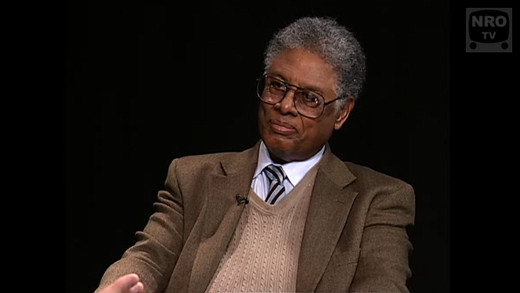
One of the sad and dangerous signs of our times is how many people are enthralled by words, without bothering to look at the realities behind those words.
One of those words that many people seldom look behind is “education.” But education can cover anything from courses on nuclear physics to courses on baton twirling.
Unfortunately, an increasing proportion of American education, whether in the schools or in the colleges and universities, is closer to the baton twirling end of the spectrum than toward the nuclear physics end. Even reputable colleges are increasingly teaching things that students should have learned in high school.
We don’t have a backlog of serious students trying to take serious courses. If you look at the fields in which American students specialize in colleges and universities, those fields are heavily weighted toward the soft end of the spectrum.
When it comes to postgraduate study in tough fields like math and science, you often find foreign students at American universities receiving more of such degrees than do Americans.
A recent headline in the Chronicle of Higher Education said: “Master’s in English: Will Mow Lawns.” It featured a man with that degree who has gone into the landscaping business because there is no great demand for people with Master’s degrees in English.
Too many of the people coming out of even our most prestigious academic institutions graduate with neither the skills to be economically productive nor the intellectual development to make them discerning citizens and voters.
Students can graduate from some of the most prestigious institutions in the country, without ever learning anything about science, mathematics, economics or anything else that would make them either a productive contributor to the economy or an informed voter who can see through political rhetoric.
On the contrary, people with such “education” are often more susceptible to demagoguery than the population at large. Nor is this a situation peculiar to America. In countries around the world, people with degrees in soft subjects have been sources of political unrest, instability and even mass violence.
Nor is this a new phenomenon. A scholarly history of 19th century Prague referred to “the well-educated but underemployed” Czech young men who promoted ethnic polarization there– a polarization that not only continued, but escalated, in the 20th century to produce bitter tragedies for both Czechs and Germans.
In other central European countries, between the two World Wars a rising class of newly educated young people bitterly resented having to compete with better qualified Jews in the universities and with Jews already established in business and the professions. Anti-Semitic policies and violence were the result.
It was much the same story in Asia, where successful minorities like the Chinese in Malaysia were resented by newly educated Malays without either the educational or business skills to compete with them. These Malaysians demanded– and got– heavily discriminatory laws and policies against the Chinese.
Similar situations developed at various times in Nigeria, Romania, Sri Lanka, Hungary and India, among other places.
Many Third World countries have turned out so many people with diplomas, but without meaningful skills, that “the educated unemployed” became a cliche among people who study such countries. This has not only become a personal problem for those individuals who have been educated, or half-educated, without acquiring any ability to fulfill their rising expectations, it has become a major economic and political problem for these countries.
Such people have proven to be ideal targets for demagogues promoting polarization and strife. We in the United States are still in the early stages of that process. But you need only visit campuses where whole departments feature soft courses preaching a sense of victimhood and resentment, and see the consequences in racial and ethnic polarization on campus.
There are too many other soft courses that allow students to spend years in college without becoming educated in any real sense.
We don’t need more government “investment” to produce more of such “education.” Lofty words like “investment” should not blind us to the ugly reality of political porkbarrel spending.
A third of high school grads never studied the Constitution…
The best way to “fundamentally transform America” is to make sure new generations forget what it is all about.
A third of graduated and rising high school seniors – who will be voting in the 2012 elections – have never studied the U.S. Constitution.
A recent study by the National Assessment for Educational Progress reported that only 67% of all high school students have spent any time studying the nation’s founding document. Every four years, the NAEP polls 10,000 students about their knowledge of – or even exposure to – the Constitution. The percentage of knowledgeable students is continually decreasing and, since 2007, the numbers have fallen another five percentage points from 72%. Maybe this is obvious, but shouldn’t a responsible and informed citizenship be one of the goals of public education?
Without basic knowledge of this foundational document, these voters will be hard pressed to answer some of the most important political questions in 2012. The next election is going to depend on every voter’s understanding of constitutional authority. For instance, does Obamacare’s individual mandate fall under the commerce clause? Other recent questions – like which branches are involved in the decision to declare war – cannot be answered without a thorough understanding of the Constitution.
But a basic understanding of the Constitution is useful well beyond just the next election. The Constitutionspells out both the powers and limitations of the federal government. It seems that it could become rather difficult to secure the blessings of liberty without teaching the next generation how our government is designed to protect these liberties.
David Horowitz at UCLA – Palestinian Wall of Lies
Wall of Lies:
Horowitz at UCLA:
Part 2
3
4
5
6
David Horowitz Q&A:
America’s Founders Your School Will Never Tell You About: Black, Jewish, Women Founders and War Heroes. Women Voted in the 1770′s. What Happened?
Plus, the most recognizable man of the revolution was NOT George Washington, who was he, and why has he been erased from America’s school books? [Hint he was the first evangelical preacher – Editor]
Watch this video, even if you are not a fan of Glenn Beck, what you are about to see will change you forever.
 Political Arena
