Category Archives: Budget

Obama to cut healthcare benefits for active duty and retired US military, no cuts for government unions

Obama’s new proposed budget, which has no chance of passing, not only proposed giving $800 million to the Muslim Brotherhood, he wants to slash medical benefits for retired and active duty military. The military likely will not vote for Obama and the government unions will; it is just that simple.

Washington Free Beacon:

The Obama administration’s proposed defense budget calls for military families and retirees to pay sharply more for their healthcare, while leaving unionized civilian defense workers’ benefits untouched. The proposal is causing a major rift within the Pentagon, according to U.S. officials. Several congressional aides suggested the move is designed to increase the enrollment in Obamacare’s state-run insurance exchanges.

The disparity in treatment between civilian and uniformed personnel is causing a backlash within the military that could undermine recruitment and retention.

The proposed increases in health care payments by service members, which must be approved by Congress, are part of the Pentagon’s $487 billion cut in spending. It seeks to save $1.8 billion from the Tricare medical system in the fiscal 2013 budget, and $12.9 billion by 2017.

Many in Congress are opposing the proposed changes, which would require the passage of new legislation before being put in place.

“We shouldn’t ask our military to pay our bills when we aren’t willing to impose a similar hardship on the rest of the population,” Rep. Howard “Buck” McKeon, chairman of the House Armed Services Committee and a Republican from California, said in a statement to the Washington Free Beacon. “We can’t keep asking those who have given so much to give that much more.”

Administration officials told Congress that one goal of the increased fees is to force military retirees to reduce their involvement in Tricare and eventually opt out of the program in favor of alternatives established by the 2010 Patient Protection and Affordable Care Act, aka Obamacare.

Britain passes 50% tax rate for the evil rich, and loses $807.53 million in tax revenue in three months…

If you tax the productive, the productive produce less, pay less in tax, pay people off and it ripples through the economy; or as my teenage daughter might say “duh!”. Those stuck in such a bracket rearrange their affairs to avoid the tax. They invest in China, expatriate, buy gold or other hard assets or just stop moving their money; they stop taking as much risk.

UK Telegraph:

The Treasury received £10.35 billion in income tax payments from those paying by self-assessment last month, a drop of £509 million [that is$807.53 American] compared with January 2011. Most other taxes produced higher revenues over the same period.

Senior sources said that the first official figures indicated that there had been “manoeuvring” by well-off Britons to avoid the new higher rate. The figures will add to pressure on the Coalition to drop the levy amid fears it is forcing entrepreneurs to relocate abroad.

The self-assessment returns from January, when most income tax is paid by the better-off, have been eagerly awaited by the Treasury and government ministers as they provide the first evidence of the success, or failure, of the 50p rate. It is the first year following the introduction of the 50p rate which had been expected to boost tax revenues from self-assessment by more than £1billion.

A Treasury source said the relatively poor revenues from self-assessment returns was partly down to highly-paid individuals arranging their affairs to avoid paying the 50p rate.

“It’s true that SA revenues are a bit disappointing — it’s still early, but it looks like there’s been quite a lot of forestalling and other manoeuvring to avoid the top rate,” said the source.

However, another Treasury source added that the tax deadline had been extended by two days because of industrial action at HM Revenue and Customs. Therefore, it was too early to begin assessing the revenues raised from the 50p rate of tax because about 20 per cent of self-assessment tax is paid in the hours before the deadline.

Francesca Lagerberg, head of tax at Grant Thornton, an accountancy firm, said: “My guess is that because the 50 per cent rate was flagged up in advance many taxpayers, particularly those with their own businesses, decided to extract dividends ahead of the change. It highlights the fact that high tax rates don’t always deliver high tax revenues.”

U.S. per capita government debt worse than Greece

Via the Washington Examiner:


According to a new analysis by the office of Sen. Jeff Sessions, R-Ala., ranking member on the Senate Budget Committee, the United States has a higher per capita debt burden than any European country, including riot-ridden Greece.

Using the most recent data available from the International Monetary Fund, the Senate Budget Committee found that U.S. federal government debt per capita is nearly $45,000. That is almost 15 percent higher than the per capita debt burden of Greece ($38,937).

The Senate Budget Committee also notes that our debt per capita would rise to $75,000 by 2020 if President Obama’s budget became law.

Earlier last month, the U.S. government’s total out standing debt, $15,419,800,222,325, surpassed the nation’s gross domestic product ($15,294,300,000,000).

Forbes: Government Education Spending Up 7 Times & Nothing To Show For It

Forbes:

Solyndra’s in the classroom.

Accordingly, the “investment in education” that Obama wants more (and more, and more) of is actually “federal-government-directed investment in education”. When considering whether we really want more of this, it is important to remember that it was “federal-government-directed investment in energy” that gave us Solyndra, Ener1, and Beacon Power, and that it was “federal-government-directed investment in housing” that has cost taxpayers more than $150 billion in losses (thus far) at Fannie Mae and Freddie Mac.

So, how would we know if increased government “investment” in education was producing a return? We would see a steady rise in the ratio of GDP to “nonresidential produced assets” over time. Our GDP is produced by a combination of physical capital and human capital. Accordingly, if the economic value of our human capital were rising, the impact would show up in the numbers as increasing productivity of physical capital.

Now, here is the bad news. While total real ($2010) government spending on education increased almost 13-fold from 1951 to 2009, the measured GDP return on physical capital actually declined slightly, from 47.7% to 44.1%. This could not have happened if we were getting an appreciable economic return on our huge “investment” in education.

What follows is a “first approximation analysis”. The numbers could be done with more precision, but they are good enough to give us an idea of what the nation has been getting (actually, not getting) for its massive “investments” in education.

Assuming that about 25% of our total population is in school at any one time, average real (2010 dollars) government spending per student rose from $1,763 in 1951 to $12,209 in 2009. This is an increase of about 7 times. Assuming an average of 13 years of education per student (some go to college, some drop out of high school), this means that during this 58-year time period, we increased our real “investment” in the human capital represented by each student from $22,913 to $158,717.

More:

Also, imagine if, instead of being given a 2009 education for $158,717, an average student were given a 1967-style education for about $58,000, and $100,000 in capital with which to start his working life. This would be sufficient to start any number of small businesses. Alternatively, if put in an IRA earning a real return of 6%, the $100,000 would grow to about $1.8 million over 50 years.

The huge government “investments” made in education over the past 50 years have produced little more than “Solyndras in the classroom”. They have enriched teachers unions and other rent-seekers, but have added little or nothing to the economic prospects of students. America does not need more such “investment”.

Read more HERE.


New Jersey Teachers Union on Kids in Failing Union Schools: Life’s Not Fair

In some failing unionized schools in New Jersey the kids have only a 17% proficiency rate in literature and math.

Via Real Clear Politics:

“An outrageous statement. I cannot express how disgusted I am by that statement by the head of the largest teachers union in our state. But I also have to tell you I’m not the least bit surprised, because I think it so succinctly captures what their real position is,” Gov. Chris Christie (R-NJ) said about a union boss who makes 500K a year telling the poor “life’s not fair.”

“It’s an immoral position, and it continues to prop up abject failure in districts across our state,” Christie also said.

Wall St. Made More Money In 2.5 Years Of Obama Than 8 Years Of Bush

Mika Brzezinski, MSNBC’s “Morning Joe”: “New government data shows profits for America’s largest financial firms are once again reaching record highs not seen sense before the financial crisis of 2008. In fact, Wall Street firms have earned more in the first two and a half years of the Obama presidency than all 8 years of the Bush presidency. Over 85 billion dollars in profits compared to 77 billion.”

Joe Scarborough: “Wait — you mean in the first two years they made more than in eight years than in the Bush administration?”

Brzezinski: “That’s correct.”

The facts are that while Obama claims to be against Wall Street and is a champion of the poor against the rich, he is in Wall Street’s back pocket. The Dodd-Frank bill and these other regulations passed in the name of defending the poor, actually tilt the playing field to his donors, expend the power of the federal government to pick winners and losers and Lord help you if you are a part of the smaller competition. I explored this subject for years in great detail on my old college blog.

Related:

Top All-Time Donors, 1989-2012 – Hint: Most goes to Democrats – LINK.

Top 20 Industry Money Recipients This Election Cycle – Who is in the back pocket of Wall Street? – LINK.

Corruption You Can Believe In: Failed Sub Primes and Mortgage Fraud Lenders Funneled Money to Dodd & Obama the Most. Fannie & Freddie Gave $200 Million to Partisans-Most Went to Democrats! Dodd, Obama Among Top Recipients. Republicans Attempted to Pass Reforms-Blocked by Democrat Leadership! – LINK.

Hypocrite! Elizabeth Warren Takes Wall Street Cash! – LINK.

Corruption: Most Stimulus Funds Spent in Democrat Districts – LINK.

The taxes Democrats propose to “soak the rich” always seem to miss those who they demagogue for not paying their fair share. They have been “soaking the rich” for decades and keep missing the target. Why? – LINK.

VDH: We too can lose our civilization…

Dr. Victor Davis Hanson (excerpt):

In my state, Californians for 40 years have hiked taxes; grown their government; vastly expanded entitlements; put farmland, timberland, and oil and gas lands off limits; and opened their borders to millions of illegal aliens. They apparently assumed that they had inherited so much wealth from prior generations and that their state was so naturally rich, that a continually better life was their natural birthright.

It wasn’t. Now, as in Greece, the veneer of civilization is proving pretty thin in California. Hospitals no longer have the money to offer sophisticated long-term medical care to the indigent. Cities no longer have the funds to self-insure themselves from the accustomed barrage of monthly lawsuits. When thieves rip copper wire out of street lights, the streets stay dark. Most state residents would rather go to the dentist these days than queue up and take a number at the Department of Motor Vehicles. Hospital emergency rooms neither have room nor act as if there’s much of an emergency.

Traffic flows no better on most of the state’s freeways than it did 40 years ago — and often much worse, given the crumbling infrastructure and increased traffic. Once-excellent K–12 public schools now score near the bottom in nationwide tests. The California state-university system keeps adding administrators to the point where they have almost matched the number of faculty, though half of the students who enter CSU need remedial reading and math. Despite millions of dollars in tutoring, half the students still don’t graduate. The taxpayer is blamed in constant harangues for not ponying up more money, rather than administrators being faulted for a lack of reform.

In 1960, there were far fewer government officials, far fewer prisons, far fewer laws, and far fewer lawyers — and yet the state was a far safer place than it is a half-century later. Technological progress — whether iPhones or Xboxes — can often accompany moral regress. There are not yet weeds in our cities, but those too may be coming.

The average Californian, like the average Greek, forgot that civilization is fragile. Its continuance requires respect for the law, tough-minded education, collective thrift, private investment, individual self-reliance, and common codes of behavior and civility — and exempts no one from those rules. Such knowledge and patterns of civilized behavior, slowly accrued over centuries, can be lost in a single generation.

A keen visitor to Athens — or Los Angeles — during the last decade not only could have seen that things were not quite right, but also could have concluded that they could not go on as they were. And so they are not.

Washington, please take heed.

Obama Administration Gave Electric Car Battery Maker $118 Million, Company Now Bankrupt

Via Big Government:

The latest taxpayer-funded boondoggle to emerge from the Obama Administration’s infamous Energy Department grant and loan program has cost taxpayers $118.5 million, new bankruptcy filings by electric battery maker Ener1 reveal.

From Bloomberg News:

The company listed assets of $73.9 million and debt of $90.5 million as of Dec. 31 in Chapter 11 papers filed today in U.S. Bankruptcy Court in Manhattan. Ener1 has been affected by competing battery developers in China and South Korea, “which generally have a lower cost manufacturing base” and lower labor and raw material costs, interim Chief Executive Officer Alex Sorokin said in the petition.

Like Solyndra, Ener1 was a company touted by President Obama as being a shining example of his vision for taxpayer-subsidized clean energy.

The day following President Barack Obama’s 2011 State of the Union Address, Vice President Joe Biden toured Ener1’s lithium-ion battery system manufacturing facility in Greenfield, Indiana and said:

As you heard President Obama say last night, this Administration is forging a new path forward by making sure America doesn’t just lead in the 21st Century, but dominates in the 21st Century. We’re not just creating new jobs-but sparking whole new industries that will ensure our competitiveness for decades to come-industries like electric vehicle manufacturing.

Ener1’s EnerDel unit, which is based in Indianapolis, Indiana, likewise received a Solyndra-style shout out from Mr. Obama during a 2009 swing through Indiana. During his remarks, Mr. Obama said:

See, I’m committed to a strategy that ensures America leads in the design and the deployment of the next generation of clean-energy vehicles.  This is not just an investment to produce vehicles today; this is an investment in our capacity to develop new technologies tomorrow.  This is about creating the infrastructure of innovation.

Indiana is the second largest recipient of grant funding, and it’s a perfect example of what this will mean.  You’ve got Purdue University, Notre Dame, Indiana University, and Ivy Tech, and they’re all going to be receiving grant funding to develop degree and training programs for electric vehicles.  That’s number one.  We’ve got EnerDel, a small business in Indianapolis that will develop batteries for hybrid and electric vehicles.

Now, in the wake of the Dec. 31st bankruptcy filing, Mr. Obama used his 2012 State of the Union Address to make it clear he intends to double down, not reverse course, from his decision to use taxpayer dollars to prop up clean energy companies that are too weak to compete and thrive on their own:

Payoffs on these public investments don’t always come right away.  Some technologies don’t pan out; some companies fail.  But I will not walk away from the promise of clean energy.

As Newsweek and Breitbart editor Peter Schweizer have reported, Mr. Obama’s green energy loan and grant program have funneled 80% of the Energy Department’s $20.5 billion to companies owned by or associated with Mr. Obama’s top campaign fundraisers and bundlers.

Read on HERE!

Art Laffer: Why Gingrich’s Tax Plan Beats Romney’s

Art Laffer is the economic genius behind the Reagan Recovery where 8 of the top 10 economic indicators showed almost unending growth for two decades.

Read every last word carefully before you vote.

Art Laffer at the Wall Street Journal:

If we judge both leading contenders in the Republican primary, Newt Gingrich and Mitt Romney, by what they’ve done in life and by what they propose to do if elected, either one could be an excellent president. But when it comes to the election’s core issue—restoring a healthy economy—the key is a good tax plan and the ability to implement it.

Mr. Gingrich has a significantly better plan than does Mr. Romney, and he has twice before been instrumental in implementing a successful tax plan on a national level—once when he served in Congress as a Reagan supporter in the 1980s and again when he was President Clinton’s partner as speaker of the House of Representatives in the 1990s. During both of these periods the economy prospered incredibly—in good part because of Mr. Gingrich.

Jobs and wealth are created by those who are taxed, not by those who do the taxing. Government, by its very nature, doesn’t create resources but redistributes resources. To minimize the damages taxes cause the economy, the best way for government to raise revenue is a broad-based, low-rate flat tax that provides people and businesses with the fewest incentives to avoid or otherwise not report taxable income, and the least number of places where they can escape taxation. On these counts it doesn’t get any better than Mr. Gingrich’s optional 15% flat tax for individuals and his 12.5% flat tax for business. Each of these taxes has been tried and tested and found to be enormously successful.

Hong Kong, where there has been a 15% flat income tax on individuals since 1947, is truly a shining city on the hill and one of the most prosperous cities in history. Ireland’s 12.5% flat business income tax propelled the Emerald Isle out of two and a half centuries of poverty. Mr. Romney’s tax proposals—including eliminating the death tax, reducing the corporate tax rate to 25%, and extending the current tax rates on personal income, interest, dividends and capital gains—would be an improvement over those of President Obama, but they don’t have the boldness or internal integrity of Mr. Gingrich’s personal and business flat taxes.

Imagine what would happen to international capital flows if the U.S. went from the second highest business tax country in the world to one of the lowest. Low taxes along with all of America’s other great attributes would precipitate a flood of new investment in this country as well as a quick repatriation of American funds held abroad. We would create more jobs than you could shake a stick at. And those jobs would be productive jobs, not make-work jobs like so many of Mr. Obama’s stimulus jobs.

Tax codes, in order to work well, require widespread voluntary compliance from taxpayers. And for taxpayers to voluntarily comply with a tax code they have to believe that it is both fair and efficient.

Fairness in taxation means that people and businesses in like circumstances have similar tax burdens. A flat tax, whether on business or individuals, achieves fairness in spades. A person who makes 10 times as much as another person should pay 10 times more in taxes. It is also patently obvious that it is unfair to tax some people’s income twice, three times or more after it has been earned, as is the case with the death tax.

The current administration’s notion of fairness—taxing high-income earners at high rates and not taxing other income earners at all—is totally unfair. It is also anathema to prosperity and ultimately leads to the situation we have in our nation today.

In 2012, those least capable of navigating complex government-created economic environments find themselves in their worst economic circumstances in generations. And the reason minority, lesser-educated and younger members of our society are struggling so greatly is not because we have too few redistributionist, class-warfare policies but because we have too many. Overtaxing people who work and overpaying people not to work has its consequences.

On a bipartisan basis, government has enacted the very policies that have created the current extremely uneven distribution of income. And then in turn they have used the very desperation they created as their rationale for even more antibusiness and antirich policies. As my friend Jack Kemp used to say, “You can’t love jobs and hate job creators.” Economic growth achieved through a flat tax in conjunction with a pro-growth safety net is the only way to raise incomes of those on the bottom rungs of our economic ladder.

When it comes to economic efficiency, nothing holds a candle to a low-rate, simple flat tax. As I explained in a op-ed on this page last spring (“The 30-Cent Tax Premium,” April 18), for every dollar of net income tax collected by the Internal Revenue Service, there is an additional 30¢ paid out of pocket by the taxpayers to maintain compliance with the tax code. Such inefficiency is outrageous. Mr. Gingrich’s flat taxes would go a lot further toward reducing these additional expenses than would Mr. Romney’s proposals.

Mr. Gingrich’s tax proposal is not revenue-neutral, nor should it be. If there’s one truism in fiscal policy, it’s this: Wasteful spending will always rise to the level of revenues. Whether you’re in Greece, Washington, D.C., or California, overspending is a prosperity killer of the first order. Mr. Gingrich’s flat tax proposals—along with his proposed balanced budget amendment—would put a quick stop to overspending and return America to fiscal soundness. No other candidate comes close to doing this.


CBO another reports another $1 trillion deficit

It is enough to make one ill.

Politico:

The government faces a fourth year of trillion-plus deficits in 2012, according to new projections released Tuesday—numbers which also show little relief in the future unless Washington comes to grips with needed changes in its tax and spending policies.

Like Aunt Cassandra coming down from the attic, the Congressional Budget Office steps squarely into the 2012 campaign season with the 147-page report which might have been subtitled “It’s not just the economy stupid, it’s also the debt.”

Read more: http://www.politico.com/news/stories/0112/72205.html#ixzz1l4LbX8qh


Solyndra caught tossing millions of dollars’ worth of assets YOU paid for into dumpsters

With so many of thee green energy boondoggles it looks like this: Obama gives big taxpayer money to a fund raiser who is an owner in a “green energy company”. Said owners pay themselves in a big way, give big money to Democrats and go out of business.

Related:

Another Green Energy Stimulus Recipient Hits the Skids (the third this week!) – LINK

CBS: Obama Admin knew green energy boondoggles were politically motivated – LINK

Whopping Lies: New Obama ad defends energy policy, Solyndra – LINK


Another Green Energy Stimulus Recipient Hits the Skids (the third this week!)

With so many of thee green energy boondoggles it looks like this: Obama gives big taxpayer money to a fund raiser who is an owner in a “green energy company”. Said owners pay themselves in a big way, give big money to Democrats and go out of business.

Via GlobalWarming.org:

Earlier this week, Stimulus beneficiary Evergreen Energy bit the dust. Then, Ener1, a manufacturer of batteries for electric vehicles and recipient of Stimulus largesse, filed for bankruptcy. And today, the Las Vegas Sun reports that Amonix, Inc., a manufacturer of solar panels that received $5.9 million from the Porkulus, will cut two-thirds of its workforce, about 200 employees, only seven months after opening a factory in Nevada.

I foresaw this spate of bad news last November. As I explained yesterday,

In a previous post, I compared renewable energy spending in the 2009 Stimulus to a green albatross burdening the President. I argued that Stimulus spending was inherently wasteful, because politics invariably corrupts government’s investment decisions. The result is taxpayers losses on bankrupt companies that existed only by the grace of political favoritism, a la Solyndra. I predicted the green stimulus would haunt the President, in the form of a slow drip public relations nightmare, as a litany of bad investments go belly-up in the run up to the 2012 elections.

GlobalWarming.org is a nice site. I suggest that our readers add it to their reading lists.

Democrats Face Another Financial Scandal: MF Global client money feared gone

CEO of Thomas Capital Management and Political Arena contributor Thomas J. Zaleski comments:

WHERE are the Democrats blood curdling screams of corporate raiders, banksters, greed, etc? Oh, Democrats love [former New Jersey Governor] Corzine! And it’s Bush’s fault?

Imagine a CPA NOT being able to find ONE POINT TWO BILLION? Must be a drunk CPA. James R. Spear, CPA Diplomat Forensic Accounting could find the money in days.


Watch this video and keep in mind that New Jersey fired Gov. Corzine because he put the state on the brink of default, now Gov. Chris Christie is cleaning up the mess:

Wall Street Journal/NY Post:

MF Global client money feared gone

Nearly three months after MF Global Holdings collapsed, officials hunting for an estimated $1.2 billion in missing customer money increasingly believe that much of it might never be recovered, according to people familiar with the investigation.

As the sprawling probe that includes regulators, criminal and congressional investigators, and court-appointed trustees grinds on, the findings so far suggest that a “significant amount” of the money could have “vaporized” as a result of chaotic trading at MF Global during the week before the company’s Oct. 31 bankruptcy filing, a person close to the investigation was cited as saying Monday.

Many officials now believe certain employees at MF Global dipped into the “customer segregated account” that the New York company was supposed to keep separate from its own assets — and then used the money to meet demands for more collateral or to unfreeze assets at banks and other counterparties as they grew more concerned about their financial exposure to MF Global.

Lawmakers have pushed for answers from Jon S. Corzine, the former New Jersey governor and Goldman Sachs Group chairman who led MF Global into its big European bet and was CEO when the company failed.

[But I thought it was those rascally Republicans who owned Wall Street and Goldman Sachs…. – Editor]

Read more HERE.

If George Soros is so into promoting socialism, why does he go to such lengths to enrich himself often at the expense of others?

I was asked the question in the title so I thought I would provide a short answer with some supporting evidence.

Socialists like Soros are not truly into socialism, they are into control. Envy is the tool and socialism is the vehicle that he and people like him use.

There are essentially three kinds of socialists:

The Control Freak: We are the ruling elite and are born to rule. Follow me and stay out of my way or else…

The Utopian: The Utopian wants to create a perfect society which is impossible. The more they tighten their grip the more slips through their fingers. When Utopians come into power they often lose that naivete and become control freaks.

The Sucker: Those who have swallowed the envy narrative. They see someone else get taxed or punished who has more and that makes them feel better in spite of the fact that they are not better off for it and are in fact, worse off. Why? Because envy corrupts the spirit and the thought process. There are 37% fewer millionaires in the country now than when Obama got elected. If this is all about redistribution of wealth let me ask you –  how much of that money did you get?

Obama while giving a speech to Google blasted the Chamber of Commerce for opposing a raise in the top marginal tax rate to 39.9% because millionaires and billionaires weren’t paying their fair share.

Google paid 2.4% federal tax on 3.1 billion in income. Google doesn’t pay the top marginal rate – small to medium sized businesses called “S-Corps” do.

Google pays the corporate rate and has the influence to get favors in the 60,000 page tax code. Google also makes money overseas and chooses not to repatriate the profits.

Raising the top marginal tax rate doesn’t effect millionaires and billionaires because by and large they do not pay that tax, but small businesses would get soaked. Google and GE pay next to nothing and small to medium domestic business pays 39.9% (albeit with some deductions). This is how President Obama and the leadership of his party define fairness. Now you have just figured out why the largest Wall Street outfits and many other mega-corporations donate to Democrats in such numbers over Republicans.

Hence Norton’s First Law: Big Business loves big government because big government taxes and regulates the small and medium sized domestic competition out of the competition.

The taxes Democrats propose to “soak the rich” always seem to miss those who they demagogue for not paying their fair share. They have been “soaking the rich” for decades and keep missing the target. Why? – LINK

Related:

George Soros and Warren Buffet benefited from Obama Keystone Pipeline Veto – LINK.

Don’t forget George Soros – LINK.

Political Arena George Soros Coverage – LINK.

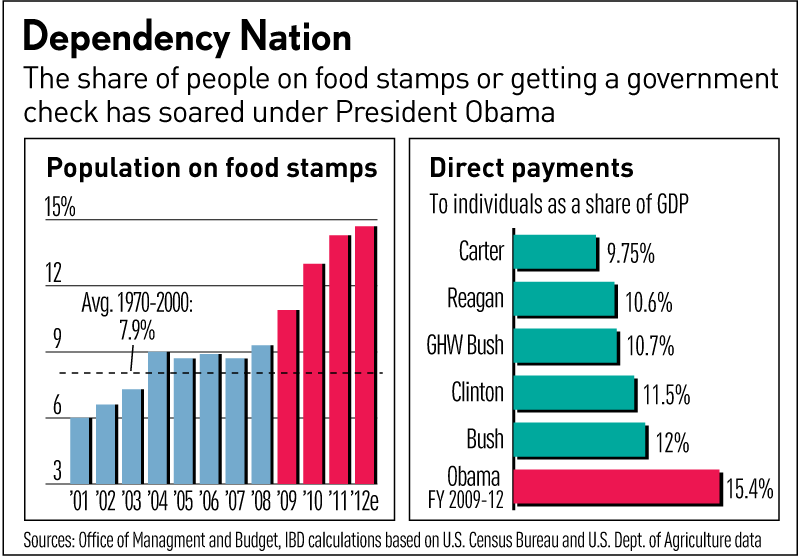
Real GDP Tanked at 1.7%. Food Stamps and Welfare at Record Levels

Business Insider:

1.7%. That’s the final, pathetic growth number for 2011.

From the just-released GDP report:

Real GDP increased 1.7 percent in 2011 (that is, from the 2010 annual level to the 2011 annual level), compared with an increase of 3.0 percent in 2010.

The increase in real GDP in 2011 primarily reflected positive contributions from personal consumption expenditures (PCE), exports, and nonresidential fixed investment that were partly offset by negative contributions from state and local government spending, private inventory investment, and federal government spending.  Imports, which are a subtraction in the calculation of GDP, increased.


Business Insider:

Direct payments. The amount of money the federal government hands out in direct payments to individuals steadily increased over the past four decades, but shot up under Obama, climbing by almost $600 billion — a 32% increase — in his first three years. And Obama’s last budget called for these payments to climb another $500 billion by 2016, at which point they would account for fully two-thirds of all federal spending.

People getting benefits. According to the Census Bureau 49% now live in homes where at least one person gets a federal benefit — Social Security, workers comp, unemployment, subsidized housing, and the like. That’s up from 44% the year before Obama took office, and way up from 1983, when fewer than a third were government beneficiaries.

Food stamps. This year, more than 46 million (15% of all Americans) will get food stamps. That’s 45% higher than when Obama took office, and twice as high as the average for the previous 40 years. This surge was driven in part by the recession, but also because Obama boosted the benefit amount as part of his stimulus plan.

Disability. The number of people on Social Security disability has steadily climbed since the 1970s, thanks mainly to easier eligibility rules. But their numbers jumped 10% in Obama’s first two years in office, according to the Social Security Administration. That sharp rise was due largely to meager job prospects since the recession ended in 2009. When employment opportunities are scarce, experts note, many who could otherwise work sign up for disability benefits instead.


Democrat’s Sugar-Daddy George Soros Helped Craft Stimulus Then Invested in Companies Benefiting

George Soros
George Soros

Via Big Government:

Billionaire George Soros gave advice and direction on how President Obama should allocate so-called “stimulus” money in a series of regular private meetings and consultations with White House senior advisers even as Soros was making investments in areas affected by the stimulus program.

It’s just one more revelation featured in the blockbuster new book that continues to rock Washington,Throw Them All Out, authored by Breitbart News editor Peter Schweizer.

Mr. Soros met with Mr. Obama’s top economist on February 25, 2009 and twice more with senior officials in the Old Executive Office Building on March 24th and 25th as the stimulus plan was being crafted.  Later, Mr. Soros also participated in discussions on financial reform.

Then, in the first quarter of 2009, Mr. Soros went on a stock buying spree in companies that ultimately benefited from the federal stimulus.

  • Soros doubled his holdings in medical manufacturer Hologic, a company that benefited from stimulus spending on medical systems
  • Soros tripled his holdings in fiber channel and software maker Emulus, a company that wound up scoring a large amount of federal funds going to infrastructure spending
  • Soros bought 210,000 shares in Cisco Systems, which came up big in the stimulus lottery
  • Soros also bought Extreme Networks, which, months later, said it was expanding broadband to rural America “as part of President Obama’s broadband strategy”
  • Soros bought 1.5 million shares in American Electric Power, a company Mr. Obama gave $1 billion to in June 2009
  • Soros bought shares in utility company Ameren, which bagged a $540 million Department of Energy loan
  • Soros bought 250,000 shares of Public Service Enterprise Group, 500,000 shares of NRG Energy, and almost a million shares of Entergy—all companies that  came up winners in the Department of Energy taxpayer giveaway that produced the Solyndra debacle
  • Soros bought into BioFuel Energy, a company that benefitted when the EPA announced a regulation on ethanol
  • Soros bought Powerspan in April 2009.  Just weeks later, the clean-energy company landed $100 million from the Department of Energy
  • In the second quarter of 2009, Soros bought education technology giant Blackboard, which became a big recipient of education stimulus money
  • Soros also bought Burlington Northern Santa Fe and CSX, both beneficiaries of Mr. Obama’s plans for revitalizing the railroads
  • Soros bought Cognizant Technology Solutions, which scored stimulus funds in education and health care technology
  • Soros also bought 300,000 shares of Constellation Energy Group and 4.6 million shares of Covanta, both of which landed taxpayers’ money through the stimulus, the former of which bagged $200 million

In Throw Them All Out, Schweizer catalogs several more of Mr. Soros’s trades and says that, while “it is not necessarily the case that Soros had specific insider tips about any government grants,” nevertheless, Soros’s “investment decisions aligned remarkably closely with government grants and transfers.”

The Truth About RomneyCare

Why is it that Mitt won’t talk about the whole story on RomneyCare. Keep in mind that this is the policy he refuses to walk away from… price controls and all…..

PJ Media Paul Hsieh, MD:

Now that Mitt Romney has shown himself politically vulnerable after Iowa, more people are taking a closer look at his claims about the “RomneyCare” health care plan he helped create as Massachusetts governor. In this interview from April 2010 which recently recirculated last month, Romney attempts to draw some distinctions (as well as acknowledge similarities) between his RomneyCare plan and the national ObamaCare plan. One of the alleged virtues of RomneyCare over ObamaCare is that Romney’s plan does not contain “price controls,” whereas ObamaCare does. But how does this stack up against reality?

Romney’s claim may have been technically true at the time the plan was enacted. But according to the New York Times, this was a deliberate choice on the part of Romney and the Massachusetts lawmakers when they passed the law in 2006. They aimed for “universal coverage” first, and decided to worry about controlling costs later. In other words, they knew that costs would be a problem but chose to kick the can down the road. It’s like borrowing money from a loan shark then saying, “At least I don’t owe him any money right now!”

But even before Romney’s 2010 claims, the state had already implemented some price controls. As Michael Tennant notes, “Requiring insurers to cover those with pre-existing conditions at the same rates as healthy individuals –  another feature of the Massachusetts law that Romney praises — surely qualifies as a price control.”

Similarly, requiring insurance companies to provide numerous mandatory benefits (including lay midwives, orthotics, and drug-abuse treatment) and then denying insurers’ requests for rate increases to cover their increased costs is another form of price control.

Yet another price control considered (but ultimately not implemented) was a proposal to compel doctors to accept patients covered by the state’s “Affordable Health Plans” at government-set payment rates or else lose their state medical licenses.

And because costs continue to rise faster in Massachusetts than in the rest of the country….

Read the rest HERE.

You paid the high cost of RomneyCare in Massachusetts….

This study from the Beacon Hill (Economics) Institute at Suffolk University illuminates the disastrous results of the failed experiment known as RomneyCare and yet presidential candidate Mitt Romney continues to stand by the program.

Here are the key findings from the Beacon Hill study:

The High Price of Massachusetts Health Care Reform

http://www.beaconhill.org/BHIStudies/HCR-2011/BHIMassHealthCareReform2011-0627.pdf

We find that, under health care reform:

• State health care expenditures have risen by $414 million over the period;

• Private health insurance costs have risen by $4.311 billion over the period;

• The federal government has spent an additional $2.418 billion on Medicaid for Massachusetts.

• Over this period, Medicare expenditures increased by $1.426 billion;

• For a total cumulative cost of $8.569 billion over the period; and

• The state has been able to shift the majority of the costs to the federal government.

The federal government continues to absorb a significant cost of health care reform through enhanced Medicaid payments and the Medicare program.   Health care reform has also increased the rate for Medicare Advantage plans in Massachusetts, which has contributed to an increase in Medicare health care expenditures through prices for medical service delivery.

This is not defendable.

It gets worse. The Beacon Hill Institute did a fraud study to determine how the RomneyCare system is being “gamed”:

Massachusetts Health Care Reform Mandates: The Gaming Gamble

http://www.beaconhill.org/BHIStudies/HCR-2011/GamingMandates2011-1128.pdf

The law requires that individuals with sufficient means purchase health insurance and that businesses with more than ten employees make a “fair and reasonable” contribution toward their employees’ health insurance. Under the law, health insurance companies cannot refuse to cover individuals with preexisting conditions.  Individuals and businesses face fines if they fail to comply with the mandates.

Because the fines imposed by the law cost are often less than the cost of insurance, the law is vulnerable to the problem of moral hazard.

Individuals can game the mandate by buying insurance only upon being diagnosed as needing a non‐emergency procedure such as a hip replacement and then canceling their insurance after receiving the treatment or procedure.  Businesses can likewise game the mandate by canceling their health insurance plans and shifting their employees to newly subsidized state plans.    Massachusetts taxpayers and health insurance policyholders pick up the tab for these “jumpers and dumpers.”
The Beacon Hill Institute (BHI) has estimated the prevalence and cost of gaming the mandates.  We find that:

• In tax year 2008 (the latest data available) 26,000 individuals paid a total of $16 million in fines, while 758 businesses paid $7.1 million.

• In 2009, between 2,089 and 2,659 individuals gamed the individual mandate at an estimated cost to insurance carriers of between $29.3 million and $37.3 million.

• Between June 2006 and June 2010 enrollment in state subsidized insurance plans increased by 319,000, while the private group (employer) market was flat and the individual market increased by 83,000.

In essence, the incentives in RomneyCare, just as in ObamaCare, are backwards. They encourage people to behave in ways that maximize costs and inefficiency. This is what economists refer to as an “Adverse Selection Spiral”. Eventually the system collapses under the weight of its own costs and inefficiency.

UPDATE – Thomas Zaleski adds:

Wouldn’t it be great if you could purchase AUTO insurance AFTER you had an accident? That is PRECISELY what Romney care is. Break a leg, BUY insurance the SAME day!

U.S. Debt Now 100% of GDP

When debt reaches 100% of GDP it is usually a point of no return. Only one country in the history of the world has survived that much debt. What happens is that spending and interest spiral up to the point where those making the loans realize that the debtor is incapable of paying it back. The currency starts to fall apart fast at 120-130% of GDP, which isn’t far away. We are already seeing the inflationary effects of so much debt.

USA Today:

WASHINGTON – The soaring national debt has reached a symbolic tipping point: It’s now as big as the entire U.S. economy.

The amount of money the federal government owes to its creditors, combined with IOUs to government retirement and other programs, now tops $15.23 trillion.

That’s roughly equal to the value of all goods and services the U.S. economy produces in one year: $15.17 trillion as of September, the latest estimate. Private projections show the economy likely grew to about $15.3 trillion by December — a level the debt is likely to surpass this month.

“The 100% mark means that your entire debt is as big as everything you’re producing in your country,” says Steve Bell of the Bipartisan Policy Center, which has proposed cutting nearly $6 trillion in red ink over 10 years. “Clearly, that can’t continue.”

Long-term projections suggest the debt will continue to grow faster than the economy, which would have to expand by at least 6% a year to keep pace.

TSA security measures accomplish nothing, at enormous cost.

The TSA has proved to be very poor at stopping contraband when the GAO put them to the test. Things have not gotten better.

Vanity Fair:

Smoke Screening

As you stand in endless lines this holiday season, here’s a comforting thought: all those security measures accomplish nothing, at enormous cost. That’s the conclusion of Charles C. Mann, who put the T.S.A. to the test with the help of one of America’s top security experts.

Bruce Schneier’s exasperation is informed by his job-related need to spend a lot of time in Airportland. He has 10 million frequent-flier miles and takes about 170 flights a year; his average speed, he has calculated, is 32 miles and hour. “The only useful airport security measures since 9/11,” he says, “were locking and reinforcing the cockpit doors, so terrorists can’t break in, positive baggage matching”—ensuring that people can’t put luggage on planes, and then not board them —“and teaching the passengers to fight back. The rest is security theater.”

Remember the fake boarding pass that was in Schneier’s hand? Actually, it was mine. I had flown to meet Schneier at Reagan National Airport because I wanted to view the security there through his eyes. He landed on a Delta flight in the next terminal over. To reach him, I would have to pass through security. The day before, I had downloaded an image of a boarding pass from the Delta Web site, copied and pasted the letters with Photoshop, and printed the results with a laser printer. I am not a photo-doctoring expert, so the work took me nearly an hour. The T.S.A. agent waved me through without a word. A few minutes later, Schneier deplaned, compact and lithe, in a purple shirt and with a floppy cap drooping over a graying ponytail.

The boarding-pass problem is hardly the only problem with the checkpoints. Taking off your shoes is next to useless. “It’s like saying, Last time the terrorists wore red shirts, so now we’re going to ban red shirts,” Schneier says. If the T.S.A. focuses on shoes, terrorists will put their explosives elsewhere. “Focusing on specific threats like shoe bombs or snow-globe bombs simply induces the bad guys to do something else. You end up spending a lot on the screening and you haven’t reduced the total threat.”

As I waited at security with my fake boarding pass, a T.S.A. agent had darted out and swabbed my hands with a damp, chemically impregnated cloth: a test for explosives. Schneier said, “Apparently the idea is that al-Qaeda has never heard of latex gloves and wiping down with alcohol.” The uselessness of the swab, in his view, exemplifies why Americans should dismiss the T.S.A.’s frequent claim that it relies on “multiple levels” of security. For the extra levels of protection to be useful, each would have to test some factor that is independent of the others. But anyone with the intelligence and savvy to use a laser printer to forge a boarding pass can also pick up a stash of latex gloves to wear while making a bomb. From the standpoint of security, Schneier said, examining boarding passes and swabbing hands are tantamount to performing the same test twice because the person you miss with one test is the same person you’ll miss with the other.

After a public outcry, T.S.A. officers began waving through medical supplies that happen to be liquid, including bottles of saline solution. “You fill one of them up with liquid explosive,” Schneier said, “then get a shrink-wrap gun and seal it. The T.S.A. doesn’t open shrink-wrapped packages.” I asked Schneier if he thought terrorists would in fact try this approach. Not really, he said. Quite likely, they wouldn’t go through the checkpoint at all. The security bottlenecks are regularly bypassed by large numbers of people—airport workers, concession-stand employees, airline personnel, and T.S.A. agents themselves (though in 2008 the T.S.A. launched an employee-screening pilot study at seven airports). “Almost all of those jobs are crappy, low-paid jobs,” Schneier says. “They have high turnover. If you’re a serious plotter, don’t you think you could get one of those jobs?”

Read more HERE.


34 Facts About The National Debt

Business Insider:

Enjoy this false prosperity while you can, because it is not going to last.

Debt is a very cruel master, and our day of reckoning is almost here.

The following are 34 shocking facts about U.S. debt that should set America on fire with anger….

#1 During fiscal year 2011, the U.S. government spent 3.7 trillion dollars but it only brought in 2.4 trillion dollars.

#2 When Ronald Reagan took office, the U.S. national debt was less than 1 trillion dollars.  Today, the U.S. national debt is over 15.2 trillion dollars.

#3 During 2011, U.S. debt surpassed 100 percent of GDP for the first time ever.

#4 According to Wikipedia, the monetary base “consists of coins, paper money (both as bank vault cash and as currency circulating in the public), and commercial banks’ reserves with the central bank.”  Currently the U.S. monetary base is sitting somewhere around 2.7 trillion dollars.  So if you went out and gathered all of that money up it would only make a small dent in our national debt.  But afterwards there would be no currency for anyone to use.

#5 The U.S. government spent over 454 billion dollars just on interest on the national debt during fiscal 2011.

#6 The U.S. government has total assets of 2.7 trillion dollars and has total liabilities of 17.5 trillion dollars.  The liabilities do not even count 4.7 trillion dollars of intragovernmental debt that is currently outstanding.

#7 During the Obama administration, the U.S. government has accumulated more debt than it did from the time that George Washington took office to the time that Bill Clinton took office.

#8 It is being projected that the U.S. national debt will surpass 23 trillion dollars in 2015.

#9 According to the GAO, the U.S. government is facing 34 trillion dollars in unfunded liabilities for social insurance programs such as Social Security and Medicare.  These are obligations that we have already committed ourselves to but that we do not have any money for.

#10 Others estimate that the unfunded liabilities of the U.S. government now total over 117 trillion dollars.

#11 According to the GAO, the ratio of debt held by the public to GDP is projected to reach 287 percent of GDP by 2086.

#12 Others are much less optimistic.  A recently revised IMF policy paper entitled “An Analysis of U.S. Fiscal and Generational Imbalances: Who Will Pay and How?” projects that U.S. government debt will rise to about 400 percent of GDP by the year 2050.

#13 The United States government is responsible for more than a third of all the government debt in the entire world.

#14 If you divide up the national debt equally among all U.S. taxpayers, each taxpayer would owe approximately $134,685.

#15 Mandatory federal spending surpassed total federal revenue for the first time ever in fiscal 2011.  That was not supposed to happen until 50 years from now.

#16 Between 2007 and 2010, U.S. GDP grew by only 4.26%, but the U.S. national debt soared by 61% during that same time period.

#17 During Barack Obama’s first two years in office, the U.S. government added more to the U.S. national debt than the first 100 U.S. Congresses combined.

#18 When you add up all spending by the federal government, state governments and local governments, it comes to 46.6% of GDP.

#19 Our nation is more addicted to government checks than ever before.  In 1980, government transfer payments accounted for just 11.7% of all income.  Today, government transfer payments account for 18.4% of all income.

#20 U.S. households are now actually receiving more money directly from the U.S. government than they are paying to the government in taxes.

#21 A staggering 48.5% of all Americans live in a household that receives some form of government benefits.  Back in 1983, that number was below 30 percent.

#22 Back in 1965, only one out of every 50 Americans was on Medicaid.  Today, one out of every 6 Americans is on Medicaid.

#23 In 1950, each retiree’s Social Security benefit was paid for by 16 U.S. workers.  According to new data from the U.S. Bureau of Labor Statistics, there are now only 1.75 full-time private sector workers for each person that is receiving Social Security benefits in the United States.

#24 The U.S. government now says that the Medicare trust fund will run out five years faster than they were projecting just last year.

#25 Right now, spending by the federal government accounts for about 24 percent of GDP.  Back in 2001, it accounted for just 18 percent.

#26 If the U.S. government was forced to use GAAP accounting principles (like all publicly-traded corporations must), the U.S. government budget deficit would be somewhere in the neighborhood of $4 trillion to $5 trillion each and every year.

#27 If you were alive when Christ was born and you spent one million dollars every single day since that point, you still would not have spent one trillion dollars by now.  But this year alone the U.S. government is going to add more than a trillion dollars to the national debt.

#28 If right this moment you went out and started spending one dollar every single second, it would take you more than 31,000 years to spend one trillion dollars.

#29 A trillion $10 bills, if they were taped end to end, would wrap around the globe more than 380 times.  That amount of money would still not be enough to pay off the U.S. national debt.

#30 If the federal government began right at this moment to repay the U.S. national debt at a rate of one dollar per second, it would take over 470,000 years to pay off the national debt.

#31 If Bill Gates gave every penny of his fortune to the U.S. government, it would only cover the U.S. budget deficit for 15 days.

#32 According to Professor Laurence J. Kotlikoff, the U.S. is facing a “fiscal gap” of over 200 trillion dollars in the future.  The following is a brief excerpt from a recent article that he did for CNN….

The government’s total indebtedness — its fiscal gap — now stands at $211 trillion, by my arithmetic. The fiscal gap is the difference, measured in present value, between all projected future spending obligations — including our huge defense expenditures and massive entitlement programs, as well as making interest and principal payments on the official debt — and all projected future taxes.

#33 If you add up all forms of debt in the United States (government, business and consumer), it comes to more than 56 trillion dollars.  That is more than $683,000 per family.  Unfortunately, the average amount of savings per family in the U.S. is only about $4,735.

#34 The U.S. national debt is now more than 5000 times larger than it was when the Federal Reserve was created back in 1913.

But do our leaders care about statistics such as these?

No.

Read more: http://www.businessinsider.com/us-debt-america-michael-snyder-2012-1#ixzz1ivdb09ru

Democrats California Budget: More Taxes, More Debt, Smoke & Mirrors….

Moe Lane at RedState has a revealing piece on the California budget crisis; Democrats are making it worse on purpose:

To summarize: $92.6 billion in spending (7% increase over last year’s); $9.2 billion deficit over eighteen months (half in the first six months, the other half in the next twelve). Brown is requesting $7 billion in new taxes, mostly from raising the sales tax again (to 7.75%) but with a faux-populist-friendly soak-the-rich* (actually, soak-the-small-business-owner) increase to 10.3%. Or the state can ‘cut’ an additional $4.8 billion in educational aid (he’s already planning to reduce poverty assistance by $4.2 billion): the most increased spending appears to be in tax relief/local government**… and education. In other words, that cut would actually be mostly in a projected increase in education spending, which means that it’s not really a cut at all.

Or, to summarize the summary: Brown’s bailing out the municipalities; and he’s trying to blackmail the Californian populace into a tax hike to pay for it by threatening to wipe out anincrease in K-12 education funds if they don’t vote said hike in. See how that works? Increase spending in a line-item; then call the threat to remove that increase a ‘budget cut’ and use it to justify a ‘temporary’ tax. It’s a great scam; or, rather, it was a great scam twenty years ago, when there was more give in the system.  Today, it’s just kind of alarming.

And, just for anybody still ready to believe in old Moonbeam: “Brown had been scheduled to release his general-fund budget Jan. 10, but was forced to unveil it today after it was inadvertently posted to the Finance Department’s website.” Oops.

*Not to be rude about this, but California business owners should contemplate that, say,Texas has no state income tax and a state sales tax of 6.25%, with a maximum state/local tax of 8.25%. Which is one major reason why Texas now has four extra seats in Congress and California’s delegation has stagnated for the first time since it became a state.