Category Archives: Education

Lee Doren: Why I changed from a leftist to a conservative after college.

Lee worked for a leftist environmental lobby. He realized that he was helping to prevent poor people in Africa and other places from getting inexpensive energy. As a result people had to burn what the could find to cook. The result was lung cancers, deaths, bad medical treatment and mass suffering. How would your grandmother live with no electricity or electric heat?

Watch the rest here.

Dr. Clare Spark: Inflaming minorities in the universities with demoralizing curriculum

Dr. Spark:

We can’t talk about schools and teachers unions without inspecting the current curriculum, which is negative about America NOW, as opposed to a straightforward account of achievements and failures.

I have written extensively about the master narrative that dominates the teaching of U.S. History in  post-civil rights America throughout this website. The mobilizing of pro-government workers unions has put this issue front and center. The purpose of this blog is to remind our visitors that the humanities curriculum as it was adjusted after the assassinations of MLK Jr. and Malcolm X could have done nothing else but to intensify already existent divisions in our country, thence to under-educate the students most in need of high quality education that would prepare them to compete in the job market in fields where there is high demand for skilled labor.

I refer of course to the focus on Native Americans as victims of westward expansion; the Mexican War; slavery, the slave trade, the Civil War and Reconstruction; the Chinese Exclusion Act; the internment of Japanese-Americans during WWII; and the exclusionary policies of labor unions until the establishment of the CIO. Not only these events were and are deployed by leftists and liberals to insure the hatred of “the dominant culture” (including the “racist” white working class), but these events that did of course happen, are said to linger in the present, despite a congeries of government programs at all levels, including preferential treatment in the race for college admissions, hiring in government employment, separatist ethnic studies programs in universities and colleges, and in corporations.

1960s activists against the Viet Nam war and “the system” have taken over the command posts of education and media, always in the name of a higher law than those “bourgeois” rules that constitute the basis for our democratic republic. Such high dudgeon is then used to justify lawless actions against “the system” that has tortured and dispossessed the minorities who comprise so much of the base of the Democratic Party.  So although we see mostly white faces in the Wisconsin protesters, I suggest  that their “civil disobedience” is experienced by them as a link to abolitionists and others who argued for “the higher law” that abrogated the Constitution, seen as a slaveholders’ document. OTOH, recall that Charles Sumner, the antislavery Senator from Massachusetts and a founder of the Republican Party, did not appeal to a higher law, but rather argued that the case for antislavery lay in the Declaration of Independence and in the Preamble to the Constitution; that the individual States were akin to Republics that should insure the promised equality in our founding documents, hence could not use “state’s rights” to justify slavery and its expansion. After the Civil War, he pleaded that the hatred must stop. For this, along with his “radical” proposal for compensating the freedmen with land and full civil rights, I have inferred that he has been diminished by some key academic authorities as harsh and extreme.

Already, government and other unions are mobilizing across the nation to strengthen their collective hands against an insurgent Republican Party. It is to be hoped that the public will use this opportunity to examine every phase of our educational system, including the demoralizing curriculum that is hurting everyone, indeed, that in tandem with much of the mass media, is inspiring cynicism on a massive scale, threatening to bring down the Republic, a Republic that is our “last best hope” for the future of our species.

Dr. Spark received her Bachelor of Science from Cornell, Masters in Teaching from Harvard, and her doctorate in U.S. & European Intellectual History form UCLA.

Ann McElhinney: How public schools teach children to hate freedom and humanity

In the video Ann McElhinney says that kids are fed anti-capitalist, anti-freedom propaganda almost daily. I would say that my experience in college almost mirrors that description. She also explains how our kids are shown Al Gore’s debunked movie several times before they graduate with no attempt at balance or to tell both sides of the argument. I know this is true as I just went through this with Riley High School.

McElhinney says no one, and I mean no one will stand up in public schools and tell kids how capitalism lifts people up. How it brings wealth and gives people more of a chance for upward mobility. In my case in college that was not completely true as I did have one professor who spoke very well about capitalism. The administration fired him for it.

Ann mentions “The Story of Stuff” Marxist indoctrination video – you can see it and a complete refutation HERE.

Ann McElhinney, director/producer of “Not Evil Just Wrong”, speaking at Tea Party American Policy Summit in Phoenix (AZ) on February 26th 2011. For more, please see http://www.noteviljustwrong.com and follow Ann on Twitter @annmcelhinney.

Lou Dobbs on this indoctrination video called “The Story of Stuff”

Winston Churchill’s Warning About the American Left

This is a great read especially for students. This is an example of what you are deliberately not taught in school.

Via Julia Shaw at the Heritage Foundation:

One hundred and thirty six years ago this week, Winston Churchill—arguably the leading statesman of the twentieth century—was born. The son of a British father and an American mother, Churchill is often remembered for his formidable oratory skills and his love of fine cigars. Yet Churchill was also a great friend to America whose warnings about the empty promises of the nascent welfare state have come to fruition.

A great admirer of America, Churchill especially praised our founding document: “The Declaration is not only an American document. It follows on the Magna Carta and the Bill of Rights as the third great title deed on which the liberties of the English-speaking peoples are founded.”  Though Britain and America were two separate nations with different forms of governments, they were united in principle: “I believe that our differences are more apparent than real, and are the result of geographical and other physical conditions rather than any true division of principle.” As Justin Lyons explains in “Winston Churchill’s Constitutionalism: A Critique of Socialism in America,” Churchill’s ideas about individual liberty, constitutionalism, and limited government “stemmed from his explicit agreement with the crucial statements of these principles by the American Founders.”

When Churchill saw America’s principles of liberty, constitutionalism, and limited government, threatened with the rise of the welfare state, he admonished America to resist this soft despotism. In “Roosevelt from Afar,” Churchill admits that the American economy was suffering when FDR took office, but FDR used this crisis as an opportunity to centralize his political authority [Sound familiar? LINK – IUSB Vision Editor] rather than to bolster the free market through decentralized alternatives. Churchill commends Roosevelt’s desire to improve the economic well-being for poorer Americans [FDR’s New Deal never got non-farm unemployment below 20%. What it accomplished was a great expansion of government power, prolonged misery for the American people, and a supreme court that abandoned the idea of limited government after the court stacking threat. – IUSB Vision Editor], but he critiques Roosevelt’s policies toward trade unionism and attacks on wealthy Americans as harmful to the free enterprise system. Drawing on Britain’s experience with trade unions, Churchill understood that unions can cripple an economy: “when one sees an attempt made within the space of a few months to lift American trade unionism by great heaves and bounds [to equal that of Great Britain],” one worries that result could be “a general crippling of that enterprise and flexibility upon which not only the wealth, but the happiness of modern communities depends.” Similarly, redistribution of wealth through penalties on the rich harms the economy: “far from depriving ordinary people of their earnings, [the millionaire] launches enterprise and carries it through, raises values, and he expands that credit without which on a vast scale no fuller economic life can be opened to the millions. To hunt wealth is not to capture commonwealth.” Ultimately, attacks on the wealthy only serve as a distraction from other economic issues.

We can readily recall Churchill’s foresight in foreign affairs—his warnings about appeasing Hitler and the rise of the Soviet Union—but we forget his warnings about America’s welfare state. Unlike the progressives in America and abroad, Churchill recognized that tyranny is still possible—even with a well-intentioned welfare state. Political change does not necessarily mean change for the better.  Throughout the nineteenth century, political progress was assumed to be boundless and perpetual. After “terrible wars shattering great empires, laying nations low, sweeping away old institutions and ideas with a scourge of molten steel,” it became evident that the twentieth century would not live up to the nineteenth century’s promise of progress. Democratic regimes—even in America—would not be immune from destruction and degradation.

Years later, Churchill’s warnings about trade unionism and redistribution have proven accurate. Though our current economic situation seems bleak, we must also remember (as Churchill reminds us) that politics is not a mere victim of history. Just as progress is not inevitable in politics, neither is decline. Isn’t it time we looked to our old friend Winston Churchill?

Do you have New Common Sense? Sign up today!

David Horowitz smashes a far left talking point on “American hegemony” handed to a student…

…and you can believe  he didn’t write that himself.

The “American forced cultural hegemony” talking point is a textbook example from the Marxist polemic. I had at least three different classes where this subject was covered with zero attempt at balance at all, with the possible exception of me letting the teacher know my objections.

David gets upset because he knows the damage that is being done to young people in our universities.

Indiana takes the lead with virtual charter schools, open to all.

The Heartland Institute:

The Indiana legislature has passed a bill permitting virtual charter schools to serve students throughout the state, regardless where they live.

House Bill 1002, sponsored by Indiana House Speaker Brian Bosma (R-Indianapolis) and Representatives Bob Behning (R-Indianapolis), Mary Ann Sullivan (D-Indianapolis), and Cindy Noe (R-Indianapolis), allows the creation of virtual charter schools in the state with no limits on enrollment. The state’s two existing virtual charter schools are limited to 500 students.

The bill passed the state Senate by a 29 to 20 vote on April 12, and the House of Representatives passed it by a 61 to 37 vote on April 27. Gov. Mitch Daniels (R) signed the bill into law on.May 5.

“Once again, Indiana is at the forefront of a growing national movement that will ensure our students receive the quality instruction they deserve,” noted Indiana Superintendent of Public Instruction Dr. Tony Bennett in a press statement. “By boldly asserting every child’s right to attend a great school, the Hoosier state has taken a powerful stand in favor of equal educational opportunities for all children.”

‘High-Quality Solution’
If a student of the proposed new statewide virtual charter school previously attended a traditional public school, funds will follow the student to the virtual charter school. The range would be $4,800 to $8,400, depending on the funds allocated to the local “bricks and mortar” school system.

“This is an issue that I and many families have been advocating for years,” said Monique Christensen, president of Indiana Virtual School Families, a coalition of about 2,000 families. “Virtual schools are but one option that can provide a high-quality educational solution for kids. Not all children thrive in the standard brick and mortar environment.”

A virtual charter school enables students to access curriculum via computer rather than going to a school “building,” but many of the other educational elements are similar or superior to traditional education, said Christensen.

‘Pace Appropriate for Learning’
“Certified teachers with student/ teacher ratios similar to traditional schools oversee the schoolwork along with a committed learning coach whether it’s a parent, mentor, aunt, uncle, or someone else,” Christensen said. “Accelerated and gifted learners are able to move at a pace appropriate for their learning, and those needing remediation and extra help are able to spend the time needed in order to comprehend the material.”

Students must pass each lesson with 80 percent mastered comprehension before they are allowed to move on to the next lesson.

Even though there isn’t a traditional classroom, “teachers are in contact with their students and families frequently,” said Christensen. “Teachers often say they develop closer relationships and are in touch more with their virtual school students than they ever were in a traditional classroom through the use of phone, email, or Web cast conferences. Students also have access to their teacher and peers, as well as educational field trips, frequent social outings, and extracurricular activities.”

Students attending charter schools in Indianapolis have fared better in math and have had mixed results in other subjects compared to their counterparts in traditional schools, according to Marisa Cannata, associate director of the National Center on School Choice (NCSC) at Vanderbilt University.

‘Seeking Better Education’
Parents who move their children to virtual and brick-and-mortar charter schools seem to be pleased with the choice, Cannata added. And other parents can’t wait to make that move.

“My husband and I have begun to look into adoption and are appalled at the education choices available to our future offspring,” said Julia Porter, who lives in Warsaw, a small town in the northern part of the state.

“When looking at alternatives to schools, the closest charter school is over an hour away,” said Porter. “I feel that this virtual charter would allow for educated individuals who have children and want more for them than the community offers to seek better education. As a former New York City teacher, I see many advantages to offering this in Indiana, as Indiana offers much fewer choices to parents than larger cities.”

Phil Britt (spenterprises@wowway.com) writes from South Holland, Illinois.

Former KGB Agent Yuri Bezmenov: How the KGB Demoralized, Propagandized and Indoctrinated Youth Using Schools

The following is part one of a 1985 interview with Ex-KGB officer Yuri Bezmenov. In this interview, Bezmenov outlines the four step systematic demoralization and indoctrination techniques utilized for decades against America.

The interview is prophetic, describing effects we can see all around us today.

The goal of demoralization according to the KGB: To change the perception of reality of every American so that they are unable to come to sensible conclusions for their own good and defense in spite of abundant information.  To get the targets in such a mindset so that no amount of evidence will ever convince them that leftism is wrong. Pump the targets’ heads with the ideology of their enemy which the KGB has successfully done (in their point of view) to at least three generations of students with next to nothing opposing it.  The demoralized either knowingly or unknowingly work towards the goals of the KGB until the real Marxists come to power.

According to the KGB, those journalists, professors, activists, union leaders, film directors and other idealistically minded Marxists who believe in the “beauty of collectivism” think that they will be coming to power; when these “useful idiots” don’t they will be the first to become disillusioned and become the revolution’s worst enemy. According to the KGB they will have to be executed because revolutionaries know how to wage a counter-revolution. They have to go because they know too much. Other useful idiots who still believe even after the revolution become disillusioned when they or their communities have to feel the boot (hence the old saying a conservative is a liberal who got mugged).

[Editor’s Note – This is why when such revolutions are complete the new Marxists who are put in charge kill the old Marxists. In almost every case of such a revolution history shows this to be true. Even Hitler had his “Night of the Long Knives” in which he killed his “brown shirts” and other revolutionaries who used violence to help him come to power. After all if they would use violence to betray their own country they would be a deadly enemy if they later turned against Hitler. As history has demonstrated, the first rule of every successful revolution is “kill the revolutionaries” This is a lesson that the KGB taught its agents. They practiced it when Stalin purged the Trotskyites.]

During the demoralization process those in influential circles who will not accept “the beauty of collectivism” will be subject to character assassination.

The full 81 minute interview can be found below: 

Dr. Phyllis Chesler: Aspiring Intern Attempts to School Me on Her Third Worldist “Feelings”

A pro-Israeli women’s studies professor and psychologist who actually has the guts to stand up and say “you know women are treated pretty badly in Islam”. I am amazed.

She is looking for an intern, and of course many universities are rife with antisemitism and the most dishonest pro-Islamic/antisemitic propaganda imaginable. Of course like the most effective “attitude change propaganda’ the victim is left short on facts and big on attitude and “feelings” as you are about to see.

Dr. Chesler:

Life is funny, life is great, but life is also strange, the way it all boils down to one’s views on only two or three subjects, namely Israel, Islam, and America.

Yesterday, I met with a potential intern sent my way by a local area college with whom I’ve happily worked before. She seemed alert, bright, interested, talented and ready to start her (unpaid) full-time summer internship almost immediately. I had already told her to visit my website and to read some of my articles and assumed that she knew my current subjects and views. She did. In fact, on the phone, she went out of her way to agree with me on my critique of the academic feminist view that the Islamic face veil and polygamy are “liberating” for women.

Just after we finished discussing hours and possible projects, she stopped, smiled smoothly, and said this:

“But I have to tell you that I take issue with your position on Israel.”

“Oh” said I. “Have you lived in Israel, do you know any Palestinians, have you read many books, written many articles, taken many courses about Israel and about the Middle East?”

“Well no,” she said, “but I feel strongly about it.”

And then I said: “So, based on your feelings and perhaps on some peer pressure, you are willing to give up an internship that you might otherwise want?”

I stressed that I had no problem with her holding a view different than my own. I asked her whether she could work with someone with whom she did not agree exactly on this one issue.

She paused. And then she said: “But I have another problem. I think it is wrong to condemn all of Islam.”

Now I looked at her for a moment without saying anything.

Then I spoke.  “But I don’t. In fact, I champion the work of some religious Muslims as well as those of secular Muslims and ex-Muslims and I work with Muslim and ex-Muslim dissidents and feminists. To expose honor killings, to challenge Islamic gender apartheid practices is not the same as condemning all Muslims or all Islam.”

Again, I told her that I could work with someone with whose views I did not completely agree; could she? Although by now I was fearing that if she said yes that instead of working for me  she would force me to teach her in an unpaid tutorial.

She was not yet done.

“I also take issue with an article you wrote in which I believe you are stereotyping lesbians and Jewish lesbians.”

Friends: I actually managed not to laugh out loud.

I assured her that I was not at all biased against lesbians or against Jewish lesbians but indeed, that I had seen many lesbians, including Jews, who were “Queers for Palestine,” and who defended a toxically homophobic “Palestine” over the Jewish state when that Jewish state actually grants political asylum to Palestinian homosexuals who have been tortured and near-murdered by their Palestinian families, neighbors, and political leaders.

And then I said: “Look, if you decide that you can work for someone with whom you do not agree, call me.”

She left. Calm, cool, unruffled, almost satisfied.

This was the second time in which a young woman–no more than 20 or 21 years old–felt entitled to preach at me, rather righteously, when they were applying for a job with me. The first young woman was applying for a paid position but she did not let me speak until she first spent 15 minutes “filling me in” on her Third Worldist views. Yesterday’s cream-of-the-crop  came all the way for an interview, ultimately in order to challenge me up close and personal.

For all I know, a tape recorder might have been running in her bag because when she left my apartment she seemed strangely happy.

Why is this all important? Because these two young women (granted, they do not represent all young Ivy League women), do not seem to respect authority or at least authority with whom they do not agree. This means that, potentially, they might be willing to destroy their own civilization since they disagree with its authorities on certain key issues.  Standing on no serious knowledge base, they and others of their generation nevertheless feel absolutely entitled to stake out a position based on “feelings.”

Is this a continuation of the student uprisings in Europe and America in the 1960s?  Is this the result of the politicization of knowledge, i.e. its Stalinization and Palestinianization?

Where will this end if we do not stop it? And, how can we do that?

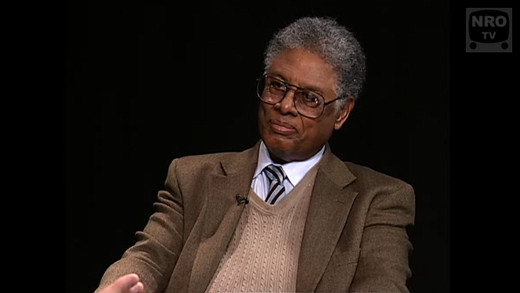
Dr. Thomas Sowell: Too many people coming out of even our most prestigious academic institutions graduate with neither the skills to be economically productive nor the intellectual development to make them discerning citizens and voters.

Famed Author and Economist Thomas Sowell

In a nutshell….

One of the sad and dangerous signs of our times is how many people are enthralled by words, without bothering to look at the realities behind those words.

One of those words that many people seldom look behind is “education.” But education can cover anything from courses on nuclear physics to courses on baton twirling.

Unfortunately, an increasing proportion of American education, whether in the schools or in the colleges and universities, is closer to the baton twirling end of the spectrum than toward the nuclear physics end. Even reputable colleges are increasingly teaching things that students should have learned in high school.

We don’t have a backlog of serious students trying to take serious courses. If you look at the fields in which American students specialize in colleges and universities, those fields are heavily weighted toward the soft end of the spectrum.

When it comes to postgraduate study in tough fields like math and science, you often find foreign students at American universities receiving more of such degrees than do Americans.

A recent headline in the Chronicle of Higher Education said: “Master’s in English: Will Mow Lawns.” It featured a man with that degree who has gone into the landscaping business because there is no great demand for people with Master’s degrees in English.

Too many of the people coming out of even our most prestigious academic institutions graduate with neither the skills to be economically productive nor the intellectual development to make them discerning citizens and voters.

Students can graduate from some of the most prestigious institutions in the country, without ever learning anything about science, mathematics, economics or anything else that would make them either a productive contributor to the economy or an informed voter who can see through political rhetoric.

On the contrary, people with such “education” are often more susceptible to demagoguery than the population at large. Nor is this a situation peculiar to America. In countries around the world, people with degrees in soft subjects have been sources of political unrest, instability and even mass violence.

Nor is this a new phenomenon. A scholarly history of 19th century Prague referred to “the well-educated but underemployed” Czech young men who promoted ethnic polarization there– a polarization that not only continued, but escalated, in the 20th century to produce bitter tragedies for both Czechs and Germans.

In other central European countries, between the two World Wars a rising class of newly educated young people bitterly resented having to compete with better qualified Jews in the universities and with Jews already established in business and the professions. Anti-Semitic policies and violence were the result.

It was much the same story in Asia, where successful minorities like the Chinese in Malaysia were resented by newly educated Malays without either the educational or business skills to compete with them. These Malaysians demanded– and got– heavily discriminatory laws and policies against the Chinese.

Similar situations developed at various times in Nigeria, Romania, Sri Lanka, Hungary and India, among other places.

Many Third World countries have turned out so many people with diplomas, but without meaningful skills, that “the educated unemployed” became a cliche among people who study such countries. This has not only become a personal problem for those individuals who have been educated, or half-educated, without acquiring any ability to fulfill their rising expectations, it has become a major economic and political problem for these countries.

Such people have proven to be ideal targets for demagogues promoting polarization and strife. We in the United States are still in the early stages of that process. But you need only visit campuses where whole departments feature soft courses preaching a sense of victimhood and resentment, and see the consequences in racial and ethnic polarization on campus.

There are too many other soft courses that allow students to spend years in college without becoming educated in any real sense.

We don’t need more government “investment” to produce more of such “education.” Lofty words like “investment” should not blind us to the ugly reality of political porkbarrel spending.

Feds spending $2 million to install cameras in school lunchroom to see what your kid is eating.

The government goes on as if there is no $16 trillion debt with Social Security and Medicare near broke. Do we really need this crap?

Related: Dept of Education is a Failure: 82 Fed Govt Programs to Improve Teachers. Billions Spent With No Results. Bill Gates Foundation Concludes that Teaching Credentials Make No Difference

For those of you who wonder why so many women, Catholics and Hispanics voted with the TEA Party in 2010, this nonsense is one of the reasons.Democrats will not make priorities and the cuts we eed to keep the important programs going and pay the debt. The GOP will only do it if we keep their feet to the fire.

AP/Yahoo News:

That’s the idea behind a $2 million project being unveiled Wednesday in the lunchroom of a San Antonio elementary school, where high-tech cameras installed in the cafeteria will begin photographing what foods children pile onto their trays — and later capture what they don’t finish eating.

Digital imaging analysis of the snapshots will then calculate how many calories each student scarfed down. Local health officials said the program, funded by a U.S. Department of Agriculture grant, is the first of its kind in a U.S. school, and will be so precise that the technology can identify a half-eaten pear left on a lunch tray.

“This is very sophisticated,” said Dr. Roberto Trevino, director of the San Antonio-based Social & Health Research Center, which will oversee the program.

The grant from the USDA will fund the study for four years. Trevino said the coming school year will be very experimental, with programmers fine-tuning the cameras and imaging software to accurately identify what’s a pear and what’s an apple. He expects the “prototype” to be in place by the second year.

A third of high school grads never studied the Constitution…

The best way to “fundamentally transform America” is to make sure new generations forget what it is all about.

Heritage:

A third of graduated and rising high school seniors – who will be voting in the 2012 elections – have never studied the U.S. Constitution.

A recent study by the National Assessment for Educational Progress reported that only 67% of all high school students have spent any time studying the nation’s founding document.  Every four years, the NAEP polls 10,000 students about their knowledge of – or even exposure to – the Constitution.  The percentage of knowledgeable students is continually decreasing and, since 2007, the numbers have fallen another five percentage points from 72%. Maybe this is obvious, but shouldn’t a responsible and informed citizenship be one of the goals of public education?

Without basic knowledge of this foundational document, these voters will be hard pressed to answer some of the most important political questions in 2012. The next election is going to depend on every voter’s understanding of constitutional authority. For instance, does Obamacare’s individual mandate fall under the commerce clause? Other recent questions – like which branches are involved in the decision to declare war – cannot be answered without a thorough understanding of the Constitution.

But a basic understanding of the Constitution is useful well beyond just the next election.  The Constitutionspells out both the powers and limitations of the federal government.  It seems that it could become rather difficult to secure the blessings of liberty without teaching the next generation how our government is designed to protect these liberties.

Dr. Thomas E. Woods’ Video: The Depression of 1920 and Why You Have Never Heard of It.

Did you even know we had a depression after Woodrow Wilson’s experiment in progressivism? Did you know that the 1020’s had it’s own Ronald Reagan who lowered taxes, spending, and government controls? The economy recovered in a short time and in fact went on a fantastic growth cycle. How could you not know about this? How come your teacher doesn’t know? This is a 49 minute lecture that is a very good lesson in economics and how propagandized our schools are.

Do Not Make This Mistake Journalism Students: Washington Post Columnist Insults Intelligence of Readers

Different newspapers can get away with different things depending on where they are and who their audience is.

When you are in Washington D.C. some of the smartest people in the world are going to read your column. It is important to not say things that are so flamboyantly incorrect that many thousands of readers will wince.  It is no different when I was a radio host on AM 1580. I know that Notre Dame Law School is right here. Some of the finest law professors in the world, such as Charlie Rice, are likely in my audience. So I had to be sure that when I spoke on the law that I had it as correct as possible. Here in South Bend there is likely someone in the audience who is a better expert on any given subject than the host, but in Washington D.C. if you try to pull one over on the audience in the fields of basic political history or basic communications strategy the result is ridicule and laughter by a great many.

I know it seems like we have been picking on The Washington Post lately, but only because they have made themselves an easy target.

The Washington Post Columnist Richard Cohen engages in spin for the president. In Washington almost everyone spins some and that is to be expected. The trick is to not get laughed at when you go too far.

Quote:

The insane policy would be to ignore the signal lesson of the Great Depression — when Franklin Roosevelt, listening to the John Boehners of his day, cut spending to reduce the deficit. The Depression deepened.

Amazing, this is exactly the opposite of historical reality. Cohen apparently never heard of the “New Deal” where government spending went off the charts. Government spending, over regulation, and redistribution don’t work well and even FDR’s own Treasury Secretary finally said so. Non farm unemployment never dropped below 20% during the “New Deal”. The United States did not enjoy full employment in a non-war economy until 1947 when government spending dropped by two third’s.

Henry Morganthau, Roosevelt’s Treasury Secretary from 1934-1945 , wrote in a letter to Congressional Democrats  May 1939:

“We have tried spending money. We are spending more than we have ever spent before and it does not work. And I have just one interest, and if I am wrong … somebody else can have my job. I want to see this country prosperous. I want to see people get a job. I want to see people get enough to eat. We have never made good on our promises … I say after eight years of this Administration we have just as much unemployment as when we started … And an enormous debt to boot!”*

* Burton Folsom, Jr., New Deal or Raw Deal? (New York: Simon & Schuster, 2008), p. 2.

Quote:

As with the business community, Obama’s assurances to the pro-Israel community mean little. His precise words are discounted. As with the business community, rumor or anecdote trumps pronouncements …

Ah yes, the old “precise words” defense. This is the oldest political trick in the book. Always include a word or a phrase that acts as an escape hatch so that, if needed, said politician can flip to the other side of the political issue in case backtracking becomes a political necessity. [Editor’s Note: always look for the escape hatch phrase in any political speech]

In the case of Obama’s controversial recent Israeli policy speech the escape hatch phrase was “1967 borders with mutually agreed swaps”. That sounds so good doesn’t it? Tell me, how can Israel give up any land West of the large valley between Israel and Jordan, or the Golan Heights etc ? [Note: If you are not aware of the details of the critical geography mentioned see the video HERE]  To do so would leave Israel with borders that are structurally indefensible. It has only been by the bravery of the Israeli people and the overwhelming technical superiority of American military hardware that has prevented a second holocaust.

With the escape hatch phrase Obama can say “I wanted borders based on the 1967 lines” which had resulted in an invasion, while at the same time saying “I said that we cannot just go back to the 1967 borders”. There are few politicians who speak that do not include these escape hatch phrases.

Israeli Prime Minister Bibi Netanyahu made use of Obama’s escape hatch phrase and wiped his feet on it saying “President Obama says that we cannot go back to the 1967 borders”. Of course the Prime Minister knows full well this was not Obama’s intent, but graciously gave him an out.

Gov. Christie of New Jersey does not use escape hatch language and even made a speech against the use of it:

Robert Spencer takes down an elite media journalist who is “playing the game”

If you are an elite media journalist, this is what will happen to you if you pull the David Gregory style of bogus accusations in the form of a question trick.

Robert Spencer is a remarkably clear thinking man. I have met Mr. Spencer and chatted with him for about five minutes at CPAC. He could not have been more gracious and kind. Do not confuse his willingness to stake out where he stands with boldness as being unkind or nasty.